







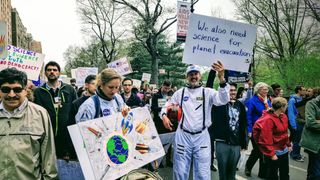
March for Science participants in New York City dress as astronauts to support science.
(Image credit: Hanneke Weitering/Space.com)
In an age of diminishing trust in science, scientists need to change how they work with the public and within the broader scientific community.
The vast majority of fundamental scientific research — the kind of science that pushes ever deeper into unknown regions and expands humanity’s knowledge — is funded by government organizations. In the United States, that typically takes the form of federal agencies like NASA, the National Science Foundation, the National Institutes of Health, and the Department of Energy. Scientists compete for grant funding to support the hiring of students and junior researchers, purchase expensive equipment, and write research papers.
Unfortunately, funding for the sciences has been dropping consistently for the past few decades. While there are occasional spikes of increased funding, there is now less money going to basic research, especially when measured as a fraction of all federal spending, than in over half a century.
Fueling this declining interest in science funding is a declining interest and trust in science itself. While scientists have historically enjoyed a high level of trust among the public, that trust has been consistently dropping, from a high of 75% just before the pandemic to a present-day low of 57%, according to a Pew Research poll conducted between Sept. 25 and Oct. 1.
Related: What is the difference between science and pseudoscience?
What’s more, science is becoming ever more politicized, with left-leaning policymakers more likely than right-leaning politicians to support science funding. Those leaders’ votes mostly align with their constituents’ views: Respondents who identified as Republican were much less likely to view scientists positively.
With that decline in trust comes a decline in funding, and unfortunately for scientists, that drop in funding creates dysfunctions that lead to even more reduced trust.
The spreading disease
A reduction in public funding for science leads to three sets of dysfunctional relationships: It affects how scientists interact with each other, with students and with the public.
The competition for grants has grown ever fiercer in the past decade, with scientists spending more of their time fighting it out for fewer research dollars. The typical grant award rate is now below 20%, meaning that researchers have to reapply year after year to get even a small amount of funding, with awards usually not even enough to cover the time spent applying for the grants in the first place.
To judge scientists in this competition for grants, awards and professional opportunities, scientists encourage each other to publish — a lot. Over 3 million journal articles were published last year. The more a scientist publishes, and the more that work is cited, the more likely that scientist will be to win awards and advance in their careers.
This intense pressure to publish — often summarized as “publish or perish” — has led to a stunning rise in shoddy work. Some of that is downright intentional fraud — a deliberate distortion of the data to get a publishable result. But more often, it’s simple laziness, driven by an eagerness to get a paper out sooner rather than later. It’s also the responsibility of journal publishers to adhere to a rigorous and thorough peer-review process, which isn’t always the case.
Along with that increased competition for funding comes increased competition for jobs. Students are signing up for science majors at record numbers, with some departments seeing double or triple the number of students compared with two decades prior. Universities love this glut of students, because they often bring federal loans to pay for their increasingly expensive education. Yet there is no commensurate growth in long-term positions. Students go on to get doctorates, start short-term positions and then find themselves in their early 30s without a permanent position in science. In some fields, there are 10 new doctorates awarded for every new open position — an untenable situation.
Lastly, scientists are discouraged from communicating their work to the public. Hiring, tenure and promotion committees view public outreach neutrally at best, and with derision and scorn at worst. Despite the critical need for the public to hear about the latest scientific research, scientists themselves are often the last ones to do it. And why should they? If it doesn’t help them in their career, it’s a waste of time for them.
The rise in fraudulent work, the lack of long-term career options for budding young scientists, and the discouragement of science communication all contribute to a lack of interest in continuing science funding, which starts the downward cycle anew. Thankfully, there’s a way out.
The way out
The lack of funding is causing these dysfunctions within science. But scientists can’t just expect to ask for more funding and automatically get it; the public is already becoming ever more disillusioned. So instead, scientists must work within the current funding restrictions and present a new face to themselves, to their students, and to the public. That is the road to rebuilding trust, and with that increased trust comes more secure funding.
First, scientists need to let go of the pressure to publish. There are already too many papers coming out for any researcher to keep up with their own field. Scientists are pretending that they can measure success through publication and citation counts, but this is simply distorting the way science is done. Scientists need to publish less and be given more time to develop long-term research plans.
Along with that, funding agencies need to offer more high-risk/high-reward programs, favor junior researchers over established ones, and introduce randomness into the selection process so that more researchers get a chance to try out new, innovative ideas.
Second, if we’re going to maintain the present science-student population levels, we need to drastically cut the number of short-term postgraduate positions. If there aren’t enough permanent positions in science, then students should be trained for positions outside academia and be allowed to exit academic research when they are still young, not after some of their most productive years have already been spent.
Lastly, scientists must communicate with the public, often and directly. Science communication training should be a part of every graduate program and a built-in expectation of every faculty position.
Once scientists tackle fraud by reducing the pressure to publish, lessen disillusionment by being honest about career paths, and make science more personable by working face-to-face with the public, they can start rebuilding trust and regaining funding and, from there, ensure the continued survival of science for generations to come.
Join our Space Forums to keep talking space on the latest missions, night sky and more! And if you have a news tip, correction or comment, let us know at: [email protected].
Breaking space news, the latest updates on rocket launches, skywatching events and more!
Paul M. Sutter is an astrophysicist at SUNY Stony Brook and the Flatiron Institute in New York City. Paul received his PhD in Physics from the University of Illinois at Urbana-Champaign in 2011, and spent three years at the Paris Institute of Astrophysics, followed by a research fellowship in Trieste, Italy, His research focuses on many diverse topics, from the emptiest regions of the universe to the earliest moments of the Big Bang to the hunt for the first stars. As an “Agent to the Stars,” Paul has passionately engaged the public in science outreach for several years. He is the host of the popular “Ask a Spaceman!” podcast, author of “Your Place in the Universe” and “How to Die in Space” and he frequently appears on TV — including on The Weather Channel, for which he serves as Official Space Specialist.
>>> Read full article>>>
Copyright for syndicated content belongs to the linked Source : Space.com – https://www.space.com/how-can-we-restore-public-trust-in-science



