













Companies striving for net-neutral climate impact find common clean energy procurement strategies largely ineffective in the U.S., according to a Princeton-led study. However, an hourly matching approach—procuring clean energy in real-time to match consumption—significantly reduces emissions, unlike the common annual matching strategy which fails to impact long-term emissions.
In the pursuit of attaining a climate-neutral impact, numerous businesses are opting to purchase extra electricity from renewable energy sources. This strategy aims to counteract the emissions produced by relying on the current grid, which is currently predominantly powered by fossil fuels.
Yet some of the most common strategies for purchasing clean energy have little impact in cutting long-term carbon emissions in the U.S., a Princeton-led study has found. However, one approach, in which companies purchase clean energy hourly to match their real-time energy consumption, can have a substantial effect.
The approach, known as temporal matching, hourly matching, or 24/7 carbon-free electricity procurement, was the only strategy that consistently lowered system-wide emissions among those studied by the Princeton team, whose analysis was published January 11 in Joule.
On the other hand, the team found that today’s most common procurement strategy — known as volumetric or annual matching — proved to be almost entirely ineffective in reducing long-term emissions in the U.S. In a volumetric matching approach, companies can claim full decarbonization by simply calculating their total annual energy consumption and procuring enough clean energy to match that yearly consumption, regardless of when it is actually produced.
“Companies are increasingly facing stricter reporting requirements to back up their emissions claims,” said Jesse Jenkins, assistant professor of mechanical and aerospace engineering and the Andlinger Center for Energy and the Environment.
Jenkins noted a California law, passed in 2023, that will require all companies earning over a billion dollars in revenues to report their full emissions footprints, including emissions from purchased power, beginning in 2026. New federal tax credits also require producers of clean hydrogen and sustainable aviation fuels to credibly demonstrate their emissions footprints. “There are beginning to be actual legal and financial ramifications for greenhouse gas accounting,” he said. “It’s not just about making marketing claims anymore.”
Another up-and-coming procurement strategy, known as emission or carbon matching, in which clean energy is procured in an attempt to offset the total carbon emissions that result from a buyer’s electricity consumption, similarly had little to no effect on reducing long-term emissions in the U.S.
“Before we commit to any procurement approach, we need to do the analysis to ensure that it is effective in lowering emissions,” said first author Qingyu Xu, a researcher at Tsinghua University’s Energy Internet Research Institute who completed much of the research while working with Jenkins as a postdoctoral researcher. “In this study, we tested whether or not some of the commonly proposed procurement approaches could back up their emissions claims.”
The product of a changing energy landscape
Wilson Ricks, study coauthor and graduate student in mechanical and aerospace engineering, said the team’s findings reflect recent cost declines in clean energy technologies such as solar and onshore wind energy. Thanks to continued policy incentives and the support of early voluntary buyers, Ricks said, solar and wind energy projects are now among the most economical options for new energy builds — competitive with and often outcompeting fossil fuel-based energy sources.
While a win for the status of renewable energy technologies, a side effect of cheap renewables means that new corporate or institutional agreements to purchase power from solar and wind projects have an increasingly limited impact in driving long-term, system-wide emissions reductions.
These voluntary agreements were effective when new solar and wind projects were more expensive than fossil fuel-based energy projects because a company’s support allowed a clean energy project to be built where fossil fuels would have been the default option. However, as clean energy projects increasingly become the default energy option, it is difficult to prove that a company’s support has had any transformational impact.
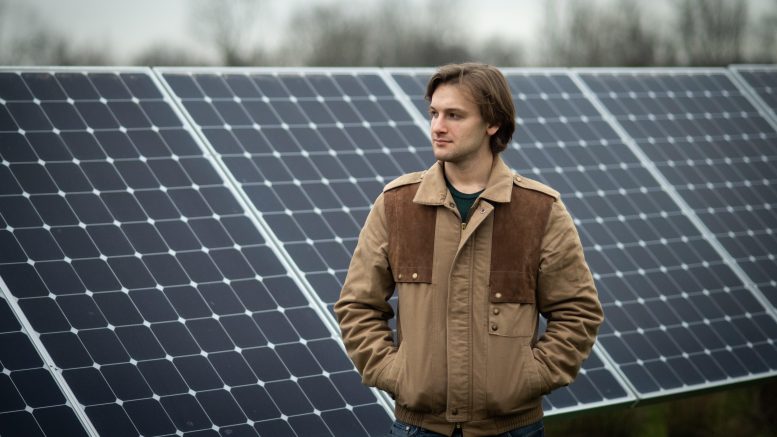
Coauthor Wilson Ricks, graduate student in mechanical and aerospace engineering, stands at Princeton University’s solar array. Credit: Bumper DeJesus, Andlinger Center for Energy and the Environment
“The general assumption behind the traditional clean energy procurement approaches is that when you procure a given amount of clean power, you’re effectively offsetting a similar amount of fossil power,” Ricks said. “But as clean power continues to be cheaper and more market-competitive, that assumption becomes less and less true. Instead, you have solar projects not competing with fossil fuel-based power, but against other solar projects that could have been built in their place.”
Under a volumetric matching approach, for example, the most cost-effective approach for a company to claim net-zero emissions leans almost entirely on procuring enough cheap solar or wind energy to match their annual energy consumption. Yet if one imagined an alternate timeline in which the company had never supported those clean energy projects, most of those projects would have found an alternative buyer and been built anyway, simply because solar and wind have become the cheapest available options for new energy projects.
Emission matching encounters similar stumbling blocks to the volumetric approach. Under emission matching, instead of pairing energy consumption with clean energy procurement on a megawatt-hour-to-megawatt-hour basis, a company would match based on the carbon emissions impact of each megawatt-hour of generation or consumption. For example, if a company’s energy demand caused a natural gas generator to turn on in California, they could support a wind project in Wyoming that would “cancel out” an equivalent amount of emissions by avoiding the need to fire up a coal-fired power plant.
While seeming to make intuitive sense at a glance, Jenkins said that much like the volumetric approach, the emission matching approach fails to consider the counterfactual scenario in which the wind project would have been built anyway because of its low costs. As a result, the company would not be contributing additional clean energy supply but instead displacing what was likely to become a wind farm regardless.
“An emission matching strategy based on short-term operational emissions impacts doesn’t tell you anything about the long-term impact of your decisions,” Jenkins said. “It doesn’t tell you how your clean power generation is going to change investment and retirement decisions across the system. If you simply want to make a qualitative claim that you’re having a positive impact on the world, then it might be a good way to go. But if you want to make a valid quantitative claim that your emissions impact as a company is zero, then it’s pretty questionable as a strategy.”
Time for a better alternative
Beyond their failure to spur additional clean energy supply, the volumetric and emission approaches also fail to address the inherent shortcomings of clean energy resources such as solar and wind: the sun isn’t always shining, and the wind isn’t always blowing.
At the same time, data centers and facilities usually consume energy around the clock. And when companies continue to operate in the absence of solar or wind generation, the backup option is typically some mix of fossil fuels.
However, the volumetric approach overlooks the daily mismatch between clean energy generation and consumption because clean energy procurement occurs annually. Consequently, companies could procure the cheapest available solar and wind energy to match their annual energy consumption to claim net-zero emissions while failing to address the daily and seasonal oscillations of solar and wind generation.
“With a 24/7 clean energy procurement strategy, you’re effectively pretending that you’re a fully decarbonized grid,” Jenkins said. “If that’s the case, then you need the portfolio of resources a fully decarbonized grid would need. And that’s not just wind and solar. It’s also things like long-duration energy storage and clean firm energy technologies like advanced geothermal or nuclear.”
The temporal matching approach the researchers studied consistently succeeded in driving down system-wide emissions because it addresses the temporal mismatch between clean energy production and consumption. By requiring companies to procure their clean energy at the same time as they consume energy, the approach drives investments beyond wind and solar to include energy storage and firm clean energy technologies.
“When a company has to match its energy consumption with clean energy every hour, it attacks the times at night when fossil resources would be the fallback choice in the energy market,” Ricks said. “It becomes no longer an option to support only cheap solar and wind projects and call yourself squared.”
The researchers acknowledged that temporal matching is significantly more expensive than the other approaches but said that companies ultimately get what they pay for. While both volumetric and emission matching can be accomplished with near-zero cost premiums, they also result in near-zero long-term emissions reductions. Temporal matching, on the other hand, can come with cost premiums exceeding $20 per megawatt-hour in some regions, but that premium enables companies to quantitatively say they are reducing their emissions.
“Achieving an around-the-clock 100% clean power system is difficult. It will take a lot of time and money,” Ricks said. “The idea that a company could come in and claim to be 100% clean in 2024 at no additional cost premium sounds a little suspect, as do the emissions accounting schemes that would enable that to happen. If it were that easy to decarbonize the world, the problem would already be solved.”
Reference: “System-level impacts of voluntary carbon-free electricity procurement strategies” by Qingyu Xu, Wilson Ricks, Aneesha Manocha, Neha Patankar and Jesse D. Jenkins, 11 January 2024, Joule.
DOI: 10.1016/j.joule.2023.12.007
>>> Read full article>>>
Copyright for syndicated content belongs to the linked Source : SciTechDaily – https://scitechdaily.com/princeton-study-uncovers-unseen-pitfalls-of-popular-clean-energy-procurement-methods/