





* . *
  • About
  • Advertise
  • Privacy & Policy
  • Contact
Wednesday, February 11, 2026
Earth-News
  • Home
  • Business
  • Entertainment

    Watch the U.S. Air Force F-35A Lightning II Light Up the Sky at the Columbus Air Show!

    Black Voices Ignite the Spark at the 2026 Sundance Film Festival

    Rock Legend Defends Bad Bunny’s Epic Halftime Show Performance

    Pedro Pascal Lights Up the Stage with an Epic Dance at Bad Bunny’s Super Bowl 2026 Halftime Show

    Lucky Strike Entertainment Rockets 5.3% Pre-Market, Bounces Back Strongly After Earnings Slump

    Unlock the Best Credit Cards to Boost Your Entertainment Rewards This February 2026

  • General
  • Health
  • News

    Cracking the Code: Why China’s Economic Challenges Aren’t Shaking Markets, Unlike America’s” – Bloomberg

    Trump’s Narrow Window to Spread the Truth About Harris

    Trump’s Narrow Window to Spread the Truth About Harris

    Israel-Gaza war live updates: Hamas leader Ismail Haniyeh assassinated in Iran, group says

    Israel-Gaza war live updates: Hamas leader Ismail Haniyeh assassinated in Iran, group says

    PAP Boss to Niger Delta Youths, Stay Away from the Protest

    PAP Boss to Niger Delta Youths, Stay Away from the Protest

    Court Restricts Protests In Lagos To Freedom, Peace Park

    Court Restricts Protests In Lagos To Freedom, Peace Park

    Fans React to Jazz Jennings’ Inspiring Weight Loss Journey

    Fans React to Jazz Jennings’ Inspiring Weight Loss Journey

    Trending Tags

    • Trump Inauguration
    • United Stated
    • White House
    • Market Stories
    • Election Results
  • Science
  • Sports
  • Technology

    Get Ready for the 2026 NHRA Chassis Certifications at World Wide Technology Raceway – March 14-15!

    John Deere Expands Precision Ag Technology Access – Morning Ag Clips

    Why AI Must Collaborate with Doctors to Create Trustworthy Healthcare Technology

    How Globalization and Technology Are Shaping the Future of Domestic Politics, According to Eswar Prasad

    UBS Lowers SoFi Technologies Price Target to $24.50 Following Mixed Earnings

    Must-Watch Technology Stocks to Watch This February

    Trending Tags

    • Nintendo Switch
    • CES 2017
    • Playstation 4 Pro
    • Mark Zuckerberg
No Result
View All Result
  • Home
  • Business
  • Entertainment

    Watch the U.S. Air Force F-35A Lightning II Light Up the Sky at the Columbus Air Show!

    Black Voices Ignite the Spark at the 2026 Sundance Film Festival

    Rock Legend Defends Bad Bunny’s Epic Halftime Show Performance

    Pedro Pascal Lights Up the Stage with an Epic Dance at Bad Bunny’s Super Bowl 2026 Halftime Show

    Lucky Strike Entertainment Rockets 5.3% Pre-Market, Bounces Back Strongly After Earnings Slump

    Unlock the Best Credit Cards to Boost Your Entertainment Rewards This February 2026

  • General
  • Health
  • News

    Cracking the Code: Why China’s Economic Challenges Aren’t Shaking Markets, Unlike America’s” – Bloomberg

    Trump’s Narrow Window to Spread the Truth About Harris

    Trump’s Narrow Window to Spread the Truth About Harris

    Israel-Gaza war live updates: Hamas leader Ismail Haniyeh assassinated in Iran, group says

    Israel-Gaza war live updates: Hamas leader Ismail Haniyeh assassinated in Iran, group says

    PAP Boss to Niger Delta Youths, Stay Away from the Protest

    PAP Boss to Niger Delta Youths, Stay Away from the Protest

    Court Restricts Protests In Lagos To Freedom, Peace Park

    Court Restricts Protests In Lagos To Freedom, Peace Park

    Fans React to Jazz Jennings’ Inspiring Weight Loss Journey

    Fans React to Jazz Jennings’ Inspiring Weight Loss Journey

    Trending Tags

    • Trump Inauguration
    • United Stated
    • White House
    • Market Stories
    • Election Results
  • Science
  • Sports
  • Technology

    Get Ready for the 2026 NHRA Chassis Certifications at World Wide Technology Raceway – March 14-15!

    John Deere Expands Precision Ag Technology Access – Morning Ag Clips

    Why AI Must Collaborate with Doctors to Create Trustworthy Healthcare Technology

    How Globalization and Technology Are Shaping the Future of Domestic Politics, According to Eswar Prasad

    UBS Lowers SoFi Technologies Price Target to $24.50 Following Mixed Earnings

    Must-Watch Technology Stocks to Watch This February

    Trending Tags

    • Nintendo Switch
    • CES 2017
    • Playstation 4 Pro
    • Mark Zuckerberg
No Result
View All Result
Earth-News
No Result
View All Result
Home Science

NASA’s Roman Space Telescope will hunt for the universe’s 1st stars — or their shredded corpses, anyway

May 10, 2024
in Science
NASA’s Roman Space Telescope will hunt for the universe’s 1st stars — or their shredded corpses, anyway
Share on FacebookShare on Twitter

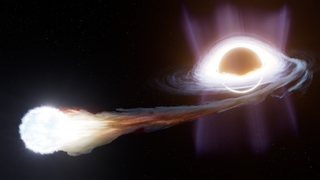
An illustration shows a black hole ripping apart a massive star in a tidal disruption event

An illustration shows a black hole ripping apart a massive star in a tidal disruption event.
(Image credit: Ralf Crawford (STScI))

NASA’s forthcoming Nancy Grace Roman Telescope could use the grisly death of stars ripped apart by black holes to hunt the universe’s first population of stellar bodies.

These early stars, referred to (somewhat confusingly) as Population III (Pop III) stars, were very different from the sun and other stars seen in the cosmos today. That’s because the universe wasn’t yet filled with “metals,” the term astronomers use to describe elements heavier than hydrogen and helium. 

Pop III stars arose just a few hundred million years after the Big Bang and were “metal-poor,” composed mostly of hydrogen and helium. They were also believed to be much larger and hotter than the sun. This means that Pop III burned through their fuel for nuclear fusion faster than smaller stars, and these short lifetimes make them elusive targets for astronomers.

Because these earliest stars are responsible for forging metals that would become the building blocks of the next generation of less-metal-poor stars, studying them is key to understanding cosmic evolution. New research suggests that the Nancy Grace Roman Telescope (or Roman for short), set to launch in 2027, could have a unique way of doing this.

Related: Astronomers witness 18 ravenous black holes ripping up and devouring stars

Rather than looking for intact Pop III stars, Roman will search for what remains of them after they have strayed too close to black holes and been destroyed in occurrences that astronomers call tidal disruption events, or TDEs.

“Since we know that black holes likely exist at these early epochs, catching them as they’re devouring these first stars might offer us the best shot to indirectly detect Pop III stars,” study team member and Yale University scientist Priyamvada Natarajan said in a statement.

Breaking space news, the latest updates on rocket launches, skywatching events and more!

Roman will watch the destruction of the first stars

When a star passes close to a black hole, the tremendous gravitational influence it encounters generates immense tidal forces within it. This causes the star to be squeezed horizontally while being stretched vertically. The matter that composes the star is transformed into a “noodle” of star-stuff, in a process called “spaghettification.”

The matter that once comprised the doomed star can’t immediately fall into the black hole, however. Instead, it gathers in a flattened cloud around the black hole called an accretion disk. As this material spirals around and toward the black hole, it heats up, emitting a glow that in some cases can be seen over billions of light-years.

TDEs themselves are transient events. This means that as the star is destroyed, there is a brief but intense flare in X-ray, radio, ultraviolet, and optical wavelengths of light. This is how TDEs appear in the local universe, where Pop III stars no longer exist. But  these violent events look quite different when seen across vast distances of 13 billion light-years or so. 

That’s because, as the light from these events travels, the expansion of space causes its wavelength to lengthen, pushing it into the infrared part of the spectrum — a phenomenon called “redshift.” 

Additionally, the transient nature of TDEs is changed as their light travels across the cosmos. This is because redshift causes a Pop III-destroying TDE to brighten over the course of hundreds to thousands of days and then fade over a time period as long as a decade.

“The evolution timescales of Pop III TDEs are very long, which is one feature that could distinguish a Pop III TDE from other transients, including supernovas and TDEs of current-generation stars like our sun,” said study team leader Rudrani Kar Chowdhury, a postdoctoral fellow at the University of Hong Kong.

Related: Black holes: Everything you need to know
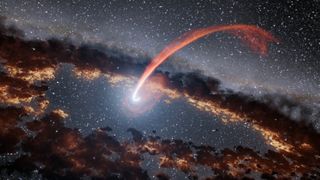
An artist's depiction of a supermassive black hole devouring material from a star.

An artist’s depiction of a black hole devouring material from a star after a TDE. (Image credit: NASA/JPL-Caltech)

By providing a panoramic field of view of the cosmos that is 200 times larger than that provided by the Hubble Space Telescope, and by surveying the sky 1,000 times faster than this ionic telescope, Roman should be the ideal instrument to find these early TDEs, team members said.

While NASA’s James Webb Space Telescope (JWST) has the kind of power that would be needed to see these distant and early TDEs, its field of view is also much smaller than that of Roman. That means it is not as effective a TDE hunter as the forthcoming space telescope. Particularly promising in the search for destroyed Pop III stars will be Roman’s High Latitude Wide Area survey, which will have a 2,000-square-degree view of the sky outside of the plane of the Milky Way.

“Roman can go very deep and yet cover a very big area of the sky,” said team member Jane Dai, a professor of astrophysics at the University of Hong Kong. “That’s what’s needed to detect a meaningful sample of these TDEs.”

That doesn’t mean that JWST won’t play a role in the search for TDEs involving Pop III stars. When Roman spots such an occurrence, the powerful infrared view of JWST will be able to zoom in on it and use its spectroscopic instruments to determine the presence of metals. This will determine if the TDE actually involves the destruction of a Pop III star.

“Since these stars are only made up of hydrogen and helium, we will not see any metal lines in the spectrum of objects, whereas, in the spectra of TDEs from regular stars, we can see various metal lines,” Kar Chowdhury said.

This tag team of Roman and JWST could, therefore, unlock the secrets of the universe’s earliest stars and how they have influenced the evolution of the next generations of stars and the galaxies that host them.

The research was published online May 8 in the Astrophysical Journal Letters.

Join our Space Forums to keep talking space on the latest missions, night sky and more! And if you have a news tip, correction or comment, let us know at: [email protected].

Robert Lea is a science journalist in the U.K. whose articles have been published in Physics World, New Scientist, Astronomy Magazine, All About Space, Newsweek and ZME Science. He also writes about science communication for Elsevier and the European Journal of Physics. Rob holds a bachelor of science degree in physics and astronomy from the U.K.’s Open University. Follow him on Twitter @sciencef1rst.

>>> Read full article>>>
Copyright for syndicated content belongs to the linked Source : Space.com – https://www.space.com/roman-space-telescope-first-stars-destroyed-black-holes


Tags: NASA’sRomanscience
Previous Post

Our neighboring galaxy’s supermassive black hole would probably be a polite dinner guest

Next Post

Cracking! Some binary black holes may roll around each other in egg-shaped orbits

From practice to policy: Why farmer collaboration matters for biodiversity – Phys.org

February 11, 2026

Why the UC system is seeing a drop in computer science enrollment – NBC Bay Area

February 11, 2026

The Surprising Clash Shaping the Future of Science

February 11, 2026

Americans Clinging to Hope for Italian Citizenship

February 11, 2026

Get Ready for the 2026 NHRA Chassis Certifications at World Wide Technology Raceway – March 14-15!

February 11, 2026

Missouri Sports Betting Launches: Top Apps Offering Nearly $3,000 in Welcome Bonuses!

February 11, 2026

Dan Hunt Warns of Massive Economic Impact and ‘A Little Bit of Chaos’ at the World Cup

February 11, 2026

Exciting Lineup of Speakers Announced for the 2026 World Economy Summit

February 11, 2026

Watch the U.S. Air Force F-35A Lightning II Light Up the Sky at the Columbus Air Show!

February 11, 2026

Kansas Senate bill may add $17M to oversight of health and welfare programs – Kansas Reflector

February 11, 2026

Categories

Archives

February 2026
M T W T F S S
 1
2345678
9101112131415
16171819202122
232425262728  
« Jan    
Earth-News.info

The Earth News is an independent English-language daily published Website from all around the World News

Browse by Category

  • Business (20,132)
  • Ecology (1,068)
  • Economy (1,084)
  • Entertainment (21,961)
  • General (19,839)
  • Health (10,125)
  • Lifestyle (1,100)
  • News (22,149)
  • People (1,094)
  • Politics (1,101)
  • Science (16,301)
  • Sports (21,587)
  • Technology (16,068)
  • World (1,075)

Recent News

From practice to policy: Why farmer collaboration matters for biodiversity – Phys.org

February 11, 2026

Why the UC system is seeing a drop in computer science enrollment – NBC Bay Area

February 11, 2026
  • About
  • Advertise
  • Privacy & Policy
  • Contact

© 2023 earth-news.info

No Result
View All Result

© 2023 earth-news.info

No Result
View All Result

© 2023 earth-news.info

Go to mobile version
