






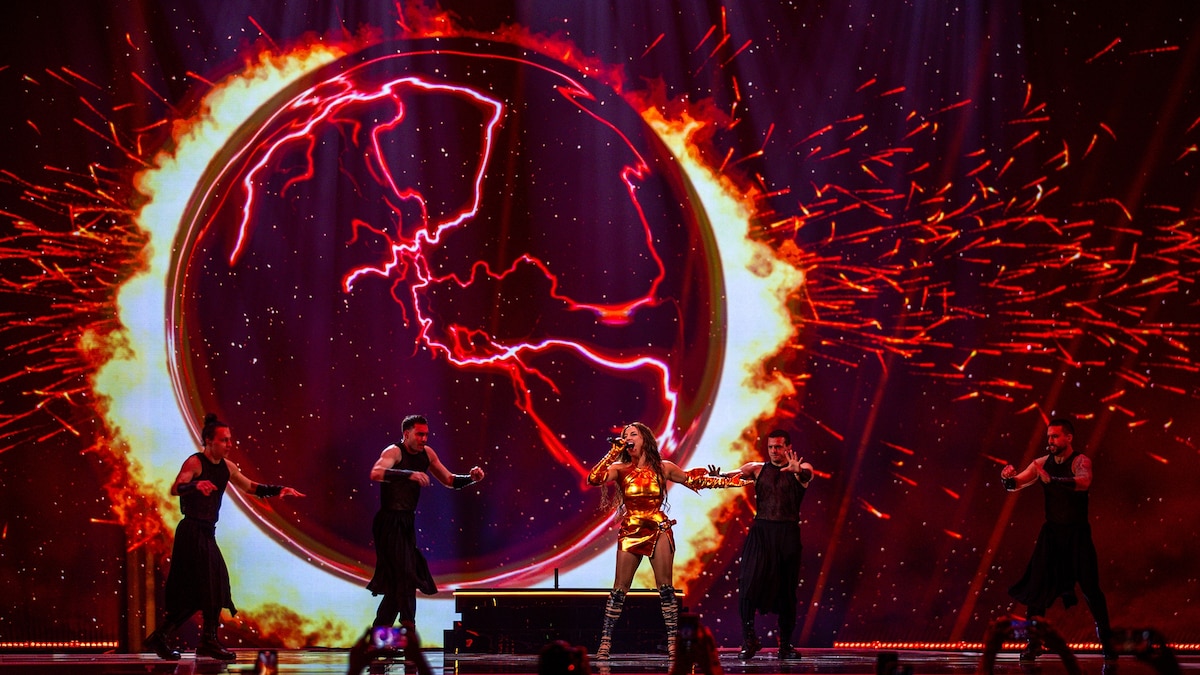
What’s campy, catchy, and fraught with international angst? If you answered “the Eurovision song contest,” you’re right. Since the 1950s, the annual song competition has pitted European performers—and fans—against one another as they vie for first place. But the hotly contested, immensely popular program—expected to draw in a whopping 162 million viewers this year— hasn’t always been what it is today. In fact, the multi-national songfest has unlikely roots in the destruction wrought on Europe during the Second World War.
What is Eurovision?
The contest’s rules and participants have evolved over time, but the Eurovision song contest hinges on one constant: the music. Nations select an act performing an original song through a process of their choice, then pit their artists against those representing other nations in a series of live semi-finals.
The culmination of the process is a grand finale where acts from the “Big Five” nations of France, Germany, Italy, Spain, and the United Kingdom and the hosting nation compete along with the acts that made it to the final round. In the semi-finals, participating nations give two sets of points to the performances: one from viewers in that nation, another from a panel of music industry experts. The finale hinges on votes from all competing nations and viewers worldwide. The winning act performs their song once again, taking that year’s Eurovision title.
Eurovision doesn’t have many privileges for the winning country aside from a glass microphone trophy, bragging rights, and the chance to host the next year’s competition. But for the millions of viewers who assemble in bars, around home televisions, and online to root on their pick and boo the competition, the campy contest is a beloved must-see. This year, 37 nations are duking it out in Malmö, Sweden.
International cooperation—and music
Historian Dean Vuletic tracks the origins of the Eurovision all the way back to the Congress of Vienna of 1814-15, which reconfigured Europe in the wake of the Napoleonic Wars. After attending multinational treaty sessions, attendees had plenty of chances to enjoy music and dance. (The waltz was so popular at the Congress that it spurred an international waltz craze.) The concerts, balls, and musical performances presented at the Austrian royal court and hosted by a variety of nations visiting Vienna were accompanied by the creation of new intergovernmental organizations that sprang up from the Congress’ multinational dealings. This new continent-wide cooperation paved the way for groups overseeing the new field of telegraphy and, eventually, radio. By 1925, a group known as the International Broadcasting Union (IBU) helped regulate and spread radio throughout Europe and the world.
But international radio cooperation couldn’t stem the tides of war, and World War II decimated European infrastructure, trust between nations, and even Europe’s borders. The Soviet government felt that the wartime IBU had been taken over by the Nazis, whose famous use of radio propaganda helped fuel Adolf Hitler’s rise, and lobbied against the organization’s existence. After tussling over voting rights and uniting in factions that reflected the growing Cold War, the IBU was abandoned in 1950. That year, 23 Western European nations joined together to create the European Broadcasting Union (EBU).
The European Broadcasting Union
Television had debuted in Europe during the 1930s, but it was largely considered an experimental technology. In the wake of the war, however, individual countries began creating their own television broadcasts—and dreaming of extending their national broadcasts to other European nations.
France and the United Kingdom led the way: In 1950, a series of experimental broadcasts over the English Channel proved that TV could cross borders. The Calais experiments, as they were known, presaged the world’s first must-see televised event, the 1953 coronation of Elizabeth II. Western Europeans could tune in thanks to what would soon be called the “Eurovision” network—the EBU’s cooperative international network that highlights individual nations’ cultural achievements and appeals to a wide European audience with sports and game shows.
Singing for Peace
The EBU’s members knew they couldn’t rely on coronations for their viewership, so in 1955 they approved a bold project: a European song contest. The show would be modeled on Italy’s Sanremo Music Festival, a hit televised competition that pitted songwriters against one another to pick the best new Italian song. Why not try a similar competition across all of Europe?
And so, on May 24, 1956, Western Europeans tuned in to the first Eurovision Song Contest, held that year in Switzerland. Only seven nations competed: Belgium, France, West Germany, Italy, Luxembourg, the Netherlands, and Switzerland. The Swiss ended up taking the prize thanks to Lys Assia’s performance of “Refrain”, a string-laden ballad about lost love. It was a success, and Eurovision has occurred every year since.
“Europe wanted to turn its back on the war,” the EBU explained in 2004. “People were starting to travel again, to cross borders, to trade. International exchanges were the order of the day, and television reflected this new atmosphere.”
Eurovision Today
In fact, the song contest has been credited as one of the first, and most potent, pan-European entities of the postwar period. The broadcast network was dubbed “Eurovision” by BBC publicist George Campey, who coined the term while trying to reduce the number of letters in a headline about European television. The use of the prefix “Euro-“, and a logo featuring a circle of stars, soon took on wider significance as many began to identify with the idea of a pan-European entity that rose above nationalism or conflict.
But Eurovision wasn’t all about international cooperation. Instead, historians say it reflected the tensions and enmities of its time, even sparking a rival competition, Intervision, behind the Iron Curtain. Early on, there was furious debate over whether Western European countries with dictators, such as Spain, could participate, and which language to use in broadcasts. There was criticism that since it contained only Western nations at first, the contest did not accurately represent Europe as a whole. (The former Soviet bloc nations joined Eurovision after the fall of the Berlin Wall and the collapse of the USSR.)
In the past, some countries gave their performances a political twist by showcasing members of persecuted communities in other nations to represent their country in the contest. Others were criticized for furthering national stereotypes. But officially, Eurovision discourages political messaging. Nonetheless, the Eurovision stage eventually became a place where culture wars over race, sexuality, and nationalism are frequently fought.
And still the contest endures—just like the stars and songs it’s helped launch, from ABBA, Celine Dion, and Julio Iglesias to chart-toppers like “99 Luftballons” and “Waterloo.” The idea of a unified Europe may be more elusive than ever, but Eurovision still hasn’t lost steam.
>>> Read full article>>>
Copyright for syndicated content belongs to the linked Source : National Geographic – https://www.nationalgeographic.com/premium/article/eurovision-history-origins-wwii-sanremo



