







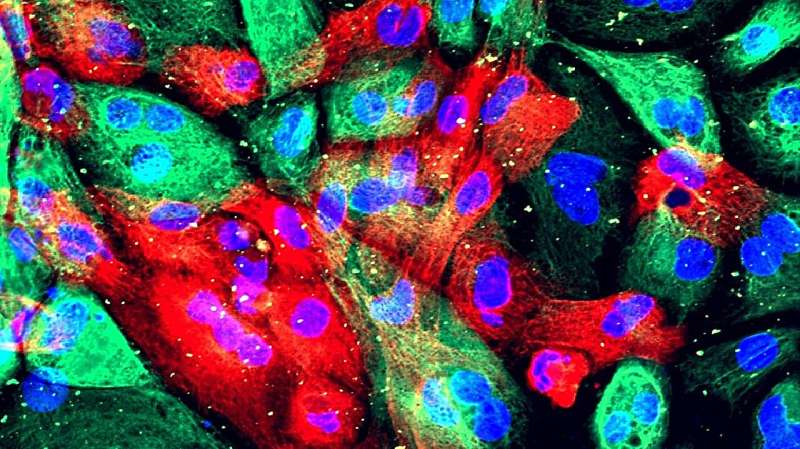
Xenograft model of prostate cancer. Credit: National Institutes of Health, 2015
Scientists have added to the list of inherited genetic mutations known to increase the risk of more aggressive prostate cancer. This information could help with identifying prostate cancer patients who are more likely to experience rapid progression of the disease.
Currently, it can be difficult for clinicians to know whether to provide intensive treatment urgently or to postpone treatment for as long as possible to spare the person from unnecessary appointments and uncomfortable side effects. This new information could support them in making these decisions, ensuring that a suitable treatment approach is used for each person with prostate cancer.
The risk of prostate cancer is often inherited, and this has made it possible for researchers to identify genetic risk factors. The study, which was published in European Urology Oncology, was led by researchers at The Institute of Cancer Research, London, who are also running a large-scale genetic study involving almost 200 hospitals in the U.K.
This study, called the UK Genetic Prostate Cancer Study (UKGPCS), opened in 1993 and aims to find genetic changes associated with prostate cancer risk.
The importance of genetics in prostate cancer
With this genetic information, researchers and clinicians can identify people with an increased risk of developing prostate cancer. Targeted screening, which can be offered to these individuals through research targeted screening programs, can detect the disease early if it does develop.
The current study has taken this further by showing that it is possible to predict the risk of prostate cancer being aggressive, which typically means a worse outlook for the patient. The researchers have identified several genes that could be brought together to make an effective gene sequencing panel—a diagnostic tool that can be used to analyze specific genes that have variants associated with certain outcomes.
In the longer term, an increased knowledge of genetic risk factors for prostate cancer could help with developing effective targeted treatments for the disease.
Additional information to guide treatment decisions
Prostate cancer usually develops slowly, and it often does not pose an immediate threat to a person’s health. For this reason, it can sometimes be best to adopt an “active surveillance” approach rather than subjecting the person to a toxic treatment regimen with harmful side effects. However, in the less frequent cases where prostate cancer grows aggressively, this approach would be insufficient and likely affect survival.
To try to determine when to treat patients, clinicians have been reliant on the pathology of the tumor, the stage of the disease and some genetic risk scores, which are based on known high-risk variants of specific genes. However, these are not the only genetic variants that are important, and the researchers behind the current study suspected that further genetic variants contribute to the disease.
Motivated by this belief, they set out to enhance the knowledge of associations between inherited mutations and prostate cancer aggressiveness.
Combining the results of multiple sub-studies
The team took advantage of the wealth of data available to them through the ongoing UKGPCS and selected six sub-studies in which the same 10 candidate genes had been sequenced in all participant samples. These genes had previously been suggested as having an association with prostate cancer risk and aggressiveness.
The researchers carried out an analysis on the data from all six sub-studies. These included a total of 6,805 prostate cancer cases, 3,548 of which were aggressive. The team looked at germline mutations, which are those that occur in an egg or sperm from a parent and therefore affect every cell in the person’s body.
The scientists focused on a type of genetic change called a putative loss of function mutation. Such mutations prevent the production or activation of the protein that the affected gene encodes. They began by searching for links between these mutations and evidence of aggressive disease, which they defined as prostate cancer that had spread, reached a certain stage or grade, or been fatal. They then used various statistical methods to study these links in more detail.
The team’s work uncovered putative loss of function mutations in four genes—ATM, MLH1, MSH2 and NBN—that were associated with aggressive prostate cancer. It also confirmed the link between mutations in BRCA2 and prostate cancer aggression that previous studies had identified.
Research is ongoing—increasing knowledge of prostate cancer risk
This important work represents just one small part of the UKGPCS, which is providing a rich bank of data for researchers to analyze. Currently, a larger scale analysis of 19,000 patient samples is in progress to further increase knowledge of prostate cancer risk factors.
Dr. Zsofia Kote-Jarai, Senior Staff Scientist in the Oncogenetics Group at the ICR and joint senior author of the paper, said, “We’re pleased to have identified more genetic mutations that might help us identify the people at risk of more aggressive prostate cancer.
“Although we’ve made good progress, prostate cancer unfortunately still kills too many men, meaning we need to come up with better screening and treatment methods.
“Using genetics to identify the individuals most at risk of aggressive disease is a crucial step towards making the best treatment decisions that are most likely to save and extend lives.”
Professor Ros Eeles, Professor of Oncogenetics at the ICR and Consultant in Cancer Genetics and Clinical Oncology at The Royal Marsden NHS Foundation Trust, who leads the UKGPCS study, said, “Our work has confirmed that people who inherit a loss of function mutation in ATM, BRCA2, MLH1, MSH2 and NBN have the highest risk of aggressive forms of prostate cancer.
“We now need to take a deeper dive into the genetics to see whether we can find a way to determine which patients will need urgent treatment and which are candidates for active surveillance.
“The ongoing UKGPCS is the largest prostate cancer study of its kind in the U.K., and we are optimistic that it will continue to teach us so much more about the disease. We are fully committed to doing everything we can to reduce mortality and morbidity from prostate cancer and believe that our latest study represents an important contribution to this goal.”
More information:
Edward J. Saunders et al, Identification of Genes with Rare Loss of Function Variants Associated with Aggressive Prostate Cancer and Survival, European Urology Oncology (2024). DOI: 10.1016/j.euo.2024.02.003
Citation:
Long-term study reveals more genetic mutations associated with aggressive prostate cancer (2024, July 1)
retrieved 1 July 2024
from https://medicalxpress.com/news/2024-07-term-reveals-genetic-mutations-aggressive.html
This document is subject to copyright. Apart from any fair dealing for the purpose of private study or research, no
part may be reproduced without the written permission. The content is provided for information purposes only.
>>> Read full article>>>
Copyright for syndicated content belongs to the linked Source : Medical Xpress – https://medicalxpress.com/news/2024-07-term-reveals-genetic-mutations-aggressive.html



