






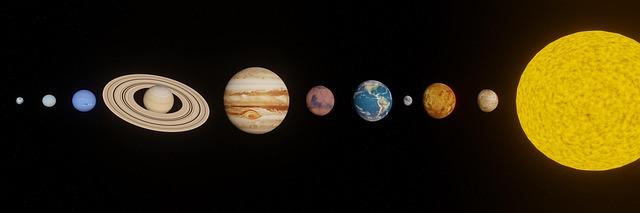
New research is challenging long-held assumptions about the makeup of our solar system’s outermost planets. Uranus and Neptune, traditionally classified as “ice giants” due to their presumed icy compositions, may instead be better described as “rock giants.” A groundbreaking new model of their internal cores suggests these distant worlds are composed largely of rocky material rather than the icy compounds previously thought to dominate their interiors. This revelation could reshape our understanding of planetary formation and the dynamic processes shaping these enigmatic planets.
Uranus and Neptune Redefined A New Model Challenges the Ice Giant Paradigm
Recent findings by planetary scientists suggest that Uranus and Neptune might be far less dominated by ices than previously thought. Traditional models have labeled these planets as “ice giants” due to their substantial icy mantles composed of water, ammonia, and methane. However, the new core model proposes a radically different internal structure, indicating that their interiors could be primarily composed of dense, rocky materials mixed with metallic elements. This challenges long-standing assumptions and may prompt a major rethink of how these distant worlds formed and evolved over billions of years.
The research employed advanced computer simulations alongside data from previous Voyager and Hubble missions, highlighting several key revisions to the ice giant model:
- Denser rocky cores: Larger and heavier than expected, influencing gravitational fields.
- Reduced icy layers: Ice layers thinner and less extensive than the classic paradigm suggests.
- Implications for magnetic field generation: Rocky compositions could explain Uranus and Neptune’s unusual magnetic orientations.
| Aspect | Previous Ice Giant Model | New Rock Giant Model |
|---|---|---|
| Core Composition | Ice-dominant mixture | Primarily rocky and metallic |
| Ice Layer Thickness | Thick and extensive | Thin and sparse |
| Magnetic Field Origin | Generated in ionic ocean | Generated in rocky core |
Reevaluating Planetary Interiors Insights into the Rock-heavy Cores of the Distant Giants
Recent advancements in planetary science have challenged the longstanding view of Uranus and Neptune as primarily “ice giants.” New modelling of their internal structures suggests these distant worlds harbor cores rich in rocky materials, significantly denser than previously estimated. By analyzing gravitational data alongside updated equations of state for planetary materials, scientists propose that the distinction between gas giants and ice giants may be less clear-cut, with Uranus and Neptune potentially belonging to a new class of “rock giants.” This shift not only changes how we understand their formation but also has broad implications for interpreting exoplanet compositions across the galaxy.
Key insights highlight several factors that have been reevaluated:
- Core Composition: Rock and metal content in their cores exceeds 60%, contrasting earlier models that assumed ices like water, methane, and ammonia dominated.
- Density Profiles: Dense interiors match measurements better when accounting for heavier elements, altering predictions of magnetic field generation and heat flow.
- Exoplanet Analogues: Understanding these “rock giants” refines classification criteria for Neptune-sized exoplanets, many of which may share similar core properties.
| Property | Previous Model | New Model |
|---|---|---|
| Core Composition | Predominantly Icy (Water, Methane) | Predominantly Rocky (Silicates, Metals) |
| Core Density | ~3 g/cm³ | >5 g/cm³ |
| Magnetic Field Source | Icy Mantle Convection | Complex Core-Mantle Interactions |
Implications for Future Exploration Missions Revisiting Target Priorities Based on Core Composition
The revelation that Uranus and Neptune might be dominated by rocky cores challenges long-held assumptions and could radically reshape the objectives of upcoming exploration missions. Traditionally classified as “ice giants,” both planets have been approached with a focus on studying volatile ices and atmospheric phenomena. However, if their interiors are instead extensive rock-dominated layers, mission planners may need to prioritize deep interior probes and geophysical measurements. This shift would involve designing instruments capable of penetrating thick atmospheres to analyze seismic activity, magnetic field generation, and core composition directly, offering unprecedented insights into planetary formation and evolution.
Prioritization of targets on these distant worlds may also evolve dramatically. Rather than focusing primarily on upper atmospheric chemistry and cloud dynamics, exploration could emphasize:
- Measuring core size and density with advanced gravimetric sensors
- Investigating mantle-rock interactions through thermal and seismic data
- Assessing the implications for magnetic field origins and stability
These objectives could redefine mission timelines and budgets, potentially shifting collaborations toward developing new technologies for deep planetary study. The new model suggests that unlocking Uranus and Neptune’s true nature will require a holistic approach that balances atmosphere and subsurface science.
| Exploration Focus | Previous Priority | Revised Importance |
|---|---|---|
| Atmospheric composition | High | Moderate |
| Core density analysis | Low | High |
| Magnetic field mapping | Moderate | High |
| Seismic monitoring | Low | High |
To Wrap It Up
As researchers continue to refine their models of Uranus and Neptune’s mysterious interiors, this new perspective challenges long-standing assumptions about the composition of these distant worlds. By suggesting that these planets may be “rock giants” rather than the traditional “ice giants,” scientists are opening fresh avenues for understanding their formation, atmospheric dynamics, and magnetic fields. Future missions and observations will be crucial in testing these theories, potentially reshaping our knowledge of the outer solar system’s most enigmatic planets.



