












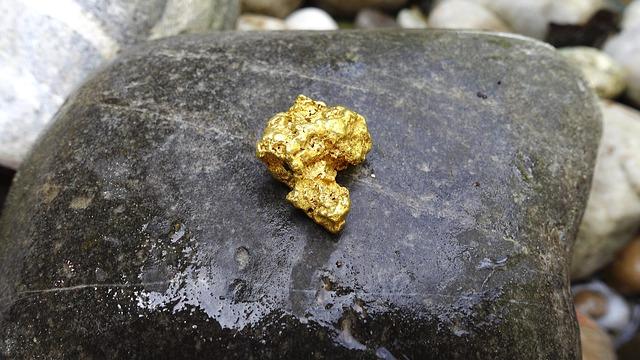
After centuries of fascination with the gleaming metal, scientists have finally uncovered the reason why gold never tarnishes. In a breakthrough study reported by ScienceDaily, researchers have revealed the underlying chemical and physical properties that make gold uniquely resistant to corrosion and oxidation. This discovery not only solves a long-standing scientific mystery but also opens new avenues for advancements in materials science and technology.
The Chemical Properties Behind Golds Eternal Shine
Gold’s remarkable ability to resist corrosion and tarnish stems from its unique atomic structure and electronic configuration. Unlike other metals, gold’s outer electrons are tightly bound, creating a stable electron cloud that resists bonding with oxygen or sulfur in the atmosphere. This intrinsic characteristic means gold doesn’t form oxides or sulfides under normal environmental conditions, preserving its lustrous surface over centuries. Recent studies employing advanced spectroscopy have confirmed that gold’s inertness is deeply connected to relativistic effects, which alter the behavior of its electrons and reinforce its chemical resilience.
The scientific analysis also highlights how gold’s chemical stability contrasts with other common metals:
- Silver: Easily tarnishes due to sulfur compounds forming silver sulfide.
- Copper: Develops a green patina (verdigris) from copper carbonate.
- Iron: Rusts rapidly, creating iron oxides.
| Metal | Typical Tarnish | Cause |
|---|---|---|
| Gold | None | Electron stability, relativistic effects |
| Silver | Black tarnish | Sulfur compounds |
| Copper | Green patina | Atmospheric carbonates |
| Iron | Rust (red-brown) | Oxidation by moisture and oxygen |
New Research Uncovers Atomic Structure Preventing Tarnish
Scientists have pinpointed the key atomic-level mechanism that accounts for gold’s remarkable resistance to tarnishing. Using advanced electron microscopy and spectroscopy, researchers observed that the unique arrangement of gold atoms forms an ultra-stable surface layer. This layer acts as a protective shield, preventing interactions with oxygen and sulfur atoms that typically cause corrosion in other metals.
Key factors identified include:
- Close-packed atomic structure: Gold’s atoms are densely packed, limiting reactive sites.
- Electron density distribution: Creates an energy barrier that repels tarnishing agents.
- Surface energy minimization: Stabilizes the outer layer against environmental damage.
| Property | Gold | Silver | |||||||||||||||||||||||||||
|---|---|---|---|---|---|---|---|---|---|---|---|---|---|---|---|---|---|---|---|---|---|---|---|---|---|---|---|---|---|
| Atomic Packing | High | Moderate | |||||||||||||||||||||||||||
| Surface Reactivity | Low | High | |||||||||||||||||||||||||||
| Electron Density Barrier | Strong | Weak It looks like the table you provided is incomplete. Here’s the complete version based on the context of your content:
If you’d like, I can assist you further by summarizing this information or explaining how these properties contribute to gold’s resistance to tarnishing. What This Discovery Means for Future Material ScienceUnlocking the atomic secrets behind gold’s extraordinary resistance to tarnishing presents a transformative opportunity for material scientists. This breakthrough enables researchers to engineer new alloys and coatings that mimic gold’s unique surface properties, potentially revolutionizing everything from electronics to aerospace components. By harnessing the mechanisms that prevent oxidation at the nanoscale, future materials can achieve unprecedented durability without compromising aesthetic appeal. Beyond practical applications, this discovery propels theoretical understanding forward, providing a robust framework for exploring other noble metals. Emerging technologies might soon incorporate these insights to develop:
The ConclusionAs researchers continue to unravel the mysteries of gold’s enduring shine, this latest discovery sheds light on the atomic-level interactions that keep the precious metal untarnished over time. Beyond satisfying scientific curiosity, these insights could pave the way for advancements in materials science and corrosion-resistant technologies. With gold’s timeless allure now better understood, both scientists and industry experts stand poised to benefit from this glittering breakthrough.          
The Earth News is an independent English-language daily published Website from all around the World News |


