





* . *
  • About
  • Advertise
  • Privacy & Policy
  • Contact
Wednesday, February 11, 2026
Earth-News
  • Home
  • Business
  • Entertainment

    Grammy Award-Winning Singer Ready to Ignite the Stage at Modesto’s Gallo Center – Discover Who and When!

    Watch the U.S. Air Force F-35A Lightning II Light Up the Sky at the Columbus Air Show!

    Black Voices Ignite the Spark at the 2026 Sundance Film Festival

    Rock Legend Defends Bad Bunny’s Epic Halftime Show Performance

    Pedro Pascal Lights Up the Stage with an Epic Dance at Bad Bunny’s Super Bowl 2026 Halftime Show

    Lucky Strike Entertainment Rockets 5.3% Pre-Market, Bounces Back Strongly After Earnings Slump

  • General
  • Health
  • News

    Cracking the Code: Why China’s Economic Challenges Aren’t Shaking Markets, Unlike America’s” – Bloomberg

    Trump’s Narrow Window to Spread the Truth About Harris

    Trump’s Narrow Window to Spread the Truth About Harris

    Israel-Gaza war live updates: Hamas leader Ismail Haniyeh assassinated in Iran, group says

    Israel-Gaza war live updates: Hamas leader Ismail Haniyeh assassinated in Iran, group says

    PAP Boss to Niger Delta Youths, Stay Away from the Protest

    PAP Boss to Niger Delta Youths, Stay Away from the Protest

    Court Restricts Protests In Lagos To Freedom, Peace Park

    Court Restricts Protests In Lagos To Freedom, Peace Park

    Fans React to Jazz Jennings’ Inspiring Weight Loss Journey

    Fans React to Jazz Jennings’ Inspiring Weight Loss Journey

    Trending Tags

    • Trump Inauguration
    • United Stated
    • White House
    • Market Stories
    • Election Results
  • Science
  • Sports
  • Technology

    NIST Fuels Quantum Technology Breakthroughs with $3.19M Investment in Next-Gen SBIR Projects

    Get Ready for the 2026 NHRA Chassis Certifications at World Wide Technology Raceway – March 14-15!

    John Deere Expands Precision Ag Technology Access – Morning Ag Clips

    Why AI Must Collaborate with Doctors to Create Trustworthy Healthcare Technology

    How Globalization and Technology Are Shaping the Future of Domestic Politics, According to Eswar Prasad

    UBS Lowers SoFi Technologies Price Target to $24.50 Following Mixed Earnings

    Trending Tags

    • Nintendo Switch
    • CES 2017
    • Playstation 4 Pro
    • Mark Zuckerberg
No Result
View All Result
  • Home
  • Business
  • Entertainment

    Grammy Award-Winning Singer Ready to Ignite the Stage at Modesto’s Gallo Center – Discover Who and When!

    Watch the U.S. Air Force F-35A Lightning II Light Up the Sky at the Columbus Air Show!

    Black Voices Ignite the Spark at the 2026 Sundance Film Festival

    Rock Legend Defends Bad Bunny’s Epic Halftime Show Performance

    Pedro Pascal Lights Up the Stage with an Epic Dance at Bad Bunny’s Super Bowl 2026 Halftime Show

    Lucky Strike Entertainment Rockets 5.3% Pre-Market, Bounces Back Strongly After Earnings Slump

  • General
  • Health
  • News

    Cracking the Code: Why China’s Economic Challenges Aren’t Shaking Markets, Unlike America’s” – Bloomberg

    Trump’s Narrow Window to Spread the Truth About Harris

    Trump’s Narrow Window to Spread the Truth About Harris

    Israel-Gaza war live updates: Hamas leader Ismail Haniyeh assassinated in Iran, group says

    Israel-Gaza war live updates: Hamas leader Ismail Haniyeh assassinated in Iran, group says

    PAP Boss to Niger Delta Youths, Stay Away from the Protest

    PAP Boss to Niger Delta Youths, Stay Away from the Protest

    Court Restricts Protests In Lagos To Freedom, Peace Park

    Court Restricts Protests In Lagos To Freedom, Peace Park

    Fans React to Jazz Jennings’ Inspiring Weight Loss Journey

    Fans React to Jazz Jennings’ Inspiring Weight Loss Journey

    Trending Tags

    • Trump Inauguration
    • United Stated
    • White House
    • Market Stories
    • Election Results
  • Science
  • Sports
  • Technology

    NIST Fuels Quantum Technology Breakthroughs with $3.19M Investment in Next-Gen SBIR Projects

    Get Ready for the 2026 NHRA Chassis Certifications at World Wide Technology Raceway – March 14-15!

    John Deere Expands Precision Ag Technology Access – Morning Ag Clips

    Why AI Must Collaborate with Doctors to Create Trustworthy Healthcare Technology

    How Globalization and Technology Are Shaping the Future of Domestic Politics, According to Eswar Prasad

    UBS Lowers SoFi Technologies Price Target to $24.50 Following Mixed Earnings

    Trending Tags

    • Nintendo Switch
    • CES 2017
    • Playstation 4 Pro
    • Mark Zuckerberg
No Result
View All Result
Earth-News
No Result
View All Result
Home Science

Rocketing to the Stars: NASA’s INFUSE Probes Sizzling Supernova Secrets

October 30, 2023
in Science
Rocketing to the Stars: NASA’s INFUSE Probes Sizzling Supernova Secrets
Share on FacebookShare on Twitter

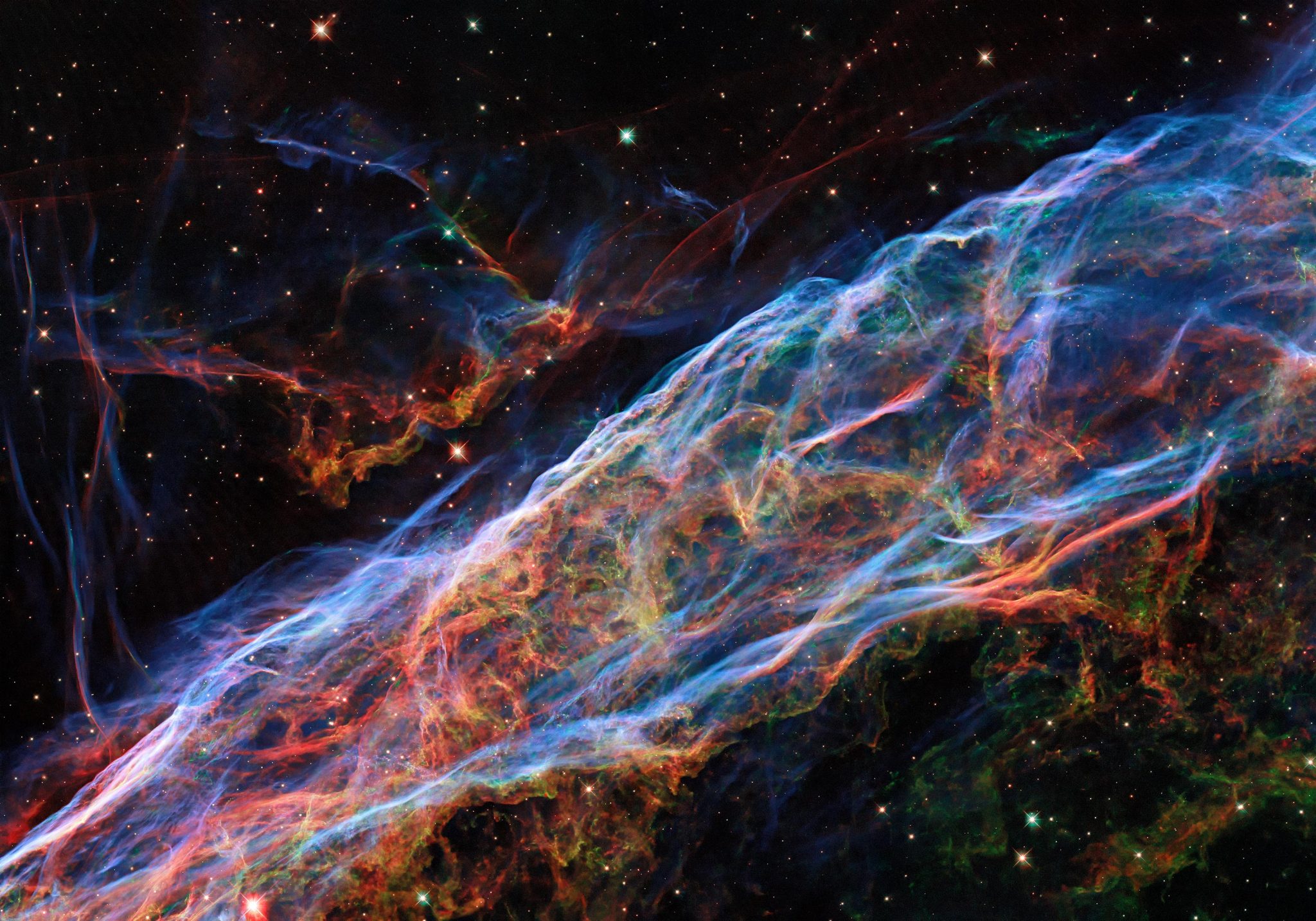
Hubble Veil Nebula

This image taken by NASA’s Hubble Space Telescope shows part of the Veil Nebula or Cygnus Loop. To create this colorful image, observations were taken by Hubble’s Wide Field Camera 3 instrument using five different filters. New post-processing methods have further enhanced details of emissions from doubly ionized oxygen (shown here in shades of blue), ionized hydrogen, and ionized nitrogen (shown here in shades of red). Credit: ESA/Hubble & NASA, Z. Levay

INFUSE, a new sounding rocket mission, is launching to study the Cygnus Loop supernova remnants. Utilizing a unique instrument that combines imaging and spectroscopy, it seeks to uncover the mysteries of stellar explosions and their role in creating new celestial bodies.

A new sounding rocket mission is headed to space to understand how explosive stellar deaths lay the groundwork for new star systems. The Integral Field Ultraviolet Spectroscopic Experiment, or INFUSE, sounding rocket mission, will launch from the White Sands Missile Range in New Mexico on October 29, 2023, at 9:35 p.m. MDT.

The Cygnus Loop: A Celestial Phenomenon

For a few months each year, the constellation Cygnus (Latin for “swan”) swoops through the northern hemisphere’s night sky. Just above its wing is a favorite target for backyard astronomers and professional scientists alike: the Cygnus Loop, also known as the Veil Nebula.
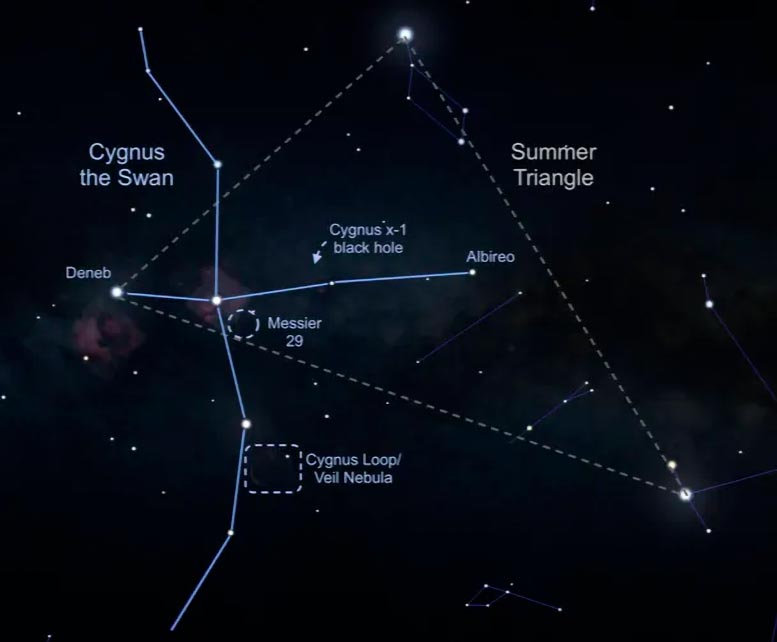
Constellation Cygnus in the Night Sky

This image shows an illustration of the constellation Cygnus, Latin for “swan,” in the night sky. The Cygnus Loop supernova remnant, also known as the Veil Nebula, is located near one of the swan’s wings, outlined here in a rectangular box.
Credit: NASA

The Cygnus Loop is the remnant of a star that was once 20 times the size of our Sun. Some 20,000 years ago, that star collapsed under its own gravity and erupted into a supernova. Even from 2,600 light-years away, astronomers estimate the flash of light would have been bright enough to see from Earth during the day.

Supernovae: Galactic Architects

Supernovae are part of a great life cycle. They spray heavy metals forged in a star’s core into the clouds of surrounding dust and gas. They are the source of all chemical elements in our universe heavier than iron, including those that make up our own bodies. From the churned-up clouds and star stuff left in their wake, gases and dust from supernovae gradually clump together to form planets, stars, and new star systems.

“Supernovae like the one that created the Cygnus Loop have a huge impact on how galaxies form,” said Brian Fleming, a research professor at the University of Colorado Boulder and principal investigator for the INFUSE mission.

Understanding Supernova Dynamics

The Cygnus Loop provides a rare look at a supernova blast still in progress. Already over 120 light-years across, the massive cloud is still expanding today at approximately 930,000 miles per hour (about 1.5 million kilometers per hour).

What our telescopes capture from the Cygnus Loop is not the supernova blast itself. Instead, we see the dust and gas superheated by the shock front, which glows as it cools back down.

“INFUSE will observe how the supernova dumps energy into the Milky Way by catching light given off just as the blast wave crashes into pockets of cold gas floating around the galaxy,” Fleming said.

Innovative Instrumentation: INFUSE

To see that shock front at its sizzling edge, Fleming and his team have developed a telescope that measures far-ultraviolet light – a kind of light too energetic for our eyes to see. This light reveals gas at temperatures between 90,000 and 540,000 degrees Fahrenheit (about 50,000 to 300,000 degrees Celsius) that is still sizzling after impact.

INFUSE is an integral field spectrograph, the first instrument of its kind to fly to space. The instrument combines the strengths of two ways of studying light: imaging and spectroscopy. Your typical telescopes have cameras that excel at creating images – showing where light is coming from, faithfully revealing its spatial arrangement. But telescopes don’t separate light into different wavelengths or “colors” – instead, all of the different wavelengths overlap one another in the resulting image.

Spectroscopy, on the other hand, takes a single beam of light and separates it into its component wavelengths or spectrum, much as a prism separates light into a rainbow. This procedure reveals all kinds of information about what the light source is made of, its temperature, and how it is moving. But spectroscopy can only look at a single sliver of light at a time. It’s like looking at the night sky through a narrow keyhole.
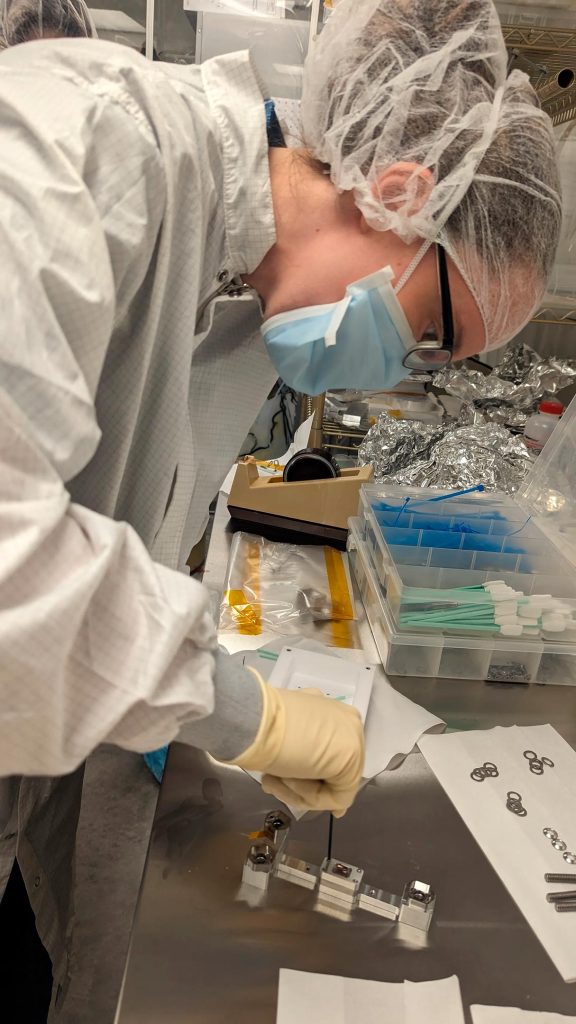
Emily Witt Image Slicer

PhD student Emily Witt installs the delicate image slicer – the core optical technology for INFUSE – onto its mount in a CU-LASP clean room ahead of integration into the payload. Credit: CU Boulder LASP/Brian Fleming

The INFUSE instrument captures an image and then “slices” it up, lining up the slices into one giant “keyhole.” The spectrometer can then spread each of the slices into its spectrum. This data can be reassembled into a 3-dimensional image that scientists call a “data cube” – like a stack of images where each layer reveals a specific wavelength of light.

Implications and Future Prospects

Using the data from INFUSE, Fleming and his team will not only identify specific elements and their temperatures, but they’ll also see where those different elements lie along the shock front.

“It’s a very exciting project to be a part of,” said lead graduate student Emily Witt, also at CU Boulder, who led most of the assembly and testing of INFUSE and will lead the data analysis. “With these first-of-their-kind measurements, we will better understand how these elements from the supernova mix with the environment around them. It’s a big step toward understanding how material from supernovas becomes part of planets like Earth and even people like us.”

To get to space, the INFUSE payload will fly aboard a sounding rocket. These nimble, crewless rockets launch into space for a few minutes of data collection before falling back to the ground. The INFUSE payload will fly aboard a two-stage Black Brant 9 sounding rocket, aiming for a peak altitude of about 150 miles (240 kilometers), where it will make its observations, before parachuting back to the ground to be recovered. The team hopes to upgrade the instrument and launch again. In fact, parts of the INFUSE rocket are themselves repurposed from the DEUCE mission, which launched from Australia in 2022.

NASA’s Sounding Rocket Program is conducted at the agency’s Wallops Flight Facility at Wallops Island, Virginia, which is managed by NASA’s Goddard Space Flight Center in Greenbelt, Maryland. NASA’s Heliophysics Division manages the sounding rocket program for the agency. The development of the INFUSE payload was supported by NASA’s Astrophysics Division.

>>> Read full article>>>
Copyright for syndicated content belongs to the linked Source : SciTechDaily – https://scitechdaily.com/rocketing-to-the-stars-nasas-infuse-probes-sizzling-supernova-secrets/


Tags: Rocketingsciencestars
Previous Post

Sport | Martin wins Thai MotoGP, SA’s Binder demoted to 3rd after penalty

Next Post

Sleep Apnea Accelerates Aging – But Using This Breathing Therapy Method Can Mitigate the Problem

BCAT’s Annual Showcase Celebrates Stunning Student Artwork

February 11, 2026

NIST Fuels Quantum Technology Breakthroughs with $3.19M Investment in Next-Gen SBIR Projects

February 11, 2026

North Dakota State to petition for immediate CFP, postseason access – CBS Sports

February 11, 2026

Myanmar Rebel Leader Calls for Worldwide Action Amid Intensifying Junta Airstrikes

February 11, 2026

Savannah Marks 50 Years of Visit Savannah with a $4.1 Billion Tourism Boom

February 11, 2026

Grammy Award-Winning Singer Ready to Ignite the Stage at Modesto’s Gallo Center – Discover Who and When!

February 11, 2026

In the 608: SSM Health Monroe Hospital donates to Family Promise of Green Co. – Channel 3000

February 11, 2026

Three House Republicans Defy Party to Challenge Protection of Trump’s Tariffs

February 11, 2026

From practice to policy: Why farmer collaboration matters for biodiversity – Phys.org

February 11, 2026

Why the UC system is seeing a drop in computer science enrollment – NBC Bay Area

February 11, 2026

Categories

Archives

February 2026
M T W T F S S
 1
2345678
9101112131415
16171819202122
232425262728  
« Jan    
Earth-News.info

The Earth News is an independent English-language daily published Website from all around the World News

Browse by Category

  • Business (20,132)
  • Ecology (1,068)
  • Economy (1,085)
  • Entertainment (21,962)
  • General (19,847)
  • Health (10,126)
  • Lifestyle (1,101)
  • News (22,149)
  • People (1,094)
  • Politics (1,102)
  • Science (16,301)
  • Sports (21,588)
  • Technology (16,069)
  • World (1,076)

Recent News

BCAT’s Annual Showcase Celebrates Stunning Student Artwork

February 11, 2026

NIST Fuels Quantum Technology Breakthroughs with $3.19M Investment in Next-Gen SBIR Projects

February 11, 2026
  • About
  • Advertise
  • Privacy & Policy
  • Contact

© 2023 earth-news.info

No Result
View All Result

© 2023 earth-news.info

No Result
View All Result

© 2023 earth-news.info

Go to mobile version
