







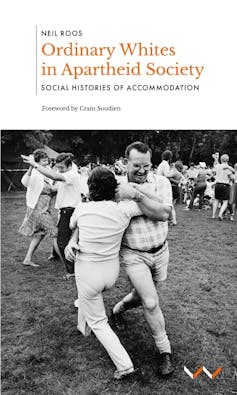
Apartheid in South Africa is widely examined through the lens of Black experiences, but “Ordinary Whites in Apartheid South Africa: Social Histories of Accommodation” by Neil Roos shifts the focus to working-class whites. This book explores how these individuals, despite some opposing apartheid’s methods, largely upheld the racial privileges it offered. Roos delves into the social engineering efforts targeting “problematic” whites and highlights the complexities of complicity within the apartheid system.
Sign up for your early morning brew of the BizNews Insider to keep you up to speed with the content that matters. The newsletter will land in your inbox at 5:30am weekdays. Register here.
Join us for BizNews’ first investment-focused conference on Thursday, 12 September, in Hermanus, featuring top experts like Frans Cronje, Piet Viljoen, and more. Get insights on electricity and exploiting SA’s gas bounty from new and familiar faces. Register here.
By Neil Roos*
In South Africa, apartheid was a divisive political system entrenched by a white minority who regarded other ethnic groups as inferior, creating townships on the outskirts of cities to house the black population and legislation to control their movements. Many academic studies have focused on black life under apartheid, but few on white life – and even fewer on the role of working-class whites in the system. A new book, Ordinary Whites in Apartheid South Africa: Social Histories of Accommodation, does exactly that. We asked historian Neil Roos about his study.
What’s the book’s premise?
Apartheid was a state system of racial oppression in South Africa initiated when the National Party came to power in 1948. It lasted formally until 1994. While we know much about the nature of Black life under apartheid, we know virtually nothing about whites. It’s inconceivable to fully understand the complexity of an oppressive society only from the perspective of the victim and not also the perpetrators.
Apartheid was notorious for its energetic approach to social engineering, using “scientific” data to develop policy and mechanisms to manage society. This is usually viewed in terms of how it affected Black people. Yet the history of “ordinary” whites shows that, from its early months in power, the state first sharpened its social engineering methods on whites it considered “problematic”. Drunks; chronically idle and itinerant men; those employed in jobs positioned on the same levels as Blacks.
 Paul Weinberg/Wits University Press
An example of this was the apartheid state’s research into alcohol consumption among whites, which led to the establishment of alcohol retreats (for women) and penal settlements called work colonies (for men). Removing white drunks from society effectively cleansed the white population by creating an image of it without drunks. Another example: the state modelled new neighbourhoods for a growing new class of white public servants. Standardised houses were built that were considered appropriate for respectable whites. These were sold cheaply to public servants. Their inhabitants were then carefully monitored by social workers.
At its core Ordinary Whites is a book about complicity. Some white people may not have approved of the apartheid state; they may have resented its social engineering, forms of discipline and its military conscription. But few actually rejected the racial privilege which apartheid offered. This allowed them to later claim they “did not support apartheid”.
Who are the working-class whites in your study?
The ordinary white people who feature in the book were a diverse mix. People from the working class, whites who broke their way into the middle class, the destitute and those separated from the mainstream of ordentlike (respectable) white society. They were both Afrikaans-speakers (who formed a substantial part of the National Party’s constituency) as well as speakers of other languages.
While they were subordinate in the white section of society, they, like all whites, were privileged in apartheid society as a whole. They had access to good education and healthcare, subsidised housing and job reservation. This limited their defiance against the regimes that apartheid society imposed. The characters I write about did not represent any particularly progressive currents in South African history. While there were small numbers of whites who were anti-racist, most were not.
You focus on a man called Geoffrey Cronjé. Why?
Geoffrey Cronjé (1907-1992) was a sociology professor and one of the intellectual architects of apartheid. He was comfortably able to straddle the halls of the academy and the machinery of state. This gave him significant power to shape parts of government social policy towards whites from the late 1940s until the late 1950s.
Of this generation of apartheid intellectuals, Cronjé was one of those most invested in whites. His career is of particular value in understanding the state’s ambitions to subject white society to social engineering, as well as its limitations. He was interested in “deviance” (alcoholism, sex work and incest caused him great anxiety) and how this was most commonly seen in certain classes of white society. These interests were shaped not only by sociological data, however dubious, but also by something more personal: his abiding distrust of whites from the working classes, the unemployed, those who survived on apartheid social subsidies – the “ordinary whites” of my book.
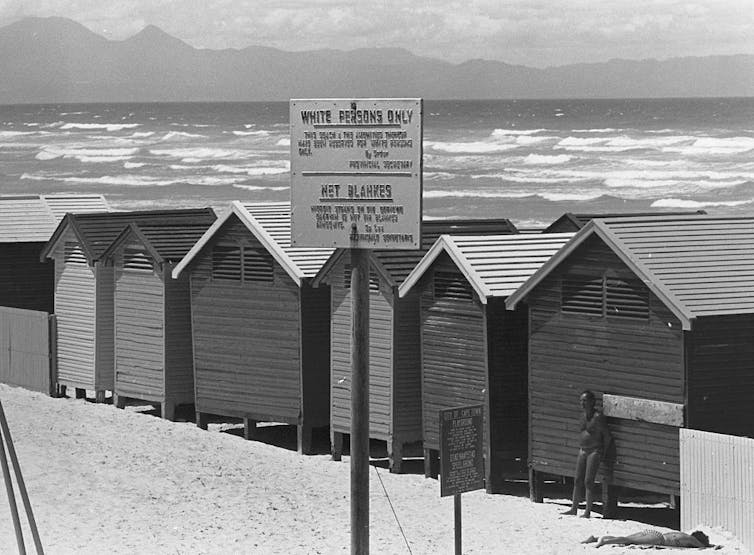 Apartheid social engineering included cordoning off areas for exclusive white use. © Hulton-Deutsch Collection/CORBIS/Corbis via Getty Images
At a time when working-class white families were beginning to employ Black women as domestic labour, Cronjé was afraid of sex across the colour line, an apartheid taboo, taking place within these households. He encouraged the social workers he trained to be particularly vigilant for signs of immorality. By describing and acting on multiple conditions of “deviance” among whites, he defined what it meant to be a “normal”, “respectable” and “decent” white.
You also focus on your own family.
Two points shaped my approach. First, in the few historical or literary accounts of white people in apartheid society I failed to identify people like me, my family or those I grew up with. Second, I was unsettled by the tones of nostalgia and apologia that I saw in some genres of “white” writing on apartheid, mainly memoirs. For a young South African growing up in the 1960s, 70s and 80s, apartheid was everywhere, yet it was nowhere. Its basic premises of racial supremacy and racial segregation were taken for granted but seldom explicitly discussed by white people.
The people whose stories feature most prominently in this volume were family and people I grew up with. None occupied influential positions in apartheid society. For me their significance lies in what their history tells us about that society. Notably, how whites could simultaneously “oppose” apartheid while still supporting the grand project of racial supremacy. The many ways that white people were bound into apartheid society, and how they contributed to sustaining it.
What do you want readers to take away?
Like anyone else, apartheid-era whites deserve to have their history told.
However, for me a history of white South Africans is not meant to be a feel-good, add-a-human-face-to-apartheid endeavour. It must be an uncompromisingly anti-racist history that challenges the very idea of stable racial categories, of race as something natural.
If, in addressing questions of complicity, we are to avoid narrating the social histories of these whites with condescension, we must understand how they were policed and disciplined. And what bound them into apartheid society: economic interests and privilege, an overweening state prepared to act harshly against “miscreant” whites and the sense that they were being watched – a fear almost certainly more imagined than real.
But we cannot write their history in ways which eliminate these people’s agency and deflect moral blame to convenient scapegoats like powerful politicians, important bureaucrats or murderous policemen.
Even as ordinary whites were often chronically distrusted by the political, bureaucratic and church elite, their participation in apartheid society through the racialised privileges they received, the racist beliefs they took for granted and their work in administering apartheid left them deeply complicit in it.
Read also:
South Africa places assassin of anti-Apartheid icon on parole
ANC loses ground in early vote tally, risks losing majority for first time since Apartheid
How Rupert fought with PW & Verwoerd over Apartheid
*Neil Roos: Dean of the Faculty of Social Sciences and Humanities, University of Fort Hare
This article was first published by The Conversation and is republished with permission
>>> Read full article>>>
Copyright for syndicated content belongs to the linked Source : BizNews – https://www.biznews.com/rational-perspective/2024/07/10/ordinary-whites-apartheid-south-africa



