






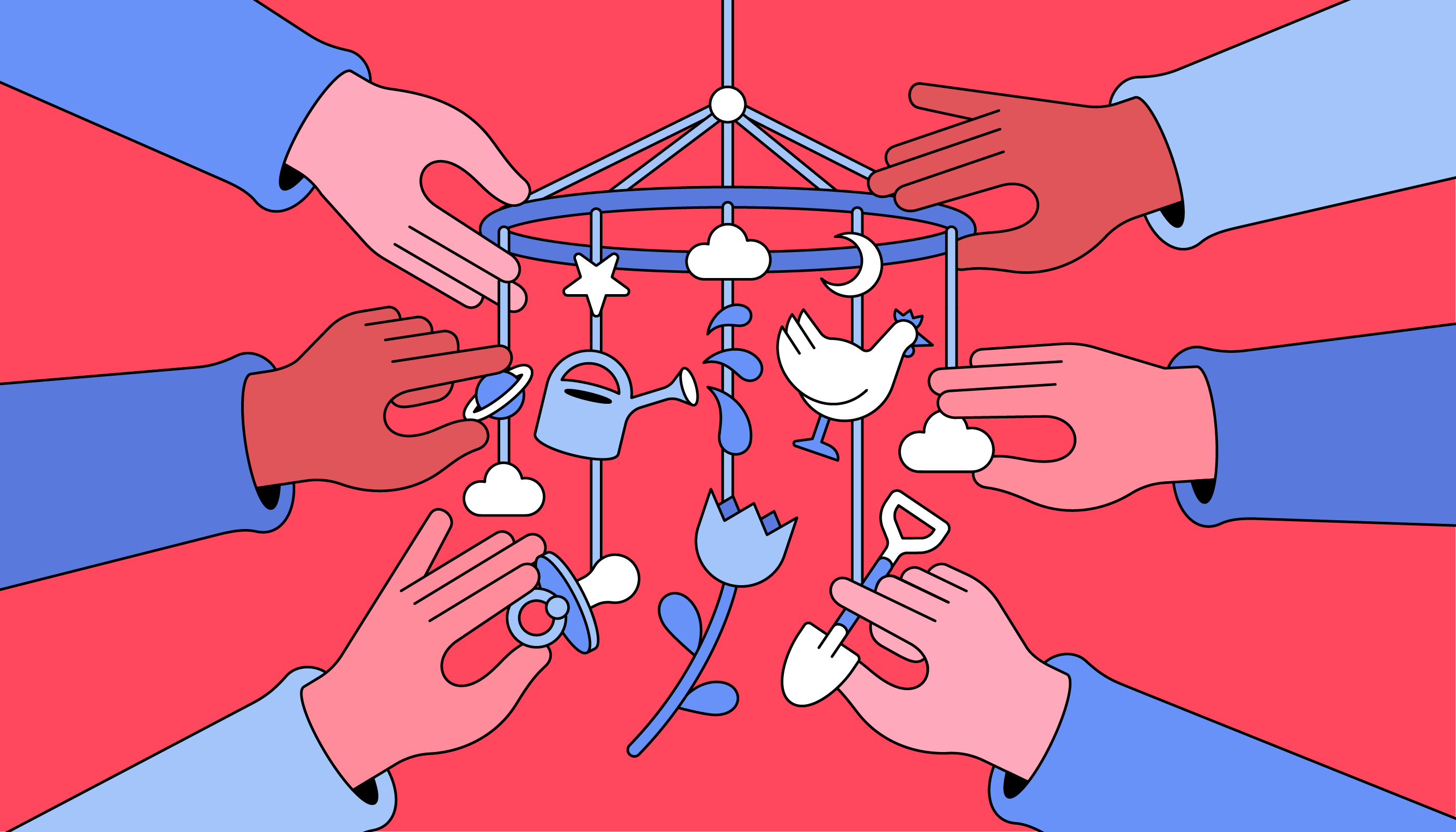
About ten years ago, during a particularly dull stretch of my life, I began kicking around the idea of starting a commune for disgruntled, disaffected, and broke media professionals. We would call ourselves the Kang Dropout Commune, and we would live on abundant acreage, in some cheap, dusty part of California, where we would dig irrigation ditches, raise chickens, and foster increasingly strange political and religious beliefs. I was joking, but not entirely—a part of me has always wanted to exit society and spend my days feeding goats among a coterie of like-minded individuals. Unfortunately, I am an irritable person who does not deal well with physical discomfort or neighborly annoyances; I am sure that I would get kicked out of my own commune, rightfully, within a matter of months. The other problem was that I could never figure out what the politics of the commune, its raison d’être, should be. Is dissatisfaction with modern life enough to bond a community? And, if we did not have more to go on than that, would we really be a commune, or would we just be ten or twelve roommates who happened to live about fifteen miles outside of Modesto? Then I had kids, and the idea of communal living went from an idle and mostly ironic fantasy into something that actually made much more sense.
In last week’s column, I wrote about middle- and upper-middle-class parents vying for competitive spots in summer camps for their children. That piece sprang from a sense of alienation that I’ve detected among my parent group, one that I feel myself. We are mostly in our forties, which means that our adulthoods have been marked by 9/11, the 2008 market crash, and the pandemic. Granted, one can look at any stretch of forty or so years in American history, find three or four bad things that happened, and use them to sympathetically pathologize a generation. But people who began their adult lives in the wake of September 11th and the Great Recession generally have less optimism about the country’s future than their parents had. If the election of Barack Obama provided temporary relief for liberals, this was undone by the rise of Donald Trump. We worry about our children inheriting a world on fire as a result of climate change and riven by political polarization and inequality, and we feel as though we are mostly alone in having to prepare them for it.
I was thinking about all this while I read “The Commune Form: The Transformation of Everyday Life,” a forthcoming book by the comparative-literature professor Kristin Ross. Ross—who has previously written about the Paris Commune of 1871 and France’s student uprising of May, 1968—focusses particularly on the ZAD de Notre-Dame-des-Landes, a thousand-acre commune created by French farmers and their allies in the late two-thousands, in an effort to block the construction of a new airport, which would have kicked many people off their own land. (The French government had designated the land a zone d’aménagement différé, or a “deferred development area”; the farmers kept the acronym but used it to mean zone à défendre, or “zone to defend.”) For a commune to work, Ross argues, one must have both a physical space to defend against an antagonist and an articulated vision for an alternative organization of human relationships and economy. The “commune form,” as she defines it, is a “political movement that is also the collective elaboration of a desired way of life—the means becoming the end.” Theory, in other words, needs to be put into practice, in an intimate and earnest setting, so that people can test out their ideas about living within the context of an actual place among actual people.
Ross identifies one of the motivating forces behind the creation of the ZAD as alienation, which was “less the loss of some human essence than it was the loss of possibilities: the sense of blockages and impasses brought on by the destruction and fragmentation of the social tissue by capitalism.” Drawing upon the work of the French philosopher Henri Lefebvre, Ross refers to “the colonization of everyday life,” each part of our day becoming dominated by economic reasoning. This, she writes, dispossesses us of “our dignity, our social life, our time, the sense of mastery over our lives, the beauty and health of our lived environment, and of the very possibility of working together to invent our future collectively.” Under such conditions, the commune becomes the only alternative.
In her own travels to the ZAD, in 2016, Ross found a group of idealistic people who were “looking consciously for models that might help them sustain a life intentionally set adrift from the world organized by state and finance.” They were living, she writes, in “a wild west construction-in-process, with all the bustle and mess and joy of collective building, the palpable sense of a world—physical dwellings as much as a space of collective social transformation and experimentation—coming into being.” In this village of half-built structures and sprawling vegetable gardens, disputes were adjudicated by a committee called the Cycle of the Twelve, a dozen revolving people whose names were drawn monthly from a hat. Ross had come to the ZAD to give a talk, but soon found herself baling hay with the commune’s residents and experiencing a “kind of intense and physically satisfying fatigue.” It wasn’t just the physical exertion, she explains; rather, it “had more to do with the social density and intensity brought on by the intermingling of labor and social interaction, especially for someone like me, used to spending much of my time by myself.”
Ross, a career academic, acknowledges, with appropriate self-deprecation, that she might be falling a bit too hard for the charms of pastoral living—an uncharitable reader might be inclined to dismiss “The Commune Form” as “Marxist N.Y.U. professor bales hay once and writes book about it.” But such a reductive reading would miss her larger point, about the hope that can be found in our most essential tasks, done together, for the greater good. As she writes, “everyday life may well be the site of alienation, but it is also the site of its undoing, the terrain for social change.” The basic responsibilities that we have as part of a community, from the distribution of food to the negotiation of disagreements, become the proof that a different type of society can be formed.
A common complaint I hear among parents is that it’s almost impossible to create a collective sense of anything. This gripe mostly centers on phones—parents don’t want their kids to have them but feel powerless to put this prohibition into practice given the extreme social pressures that their children face. If their kids’ friends are communicating primarily via smartphones, parents fear that any phoneless child will be isolated. The only solution, it seems, is to offset these pressures with a countervailing social force. (The group Wait Until 8th, for instance, encourages parents to sign a pledge not to give their children smartphones before the end of eighth grade.) The problem, as noted by Jessica Winter in a review of Jonathan Haidt’s recent book, “The Anxious Generation,” is that parents these days have little capacity for or faith in collective action. Children, after all, aren’t the only ones who are isolated, anxious, and addicted to their phones—and we parents don’t have anyone to take the devices out of our hands.
The irony of middle-class-parent alienation is that those same parents have, in some ways, never been more connected with one another, through group chats and e-mail chains and social media. (I have had four apps on my phone for youth sports leagues alone.) In recent years, these digital forums have been harnessed by middle-class parents as tools of political organization, and used, for instance, to defend exclusive admissions standards at magnet high schools across the country, to ban books from school libraries, and to eject elected officials from school boards. I don’t think it’s a coincidence that many of these fights are on behalf of essentially conservative causes. Many conservative parents feel as though their children are under constant threat, and they often see the government in a fundamentally antagonistic way. Even the faintest call to defend some tradition or another will bring them to the barricades. Middle-class parents who skew more progressive do not feel the same explicit political stakes in these fights, and seem more likely to associate collective action with issues of equity and social justice. (I suspect that part of the reason so much of the discussion around parenting among the liberal and suburban middle class has focussed on phones and screen time is that these parents don’t feel particularly connected to the culture wars that hover around their children’s schools.) One can—and maybe even should—roll one’s eyes at this particular alienation, but that doesn’t exactly help with the alienation.
All of this may seem a far cry from French communes. But another thing I was thinking about as I read Ross’s book was the nursery school that I attended four decades ago. There was a time in recent history when many American cities were dotted with vaguely socialist preschools and child-care coöperatives; some of these schools could trace their history to a group of faculty wives at the University of Chicago who, in 1916, founded a child-care coöperative to free up some of their time for Red Cross work. I attended a coöperative nursery school as a child, but, when it came time to send my daughter to a similar place, the price tag was close to three thousand dollars a month. A similar fate has met so many formerly communal spaces: civic recreational sports leagues replaced by competitive clubs, city pools replaced by prohibitively expensive swim centers, public schools supplemented with after-school tutoring. These are all physical spaces, and so many of them have been plundered by privatization and neglect. This is what happens when everyone just gets too busy to invest in the commons.
The majority of middle-class parents would never join a mildly demanding co-op, much less a commune, but there are still salient lessons in Ross’s book, and ways to build and defend little communes everywhere. If parents want to feel less alienation—if they want, for example, to believe that it might actually be possible for families in their town to hold off on giving their kids phones until high school—they may need to return to the weird, quasi-communal spirit that animated American parenting, at least in certain corners, during various periods of the twentieth century. Physical spaces, whether pools or parks, can be reclaimed through collective action, in much the way that admissions policies at exclusive magnet schools can be protected by a small group of dedicated parents. Small, everyday victories are the only real cure for alienation. What else would work? ♦
>>> Read full article>>>
Copyright for syndicated content belongs to the linked Source : The New Yorker – https://www.newyorker.com/news/fault-lines/little-communes-everywhere



