







(Image credit: Moor Studio/Getty Images)
Noland Arbaugh has a computer chip embedded in his skull and an electrode array in his brain. But Arbaugh, the first user of the Neuralink brain-computer interface, or BCI, says he wouldn’t know the hardware was there if he didn’t remember going through with the surgery. “If I had lost my memory, and I woke up, and you told me there was something implanted in my brain, then I probably wouldn’t believe you,” says the 30-year-old Arizona resident, who has been paralyzed below the middle of his neck since a 2016 swimming accident. “I have no sensation of it—no way of telling it’s there unless someone goes and physically pushes on it.”
The Neuralink chip may be physically unobtrusive, but Arbaugh says it’s had a big impact on his life, allowing him to “reconnect with the world.” He underwent robotic surgery in January to receive the N1 Implant, also called “the Link,” in Neuralink’s first approved human trial.
BCIs have existed for decades. But because billionaire technologist Elon Musk owns Neuralink, the company has received outsize attention. It’s brought renewed public interest to a technology that could significantly improve the life of those living with quadriplegia, such as Arbaugh, as well as people with other disabilities or neurodegenerative diseases.
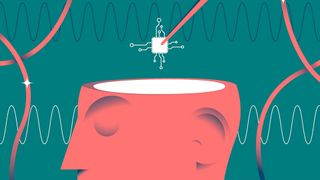
BCIs record electrical activity in the brain and translate those data into output actions, such as opening and closing a robotic hand or clicking a computer mouse. They vary in their design, level of invasiveness and the resolution of the information they capture. Some detect neurons’ electrical activity with entirely external electroencephalogram (EEG) arrays placed over a subject’s head. Others use electrodes placed on the brain’s surface to track neural activity. Then there are intracortical devices, which use electrodes implanted directly into brain tissue, to get as close as possible to the targeted neurons. Neuralink’s implant falls into this category.
Capturing neural activity can be like trying to record chitchat between two people in a packed stadium, says Douglas Weber, a mechanical engineer and neuroscientist at Carnegie Mellon University. To hear anything more than the crowd’s roar, you need to get up close with the person speaking. “The farther away from the speaker you are, the more mixed and muddled the conversations become,” he explains. Neuralink threads electrodes into the brain’s motion-controlling motor cortex, positioning “sensors right up next to the individual neurons that are conversing.”
RELATED: Elon Musk’s Neuralink has concerning lack of transparency and could be vulnerable to hacking, ethicists warn
Neuralink is not the first to do this. A device called the Utah Array—a tiny, rectangular grid of silicon spikes—is the standard electrode system for intracortical BCIs. It was developed by a University of Utah bioengineering professor, Richard Normann, in the 1990s; in 2004 Matthew Nagle was the first person to use a Utah Array BCI to control a cursor with his thoughts. Neuralink’s design, drawing on prior microwire research, is also not the first to replace the rigid Utah array with a network of thin, flexible threads that have electrodes along their length.
Get the world’s most fascinating discoveries delivered straight to your inbox.
What Neuralink has done, however, is condense multiple advances into a single implantable, intracortical, wireless device. “They’ve kind of taken the best of everything that I’ve seen and put it all together,” says Jennifer Collinger, a biomedical engineer and associate professor at the University of Pittsburgh.
Data into action
The Link’s circular electronic hub connects to 64 superfine threads that contain a total of 1,024 electrodes. That’s about 10 times as many electrodes as a Utah Array (though multiple Utah Arrays have been implanted into a single person’s brain at once). The Link transmits compressed neural data from the brain via Bluetooth, and an algorithm tuned to the user’s unique neural patterns translates those data into action.
Arbaugh says he was able to move a digital cursor within a week after the implant surgery. He does so in two ways. There’s what he describes as “attempted movement”—or simply willing a paralyzed limb to do what it no longer can. By instigating movement of the muscles in his hand (which he says can still produce slight wiggles) and going through the mental motions of using a mouse with that hand, he can move a cursor around a screen with little effort. “It’s very intuitive,” Arbaugh says.
He’s also found that looking at the cursor and picturing the path he’d like it to take enables him to navigate a screen. He calls this “imagined movement.” He uses both methods, often in conjunction with each other. The first is a bit more physically taxing, while the second requires some extra mental focus. But both allow multitasking: Arbaugh can talk or eat at the same time as he operates his computer.
Before the implant, if Arbaugh wanted to use a computer, he did so by voice command or moving a mouth stick across a touch screen (which required someone to help him get into position). But with his BCI, Arbaugh says he’s able to do more—faster, independently and more comfortably. Using the best BCIs “should feel as natural as able-bodied, voluntary movement,” says Leigh Hochberg, a neurointensive care physician and neuroscientist at Brown University, Massachusetts General Hospital, Harvard Medical School and the VA Providence Healthcare System. In his work, he has conducted multiple BCI human trials and studies, including some research for Neuralink. Hochberg says he sometimes gauges how well a device works by how little a subject can describe the user experience. “If our participants can’t tell us exactly how they just did something,” he says, “we know we’re on the right track.”
Neuralink claims that Arbaugh has broken records for BCI cursor control and has reached eight bits per second, a measure that incorporates both speed and accuracy. (Neuralink has released its cursor control benchmark, a square-clicking task, if you’d like to compare your ability to Arbaugh’s.) Arbaugh says he uses his device for hours at a time to browse the Web, send text messages, scroll social media, navigate apps and—perhaps most importantly—play video games. Online chess and the world-building strategy game Civilization VI have been his favorites.
The device has one unavoidable drawback, he says: it needs to be regularly charged, interrupting his gaming sessions. To power up his implant, Arbaugh dons a hat with an embedded wireless charger—a big change from the plug-in BCIs still used in many research settings. Otherwise, using the Link has been mostly seamless, he says—except for when, in February, it nearly stopped working.
Retracting threads
About a month following surgery, Arbaugh lost significant functionality in his implant. At first he thought it was a software bug, but the Neuralink team soon informed him it was a hardware problem. According to Arbaugh, Neuralink’s analysis of the electrode signals revealed that 85 percent of his implant threads had “retracted,” or moved out of position. Neuralink first publicly reported on the issue in a blog post on May 8, months after the setback was detected. (Neuralink did not respond to Scientific American’s questions about the thread retraction.)
“That was really hard to come to terms with,” Arbaugh says. “I was just sinking my teeth into it. I’d reached this high place. And after a month, it [felt like it] was all going to come crashing down.”
Weber notes that the possibility of such disappointment and anxiety is one of the “biggest risks” in human BCI research. “Imagine the stress of experiencing a spinal cord injury for the first time. Now imagine having to go through that again,” he says.
By tweaking the system’s algorithm to respond to the electrodes that were still transmitting data, Neuralink was able to restore much of his implant’s functionality, Arbaugh says. He’s since showed off his cursor prowess in video demos and says he’s back to breaking speed records. But some of the fixes have required creative solutions. The Neuralink engineers have created a system where Arbaugh makes a selection on a screen by hovering his cursor in place for 0.3 seconds instead of clicking. “We’re planning to go back to a single click where I initiate it,” he says. But that hasn’t happened yet.
Nor has the company released a formal scientific report on Arbaugh’s experience. That limits how much can be understood about the technology for now, says George Malliaras, an engineer leading the bioelectronics laboratory at the University of Cambridge. It’s not clear why or how far the threads retracted, if their position has continued to shift or if the remaining threads have stabilized, Malliaras notes. “We have to wait until papers are published with data,” he says.
In the meantime, the U.S. Food and Drug Administration has green-lit Neuralink’s plans to move forward with the clinical trial and implant a second device in another person. The company will attempt to address the retraction issue by implanting the N1’s threads deeper than they were placed in Arbaugh’s case (eight millimeters vs three to five millimeters), as first reported by the Wall Street Journal. “It’s a strategy worth testing, assuming it doesn’t change the safety profile,” Weber says. “They wouldn’t do it if the FDA didn’t think it was okay, so it’s got to be something that was already approved in their protocol. Hopefully it fixes the problem.”
Arbaugh, however, isn’t discouraged by the setback. In his view, everything he’s gone through has a purpose: to improve the technology for others. “The whole point of this study was to find out what does and doesn’t work,” he says. Each bit of information Neuralink collects adds to the pool of data that might one day enable some of the most ambitious goals of BCI researchers: restoring movement to paralyzed limbs or sight to the blind. “I try to keep my expectations pretty grounded,” he says. But the ground seems to be shifting rapidly in the BCI field. He’s happy to be among the first, and he’s excited for the next person to get something even better.
This article was first published at Scientific American. © ScientificAmerican.com. All rights reserved. Follow on TikTok and Instagram, X and Facebook.
Lauren Leffer is a freelance science and environmental journalist based in Brooklyn, New York who will soon be a breaking news reporter at Gizmodo. She writes on topics such as wildlife, the climate crisis, biotech and health equity. Her work has been published in National Geographic, Popular Science, Audubon Magazine, Sierra magazine and elsewhere. Lauren graduated from University of Maryland with a bachelor’s degree in biology and New York University with a master’s in science journalism. Previously, she’s worked as a research biologist, entomologist, park naturalist and curriculum writer.
>>> Read full article>>>
Copyright for syndicated content belongs to the linked Source : Live Science – https://www.livescience.com/health/neuroscience/1st-neuralink-user-describes-highs-and-lows-of-living-with-elon-musks-brain-chip



