







This article was originally featured on MIT Press.
This article is adapted from Omar W. Nasim’s book “The Astronomer’s Chair: A Visual and Cultural History“.
When you close your eyes and think of a chair, what comes to mind? You might see your father’s favorite easy chair, the one he sank into to watch television and which still holds the strong scent of his pipe tobacco; the sofa you were on when you first conquered “Mario Bros.”; or that special couch that always remained covered with a sheet or plastic slipcover until guests arrived.
Yet others might see in their mind’s eye designer chairs like Le Corbusier’s chaise lounge, Charles and Ray Eames’s arm and side chairs, or the ubiquitous plastic monobloc chairs banned by the city of Basel in 2008—chairs that embody emblematic designs of the 20th century, not to mention fetishized commercial objects that continue to inspire or repulse. Still others might imagine Van Gogh’s familiar rustic wooden chairs or the Iron Throne at the center of the hit series “Game of Thrones.” Whatever the case, it is clear that the chair encapsulates a lot more than simply inert furniture.
The chair is, after all, one of those inconspicuous supports, much like the floor beneath your feet or the walls around you, that tends to fall away into the background so that you can get on with other things, like reading. But if we attend to chairs in a systematic way and take them seriously as objects of historical research, they open up a whole world of significance.
As indicators of stature, there are chairs in the history of science that have become iconic. These range from Voltaire’s reading chair equipped with candlestick holder and bookrest, to Benjamin Franklin’s library chair with built-in steps, to Charles Darwin’s armchair on wheels, still on display at his home office in Down House, Kent. Such relics are housed in museums visited by thousands every year, for whom these artifacts sparkle with a historical and cultural aura, one related to the status of science in our modern societies. Think also of Stephen Hawking’s wheelchair, which, after the celebrated astrophysicist’s death in 2018, was initially thought to be bound for the Science Museum in London, but was bought at Christie’s auction house in London for $390,000 and ended up in private hands instead. Or the corner chair made sometime in the early 19th century from the wood of the legendary apple tree at Woolsthorpe Manor under which Newton is said to have sat.
At all these levels—from the mundane to the iconic, from the physical to the symbolic, the real and mythic—the striking presence of chairs in the history of science begs to be acknowledged and understood. As a historian of science motivated by the work of cultural historians of design and furniture, I sought to explore the significance of specialized chairs used by astronomers in my book “The Astronomer’s Chair.” Why astronomers? The book grew out of a curious observation. In researching the roles of drawing and photography in astronomy, I noticed a recurring but previously unrecognized motif: representations of observing chairs specifically designed for use by astronomers at the telescope. Once I started to notice them, I saw them everywhere. The pictures sometimes showed an astronomer seated in a custom-built chair. At other times, the specialized chair was staged empty but alongside other cutting-edge instruments of an observatory.
The astronomer’s chair, too, turns out to have a long history.
At least as far back as the mid-14th century we find a hexagonal panel relief originally crafted in the workshops of Andrea Pisano for Giotto’s Campanile in Florence. It is a panel—now in the Museo dell‘Opera del Duomo—that shows Gionitus, the mythical founder of astronomy, seated at a desk operating a quadrant while taking notes. There is also the 1493 engraved portrayal of the ninth-century Baghdad astronomer al-Farghānī (800/805–870 CE) seated on a bench next to a diminutive figure of a hermit in a Latin translation of his important work. Albrecht Dürer’s frontispiece to “De scientia motus orbis” (1504), a Latin translation of the eighth-century Arabic astronomical text by the Persian-Jewish astronomer Māshā’allāh ibn Athari (740–815 CE), shows the latter in a peculiar but presumably specialized chair holding a globe and compass.
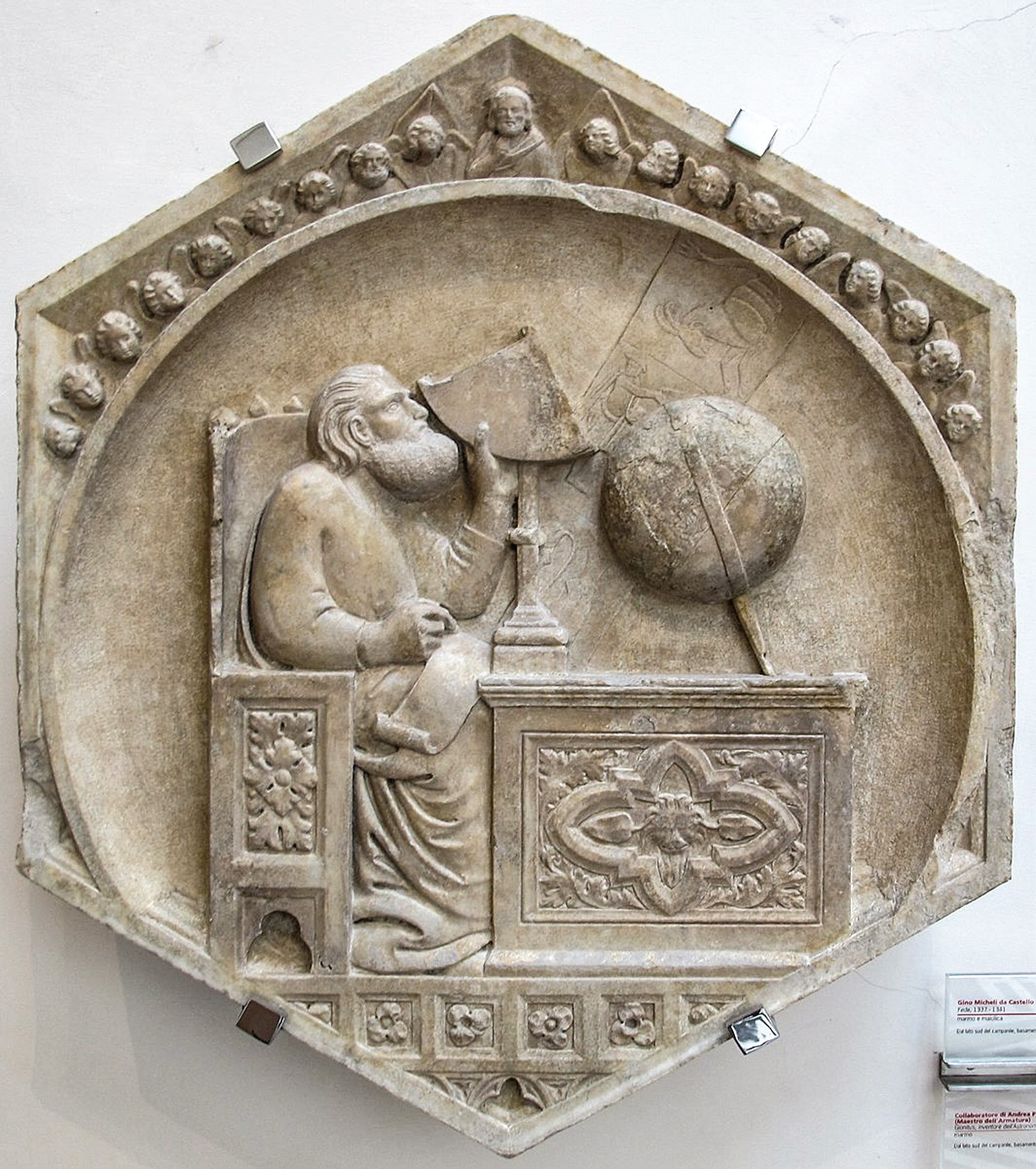 The relief made for Giotto’s Campanile. Credit: Omar W. Nasim
We find illuminated codices depicting well-seated astronomers, such as the likeness of Ptolemy that decorates the title page of “Ptolemaeus: Magna Compositio, Zierrahmen mit Tugenden und dem Wappen” (1465). Ptolemy is shown crowned and seated like a king upon a throne while holding a compass. But among the most famous depictions is certainly the 1598 engraving of Tycho Brahe that renders the famous astronomer installed in the middle of his renowned observatory on the island of Hven.
Besides Johannes Vermeer’s 1668 oil-on-canvas painting of “The Astronomer” or the intricate engraving of the German Jesuit astronomer Christopher Clavius by E. de Boulonois, the 17th century witnessed an abundance of images of astronomers with their telescopes, presumably at work. We may also think of the well-known print of the octagon room of the Royal Observatory at Greenwich from 1676.
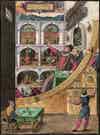 Hand-colored wood engraving of Tycho Brahe seated at the center of his observatory Uraniborg on the island of Hven. Source: Tycho Brahe, Astronomiae Instauratae Mechanica (Wandesburg, Germany, 1598)
The 18th century saw such images increase in number. Among the well-known is the 1735 depiction of the Danish astronomer Ole Rømer seated on a low cushioned stool working with his innovative meridian telescope. There is the wonderfully lush mezzotint of the Austrian astronomer Maximilian Hell seated next to his instrument and decked out in his warmest Lappish winter attire (1771); the mezzotint of Thomas Phelps and John Bartlett which presents the two at work: one looking through a telescope, while the other, seated on an observing chair, takes notes (1778); and the oil-on-canvas portrait by the painter Charles W. Peale (1796) of the American astronomer David Rittenhouse seated next to a telescope on a table.
We can multiply examples indefinitely, for as we approach the 19th century the quantity of representations begins to substantially increase in number and presence, but so do the number of physical chairs designed for the purposes of astronomical observation. In researching the book, I found hundreds of these images from that century and the next, and discerned that the upsurge in depictions corresponded to a growing concern for the use, design, and construction of such chairs by astronomers themselves.
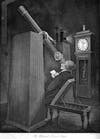 An engraving by James Basire illustrates the transit room of Dr. John Lee’s Hartwell House observatory, where William Henry Smyth (1788–1865) often came to socialize and observe.
With such an extended visual timeline, a sensitivity to multiple representations and their different sociocultural contexts can be used to broach an iconographic history that implicates the image of science, the nature of its labors, and the personae of the astronomer for a given period. But instead of presenting and examining the entire history of these images—an ambitious iconographic project for a more extensive and conclusive study—I limit myself in “The Astronomer’s Chair” to only a snapshot from this history, in a bid to provide the first concentrated look into how one might go about unraveling the cultural significance of the chair and its representations in 19th-century astronomy and design.
According to Asa Briggs, the preeminent historian of all things Victorian, objects like chairs are “emissaries” of meanings from which we can reconstruct bygone ages, indeed, other “intelligible universes.” Given how eagerly astronomers appeared to stage observing chairs and to pose in them during this period, I wanted to know what message they were trying to send to their audiences; how these performances were read by 19th-century spectators; how they informed function and design; and what they said about the cultural place of astronomy in particular, and science more generally. What I found was both surprising and illuminating. By observing chairs as topoi and indicators of much more than what first meets the eye, we gain interdisciplinary insights into a variety of previously well-studied themes—gender, historicism, labor, and race—connected to the cultural history of the long 19th century, transforming them into rich resources for histories of both science and furniture.
Omar W. Nasim is Professor for the History of Science at the Institute of Philosophy at the University of Regensburg, Germany. He is the author of “Observing by Hand: Sketching the Nebulae in the Nineteenth Century” (University of Chicago Press) and “The Astronomer’s Chair,” from which this article is adapted.
>>> Read full article>>>
Copyright for syndicated content belongs to the linked Source : Popular Science – https://www.popsci.com/science/astronomers-chair/



