







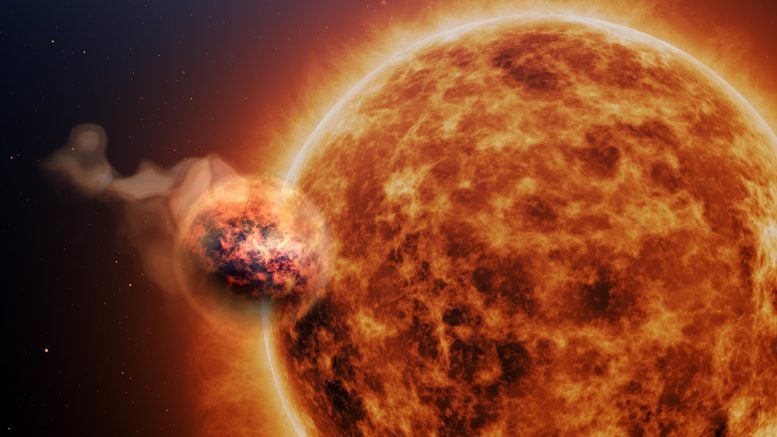
Artist impression of WASP-107b and its parent star. Credit: Illustration: LUCA School of Arts, Belgium/ Klaas Verpoest (visuals), Johan Van Looveren (typography). Science: Achrène Dyrek (CEA and Université Paris Cité, France), Michiel Min (SRON, the Netherlands), Leen Decin (KU Leuven, Belgium) / European MIRI EXO GTO team / ESA / NASA
A team of astronomers used recent observations made with the James Webb Space Telescope to study the atmosphere of the nearby exoplanet WASP-107 b. Peering deep into the fluffy atmosphere of WASP-107b they discovered not only water vapor and sulfur dioxide, but even silicate sand clouds. These particles reside within a dynamic atmosphere that exhibits vigorous transport of material.
Astronomers worldwide are harnessing the advanced capabilities of the Mid-Infrared Instrument (MIRI) aboard the James Webb Space Telescope (JWST) to conduct groundbreaking observations of exoplanets – planets orbiting stars other than our own Sun. One of these fascinating worlds is WASP-107 b, a unique gaseous exoplanet that orbits a star slightly cooler and less massive than our Sun, which was observed by a team of European astronomers, co-led by researchers from the Institute of Astronomy, KU Leuven.
The mass of the planet is similar to that of Neptune but its size is much larger than that of Neptune, almost approaching the size of Jupiter. This characteristic renders WASP-107b rather ‘fluffy’ when compared to the gas giant planets within our solar system. The fluffiness of this exoplanet enables astronomers to look roughly 50 times deeper into its atmosphere compared to the depth of exploration achieved for a solar-system giant like Jupiter.
WASP-107b is a unique gaseous exoplanet that orbits a star slightly cooler and less massive than our Sun.
In-Depth Atmospheric Analysis
The team of European astronomers took full advantage of the remarkable fluffiness of this exoplanet, enabling them to look deep into its atmosphere. This opportunity opened a window into unraveling the complex chemical composition of its atmosphere. The reason behind this is quite straightforward: the signals, or spectral features, are far more prominent in a less dense atmosphere compared to a more compact one. Their recent study, now published in Nature, reveals the presence of water vapor, sulfur dioxide (SO2), and silicate clouds, but notably, there is no trace of the greenhouse gas methane (CH4).
These detections provide crucial insights into the dynamics and chemistry of this captivating exoplanet. First, the absence of methane hints at a potentially warm interior, offering a tantalizing glimpse into the movement of heat energy in the planet’s atmosphere. Secondly, the discovery of sulfur dioxide (known for the odor of burnt matches), was a major surprise. Previous models had predicted its absence, but novel climate models of WASP-107b’s atmosphere now show that the very fluffiness of WASP-107 b accommodates the formation of sulfur dioxide in its atmosphere. Even though its host star emits a relatively small fraction of high-energy photons due to its cooler nature, these photons can reach deep into the planet’s atmosphere thanks to its fluffy nature. This enables the chemical reactions required to produce sulfur dioxide to occur.
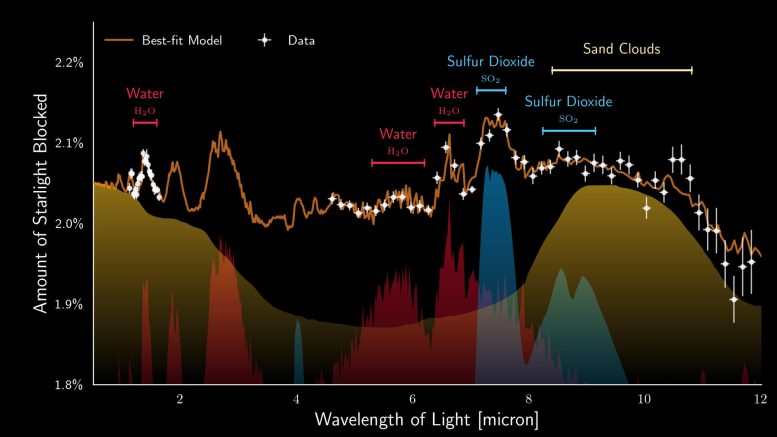
A transmission spectrum of the warm Neptune exoplanet WASP-107b, captured by the Low Resolution Spectrometer (LRS) of the Mid InfraRed Instrument (MIRI) on board JWST, reveals evidence for water vapor, sulfur dioxide, and silicate (sand) clouds in the planet’s atmosphere. Credit: Michiel Min / European MIRI EXO GTO team / ESA / NASA
Cloud Composition and Dynamics
But that’s not all they’ve observed. Both the spectral features of sulfur dioxide and water vapor are significantly diminished compared to what they would be in a cloudless scenario. High-altitude clouds partially obscure the water vapor and sulfur dioxide in the atmosphere. While clouds have been inferred on other exoplanets, this marks the first instance where astronomers can definitively identify the chemical composition of these clouds. In this case, the clouds consist of small silicate particles, a familiar substance for humans found in many parts of the world as the primary constituent of sand.
“JWST is revolutionizing exoplanet characterization, providing unprecedented insights at remarkable speed,” says lead author Prof. Leen Decin of KU Leuven. “The discovery of clouds of sand, water, and sulfur dioxide on this fluffy exoplanet by JWST’s MIRI instrument is a pivotal milestone. It reshapes our understanding of planetary formation and evolution, shedding new light on our own Solar System.”
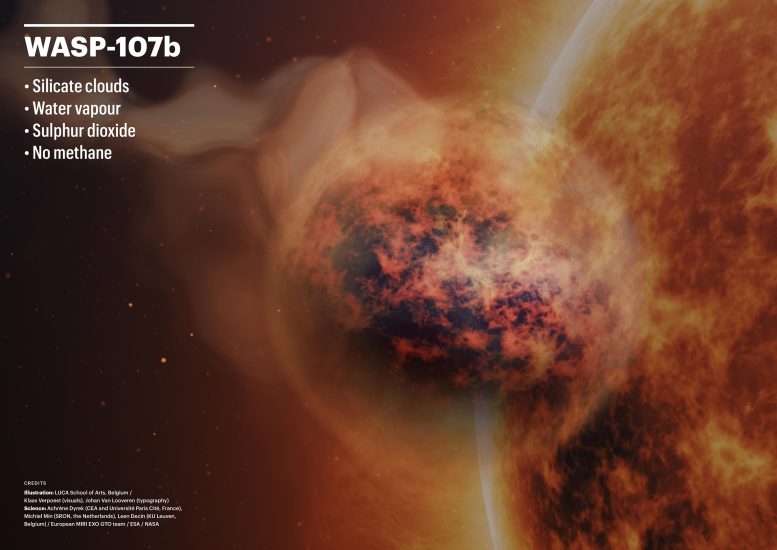
Peering deep into the fluffy atmosphere of WASP-107 b a team of European astronomers discovered not only water vapor and sulfur dioxide, but even silicate sand clouds. Credit: Illustration: LUCA School of Arts, Belgium/ Klaas Verpoest (visuals), Johan Van Looveren (typography). Science: Achrène Dyrek (CEA and Université Paris Cité, France), Michiel Min (SRON, the Netherlands), Leen Decin (KU Leuven, Belgium) / European MIRI EXO GTO team / ESA / NASA
Temperature and Cloud Formation
In contrast to Earth’s atmosphere, where water freezes at low temperatures, in gaseous planets reaching temperatures around 1000 degrees Celsius (~1800 degrees Fahrenheit), silicate particles can freeze out to form clouds. However, in the case of WASP-107 b, with a temperature of around 500 degrees Celsius (~900 degrees Fahrenheit) in the outer atmosphere, traditional models predicted that these silicate clouds should be forming deeper within the atmosphere, where temperatures are substantially higher. In addition, sand clouds high up in the atmosphere rain out. How is it then possible that these sand clouds exist at high altitudes and continue to endure?
According to lead author Dr. Michiel Min: “The fact that we see these sand clouds high up in the atmosphere must mean that the sand rain droplets evaporate in deeper, very hot layers, and the resulting silicate vapor is efficiently moved back up, where they recondense to form silicate clouds once more. This is very similar to the water vapor and cloud cycle on our own Earth but with droplets made of sand.” This continuous cycle of sublimation and condensation through vertical transport is responsible for the enduring presence of sand clouds in WASP-107 b’s atmosphere.
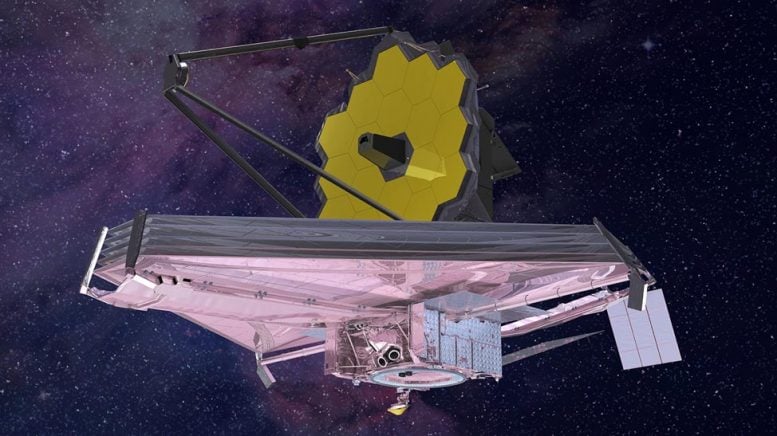
The James Webb Space Telescope was designed to study the atmospheres of exoplanets and could determine if these planets are habitable or contain biosignatures. Credit: Northrop Grumman
Advancements in Exoplanetary Research
This pioneering research not only sheds light on the exotic world of WASP-107b but also pushes the boundaries of our understanding of exoplanetary atmospheres. It marks a significant milestone in exoplanetary exploration, revealing the intricate interplay of chemicals and climatic conditions on these distant worlds.
“JWST enables a deep atmospheric characterization of an exoplanet that does not have any counterpart in our Solar System, we are unraveling new worlds!” says lead author Dr. Achrène Dyrek at CEA Paris.
Design and Development of the MIRI Instrument
Thanks to funding from the Belgian federal science policy office BELSPO via the ESA PRODEX program, Belgian engineers and scientists played a key role in the design and development of the MIRI instrument, including the Centre Spatial de Liege (CSL), Thales Alenia Space (Charleroi) and OIP Sensor Systems (Oudenaarde). At the Institute of Astronomy at KU Leuven, instrument scientists tested the MIRI instrument extensively in special test chambers simulating the space environment in laboratories in the UK, at NASA Goddard and NASA Johnson Space centers.
“With colleagues across Europe and the United States, we have been building and testing the MIRI instrument for almost 20 years. It is rewarding to see our instrument unravel the atmosphere of this intriguing exoplanet,” says instrument specialist Dr. Bart Vandenbussche of KU Leuven.
This study combines the results of several independent analyses of the JWST observations, and represents the years of work invested not only in building the MIRI instrument but also in the calibration and analysis tools for the observational data acquired with MIRI,” says Dr. Jeroen Bouwman of the Max-Planck-Institut für Astronomie, Germany.
Reference: “SO2, silicate clouds, but no CH4 detected in a warm Neptune with JWST MIRI” 15 November 2023, Nature.
DOI: 10.1038/s41586-023-06849-0
Funding: KU Leuven, Marie Sklodowska-Curie Actions
More information
These observations were taken as part of the Guaranteed Time Observation program 1280.The James Webb Space Telescope is the world’s premier space science observatory. Webb is solving mysteries in our solar system, looking beyond to distant worlds around other stars, and probing the mysterious structures and origins of our universe and our place in it. Webb is an international program led by NASA with its partners, ESA (European Space Agency) and the Canadian Space Agency.The European consortium team consists of 46 astronomers from 29 research institutions across 12 countries. From the KU Leuven, the team includes Leen Decin, Thomas Konings, Bart Vandenbussche, Ioannis Argyriou, and Linus Heinke.
>>> Read full article>>>
Copyright for syndicated content belongs to the linked Source : SciTechDaily – https://scitechdaily.com/alien-atmosphere-webb-detects-water-vapor-sulfur-dioxide-and-sand-clouds-in-nearby-exoplanet/



