







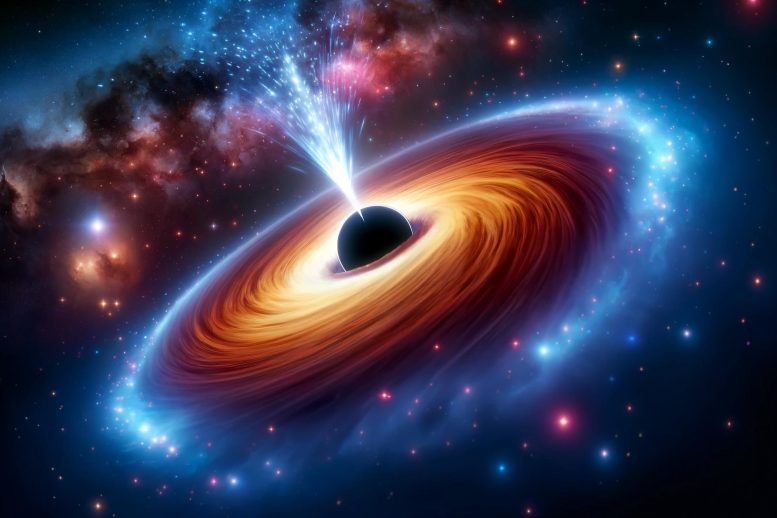
In a distant galaxy, a supermassive black hole’s intermittent gas plumes led to the discovery of a smaller black hole in its orbit, challenging conventional black hole accretion disk theories and suggesting such dynamic systems may be more common. Credit: SciTechDaily.com
Analysis reveals a tiny black hole repeatedly punching through a larger black hole’s disk of gas.
At the heart of a far-off galaxy, a supermassive black hole appears to have had a case of the hiccups.
Astronomers from MIT, Italy, the Czech Republic, and elsewhere have found that a previously quiet black hole, which sits at the center of a galaxy about 800 million light-years away, has suddenly erupted, giving off plumes of gas every 8.5 days before settling back to its normal, quiet state.
The periodic hiccups are a new behavior that has not been observed in black holes until now. The scientists believe the most likely explanation for the outbursts stems from a second, smaller black hole that is zinging around the central, supermassive black hole and slinging material out from the larger black hole’s disk of gas every 8.5 days.
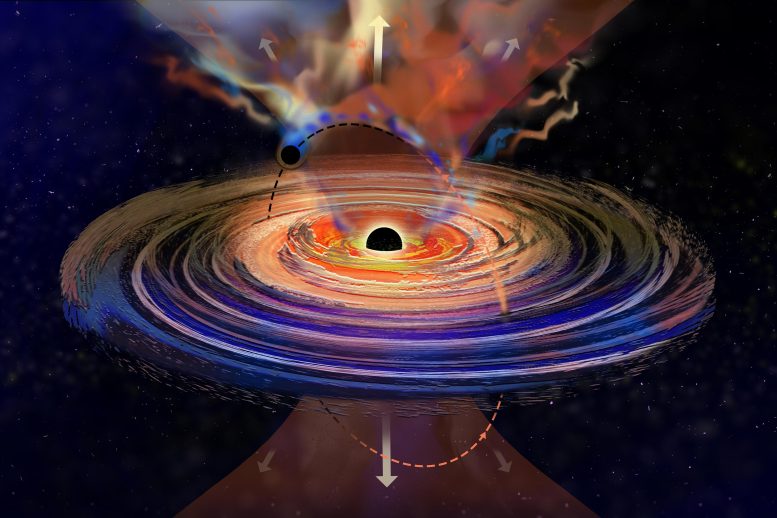
Scientists have found a large black hole that “hiccups,” giving off plumes of gas. Analysis revealed a tiny black hole was repeatedly punching through the larger black hole’s disk of gas, causing the plumes to release. Powerful magnetic fields, to the north and south of the black hole and represented by the orange cone, slingshot the plume up and out of the disk. Each time the smaller black hole punches through the disk, it would eject another plume, in a regular, periodic pattern. Credit: Jose-Luis Olivares, MIT
Challenging Black Hole Theories
The team’s findings, which were published on March 27 in the journal Science Advances, challenge the conventional picture of black hole accretion disks, which scientists had assumed are relatively uniform disks of gas that rotate around a central black hole. The new results suggest that accretion disks may be more varied in their contents, possibly containing other black holes and even entire stars.
“We thought we knew a lot about black holes, but this is telling us there are a lot more things they can do,” says study author Dheeraj “DJ” Pasham, a research scientist in MIT’s Kavli Institute for Astrophysics and Space Research. “We think there will be many more systems like this, and we just need to take more data to find them.”
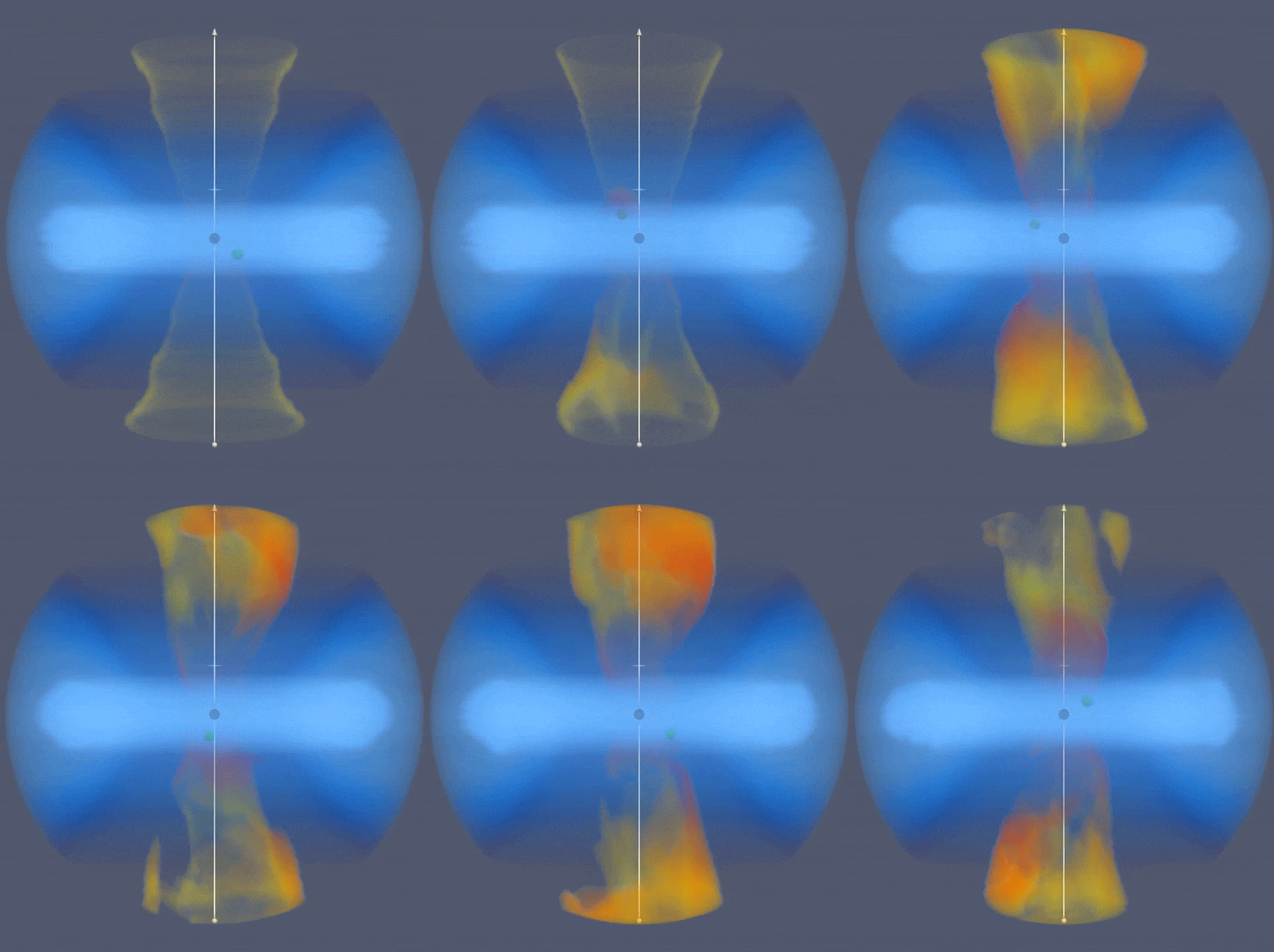
A computer simulation of an intermediate-mass black hole orbiting a supermassive black hole, and driving periodic gas plumes that can explain the observations. Credit: Petra Sukova, Astronomical Institute of the CAS
The study’s MIT co-authors include postdoc Peter Kosec, graduate student Megan Masterson, Associate Professor Erin Kara, Principal Research Scientist Ronald Remillard, and former research scientist Michael Fausnaugh, along with collaborators from multiple institutions, including the Tor Vergata University of Rome, the Astronomical Institute of the Czech Academy of Sciences, and Masaryk University in the Czech Republic.
“Use It or Lose It”
The team’s findings grew out of an automated detection by ASAS-SN (the All Sky Automated Survey for SuperNovae), a network of 20 robotic telescopes situated in various locations across the Northern and Southern Hemispheres. The telescopes automatically survey the entire sky once a day for signs of supernovae and other transient phenomena.
In December of 2020, the survey spotted a burst of light in a galaxy about 800 million light years away. That particular part of the sky had been relatively quiet and dark until the telescopes’ detection, when the galaxy suddenly brightened by a factor of 1,000. Pasham, who happened to see the detection reported in a community alert, chose to focus in on the flare with NASA’s NICER (the Neutron star Interior Composition Explorer), an X-ray telescope aboard the International Space Station that continuously monitors the sky for X-ray bursts that could signal activity from neutron stars, black holes, and other extreme gravitational phenomena. The timing was fortuitous, as it was getting toward the end of the yearlong period during which Pasham had permission to point, or “trigger,” the telescope.
“It was either use it or lose it, and it turned out to be my luckiest break,” he says.
He trained NICER to observe the far-off galaxy as it continued to flare. The outburst lasted about four months before petering out. During that time, NICER took measurements of the galaxy’s X-ray emissions on a daily, high-cadence basis. When Pasham looked closely at the data, he noticed a curious pattern within the four-month flare: subtle dips, in a very narrow band of X-rays, that seemed to reappear every 8.5 days.
It seemed that the galaxy’s burst of energy periodically dipped every 8.5 days. The signal is similar to what astronomers see when an orbiting planet crosses in front of its host star, briefly blocking the star’s light. But no star would be able to block a flare from an entire galaxy.
“I was scratching my head as to what this means because this pattern doesn’t fit anything that we know about these systems,” Pasham recalls.
Punch It
As he was looking for an explanation to the periodic dips, Pasham came across a recent paper by theoretical physicists in the Czech Republic. The theorists had separately worked out that it would be possible, in theory, for a galaxy’s central supermassive black hole to host a second, much smaller black hole. That smaller black hole could orbit at an angle from its larger companion’s accretion disk.
As the theorists proposed, the secondary would periodically punch through the primary black hole’s disk as it orbits. In the process, it would release a plume of gas, like a bee flying through a cloud of pollen. Powerful magnetic fields, to the north and south of the black hole, could then slingshot the plume up and out of the disk. Each time the smaller black hole punches through the disk, it would eject another plume, in a regular, periodic pattern. If that plume happened to point in the direction of an observing telescope, it might observe the plume as a dip in the galaxy’s overall energy, briefly blocking the disk’s light every so often.
“I was super excited by this theory, and I immediately emailed them to say, ‘I think we’re observing exactly what your theory predicted,’” Pasham says.
He and the Czech scientists teamed up to test the idea, with simulations that incorporated NICER’s observations of the original outburst, and the regular, 8.5-day dips. What they found supports the theory: The observed outburst was likely a signal of a second, smaller black hole, orbiting a central supermassive black hole, and periodically puncturing its disk.
Specifically, the team found that the galaxy was relatively quiet prior to the December 2020 detection. The team estimates the galaxy’s central supermassive black hole is as massive as 50 million suns. Prior to the outburst, the black hole may have had a faint, diffuse accretion disk rotating around it, as a second, smaller black hole, measuring 100 to 10,000 solar masses, was orbiting in relative obscurity.
The researchers suspect that, in December 2020, a third object — likely a nearby star — swung too close to the system and was shredded to pieces by the supermassive black hole’s immense gravity — an event that astronomers know as a “tidal disruption event.” The sudden influx of stellar material momentarily brightened the black hole’s accretion disk as the star’s debris swirled into the black hole. Over four months, the black hole feasted on the stellar debris as the second black hole continued orbiting. As it punched through the disk, it ejected a much larger plume than it normally would, which happened to eject straight out toward NICER’s scope.
The team carried out numerous simulations to test the periodic dips. The most likely explanation, they conclude, is a new kind of David-and-Goliath system — a tiny, intermediate-mass black hole, zipping around a supermassive black hole.
“This is a different beast,” Pasham says. “It doesn’t fit anything that we know about these systems. We’re seeing evidence of objects going in and through the disk, at different angles, which challenges the traditional picture of a simple gaseous disk around black holes. We think there is a huge population of these systems out there.”
“This is a brilliant example of how to use the debris from a disrupted star to illuminate the interior of a galactic nucleus which would otherwise remain dark. It is akin to using fluorescent dye to find a leak in a pipe,” says Richard Saxton, an X-ray astronomer from the European Space Astronomy Centre (ESAC) in Madrid, who was not involved in the study. “This result shows that very close super-massive black hole binaries could be common in galactic nuclei, which is a very exciting development for future gravitational wave detectors.”
Reference: “A case for a binary black hole system revealed via quasi-periodic outflows” by Dheeraj R. Pasham, Francesco Tombesi, Petra Suková, Michal Zajaček, Suvendu Rakshit, Eric Coughlin, Peter Kosec, Vladimír Karas, Megan Masterson, Andrew Mummery, Thomas W.-S. Holoien, Muryel Guolo, Jason Hinkle, Bart Ripperda, Vojtěch Witzany, Ben Shappee, Erin Kara, Assaf Horesh, Sjoert van Velzen, Itai Sfaradi, David Kaplan, Noam Burger, Tara Murphy, Ronald Remillard, James F. Steiner, Thomas Wevers, Riccardo Arcodia, Johannes Buchner, Andrea Merloni, Adam Malyali, Andy Fabian, Michael Fausnaugh, Tansu Daylan, Diego Altamirano, Anna Payne and Elizabeth C. Ferraraa, 27 March 2024, Science Advances.
DOI: 10.1126/sciadv.adj8898
This research was supported, in part, by NASA.
>>> Read full article>>>
Copyright for syndicated content belongs to the linked Source : SciTechDaily – https://scitechdaily.com/black-hole-hiccups-astronomers-stunned-by-periodic-outbursts-in-far-off-galaxy/



