














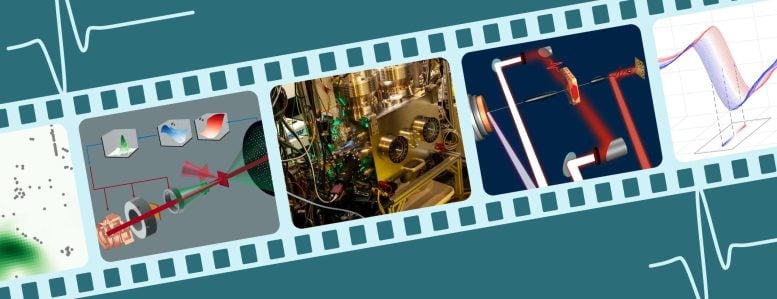
SLAC’s “electron camera” can reveal some of nature’s ultrafast processes. Now, researchers across the lab have collaborated to achieve improvements to that tool to make its molecular movies even sharper, keeping SLAC at the forefront of pioneering tools for ultrafast science. Credit: SLAC
Researchers at SLAC National Accelerator Laboratory have enhanced the capabilities of their Megaelectronvolt Ultrafast Electron Diffraction instrument through two studies.
One study developed a technique to improve the electron camera’s time resolution, while the other utilized artificial intelligence to tune the electron beam for various experimental needs. These advancements in electron beam technology allow for more precise observations of ultrafast chemical reactions and material behaviors, significantly contributing to fields like materials science, chemistry, and quantum information.
High-Speed Electron Camera
Imagine being able to watch the inner workings of a chemical reaction or a material as it changes and reacts to its environment – that’s the sort of thing researchers can do with a high-speed “electron camera” called the Megaelectronvolt Ultrafast Electron Diffraction (MeV-UED) instrument at the Linac Coherent Light Source (LCLS) at the U.S. Department of Energy’s SLAC National Accelerator Laboratory.
Now, in two new studies, researchers from SLAC, Stanford and other institutions have figured out how to capture those tiny, ultrafast details with more accuracy and efficiency. In the first study, recently published in Structural Dynamics, one team invented a technique to improve time resolution for the electron camera. In a second, published in Nature Communications, researchers trained and used artificial intelligence (AI) to tune the MeV-UED electron beam and tailor it to a variety of experimental needs.
“These effects are profound for advancing beam instrumentation and diagnostics for SLAC electron accelerators and will enable a new frontier in exploring novel effects with unprecedented precision,” said Mohamed Othman, an associate scientist at SLAC and co-author on both papers.
Importance of Precise Timing in Ultrafast Science
Chemical reactions happen fast – sometimes key events take place over millionths of a billionth of a second, or femtoseconds. Capturing these femtosecond events is the terrain of a field known as ultrafast science that requires some of the most advanced scientific instruments in the world – instruments like MeV-UED.
MeV-UED takes snapshots by hitting samples with a beam of electrons and recording what happens in the material as the electrons pass through. The result is a molecular movie that allows scientists to peer into the behavior of molecules and atoms at ultrafast speeds and gain insights into processes that are key to energy solutions and innovative new materials and medicines, among other things.
Enhanced Precision With Bunch Compression and Time Stamping
The tricky thing is, the MeV-UED beam is made up of bunches of electrons, or electron pulses – and they can be an unruly bunch. When the electron pulses arrive at the sample of material, there is a bit of spread in the arrival time between the first electron and last electron of the pulse. This time spread, along with variations in the time between pulses, called jitter, makes it hard to pinpoint exactly when things happen in each electron camera image.
The SLAC team previously reported that using terahertz radiation, which lies between microwaves and infrared light on the electromagnetic spectrum, and adding a compressor into the MeV-UED improved the time resolution of the instrument. The compressor uses terahertz radiation to shorten the time spread for an electron pulse through a method called – appropriately – bunch compression.
In their quest to further tame electron bunches, the team combined bunch compression with another method called time stamping: After the pulse interacts with the sample and hits the detector, the timing information is encoded in the electron camera image. Through a simple time sort, users can more precisely determine the timing of each image or in the movie.
Combining bunch compression and time stamping increased the timing precision and reduced jitter. “Researchers could use this technique to observe extremely fast timescales, specifically for atomic motion in materials,” said Othman. “This atomic microscope can be used in fundamental science: materials science, chemistry, green energy, quantum information and more. It’s critical to achieve the femtosecond scales for investigating these science areas.”
With the success of this prototype, their next step is to build an instrument with the combined capabilities. “We are trying to push the limits of what the MeV-UED can do in terms of, for example, timing. Because MeV-UED is part of a DOE user facility, we want to build this instrument that can be an option for users,” said Othman.
Leveraging AI for Beam Optimization
Researchers from all over the world come to SLAC’s MeV-UED to run their experiments, and their needs vary widely. For each experiment, beam operators need to optimize 20-30 parameters, such as the beam spot size, and consider trade-offs among all the parameters. SLAC staff scientist and paper lead author Fuhao Ji likened the tuning process to changing the recipe ingredients when baking bread to suit a customer’s taste – there are a lot of factors to consider, and everyone’s taste is a bit different.
Currently, experienced operators make all those choices themselves with some help from an automated process, but it is not as efficient as it could be. To make it run more smoothly, SLAC researchers on the accelerator and instrumentation sides of the lab teamed up with the lab’s AI experts to implement a special AI model, called multi-objective Bayesian optimization (MOBO), to directly tune, online, the electron beam at MeV-UED. That approach could tune about as well as an experienced operator and at least ten times faster than the automated process. Since users have a fixed amount of beam time, that means less time fiddling and more time running their experiments and gathering data.
Future Prospects and Impact of AI Integration
Before setting the AI model loose, the SLAC team had to train it so that it knew not only what to look for, but also how to evaluate the trade-offs among the beam parameters. The model learned by doing: Researchers ran experiments and gathered data as they usually would, then fed that data into the model, which learned how different parameters interacted to shape the beam.
Like other AI models, MOBO can predict new outcomes from novel parameter settings, something particularly useful when a researcher needs a beam setting that hasn’t been used before. The model also provides a more comprehensive picture of the experimental system.
“This is the result of close collaboration between MeV-UED and the Accelerator Directorate Machine Learning group and paves the way to the ultimate goal of establishing an end-to-end automated intelligent scientific user facility at MeV-UED,” said Ji, where AI algorithms would co-optimize all the components in the entire system, from the electron source to the accelerator, light source, sample settings and detector.
Ji and colleagues are looking to expand the capabilities of the MOBO tool. Their next step is to adopt another AI tool, Bayesian algorithm execution, to speed up the optimization process further and achieve better performance.
“We expect it to have broad impact across research in different disciplines, such as physics, chemistry, biology and quantum materials, at large-scale, complex scientific user facilities,” Ji said.
References:
“Improved temporal resolution in ultrafast electron diffraction measurements through THz compression and time-stamping” by Mohamed A. K. Othman, Annika E. Gabriel, Emma C. Snively, Michael E. Kozina, Xiaozhe Shen, Fuhao Ji, Samantha Lewis; Stephen Weathersby, Praful Vasireddy, Duan Luo, Xijie Wang, Matthias C. Hoffmann and Emilio A. Nanni, 22 April 2024, Structural Dynamics.
DOI: 10.1063/4.0000230
“Multi-objective Bayesian active learning for MeV-ultrafast electron diffraction” by Fuhao Ji, Auralee Edelen, Ryan Roussel, Xiaozhe Shen, Sara Miskovich, Stephen Weathersby, Duan Luo, Mianzhen Mo, Patrick Kramer, Christopher Mayes, Mohamed A. K. Othman, Emilio Nanni, Xijie Wang, Alexander Reid, Michael Minitti and Robert Joel England, 3 June 2024, Nature Communications.
DOI: 10.1038/s41467-024-48923-9
The research was supported by the DOE Office of Science and SLAC’s Laboratory Directed Research and Development Program. LCLS is a DOE Office of Science user facility.
>>> Read full article>>>
Copyright for syndicated content belongs to the linked Source : SciTechDaily – https://scitechdaily.com/breaking-time-barriers-with-slacs-ultrafast-electron-camera/