







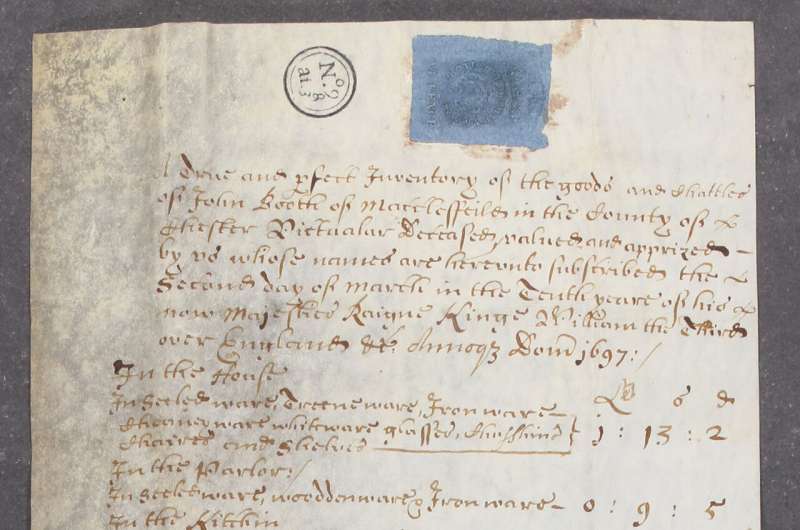
An example of a probate inventory from England in the late 17th century. This is the inventory of John Booth, a victualler (supplier of food and alcohol) from Macclesfield in the county of Cheshire, dated to 1697. Credit: Reproduced with the permission of Cheshire Archives & Local Studies.
Britain was already well on its way to an industrialized economy under the reign of the Stuarts in the 17th century—over 100 years before textbooks mark the start of the Industrial Revolution—according to the most detailed occupational history of a nation ever constructed.
Built from more than 160 million records and spanning over three centuries, the University of Cambridge’s Economies Past website uses census data, parish registers, probate records and more to track changes to the British labor force from the Elizabethan era to the eve of World War One.
The research shows that 17th century Britain saw a steep decline in agricultural peasantry, and a surge in people who manufactured goods: from local artisans like blacksmiths, shoemakers and wheelwrights, to an explosion in networks of home-based weavers producing cloth for wholesale.
Historians say the data suggests that Britain was emerging as the world’s first industrial powerhouse several generations before the mills and steam engines of the late 18th century—long credited as the birth of global industry and economic growth.
“By cataloging and mapping centuries of employment data, we can see that the story we tell ourselves about the history of Britain needs to be rewritten,” said Leigh Shaw-Taylor, project leader and Professor of Economic History at Cambridge’s Faulty of History.
“We have discovered a shift towards employment in the making of goods that suggests Britain was already industrializing over a century before the Industrial Revolution.”
In fact, by the early 1800s, when William Blake was writing of “dark satanic mills,” numbers involved in manufacturing had long been flatlining. Many parts of Britain were even “deindustrializing” say researchers—as manufacturing drained from much of the nation to concentrate around coalfields.
Instead, the 19th century saw an almost doubling of the service sector—a boom often thought to have begun closer to the 1950s. These included sales clerks, domestic staff, professionals such as lawyers and teachers, as well as a huge increase in transport workers on the canals and railways.
By 1911, some 13% of all working men were in transport. In fact, the research suggests that Britain’s service sector has been growing almost continuously for three hundred years.
The www.economiespast.org website has compiled and summarized employment statistics at local levels across England and Wales, allowing users to zoom in and trace changes to the workforce across the centuries.
The site also breaks down by sector and, after 1851, by gender as well as age—revealing the extent of child labor. Historians hope the site will prove a valuable classroom resource, so students can explore the history of labor in their area.
The work is launched at the Economic History Society’s annual conference on 6 April.
“The question of why the industrial age dawned in Britain is a much-debated one, with coal, technology and empire all major factors,” said Prof Shaw-Taylor.
“Our database shows that a groundswell of enterprise and productivity transformed the economy in the 17th century, laying the foundations for the world’s first industrial economy. Britain was already a nation of makers by the year 1700.”
“A hundred years has been spent studying the Industrial Revolution based on a misconception of what it entailed,” he said.
‘Factories without machines’
As much of Europe continued to languish in subsistence farming, the number of male agricultural workers in Britain fell by over a third (64% to 42%) from 1600–1740.
At the same time, from 1600–1700, the share of the male labor force involved in goods production rose by 50% to just under half of working men (28% to 42%).
According to Shaw-Taylor’s estimates, the share of the British labor force in an occupation involving manufacturing rather than agriculture was three times that of France by 1700.
“We can’t say for certain why this change occurred in Britain rather than elsewhere,” he said. “However, the English economy of the time was more liberal, with fewer tariffs and restrictions, unlike on the continent.”
Moving goods within many European countries was subject to tolls from land barons, so markets were often very local. In England there are few records of such levies after the medieval era.
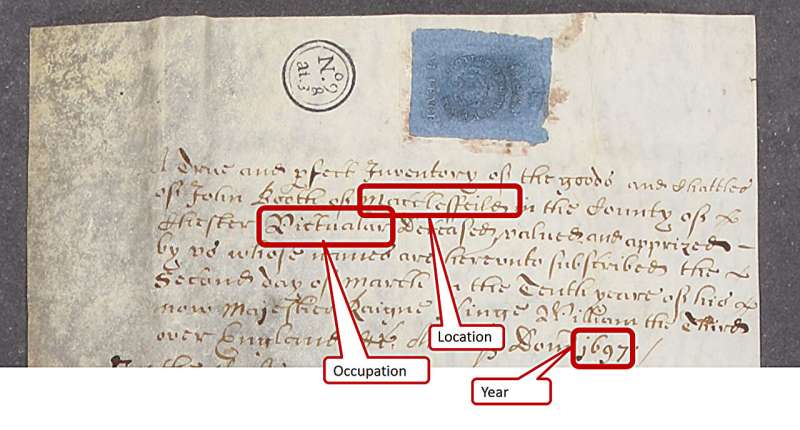
The research team extracted the name of the parish, job occupation and the year for over two million will and probate records across Britain, forming part of the dataset, as highlighted in this image. Credit: Reproduced with the permission of Cheshire Archives & Local Studies.
Shaw-Taylor argues that trade guilds also had more power in other nations. For example, textile production was prohibited in the countryside around the Dutch city of Leiden, and in Sweden no shops were permitted in rural areas within a ten-mile radius of a town until the 19th century.
Yet in the England of 1700, half of all manufacturing employment was in the countryside. “In addition to village artisans, there were networks of weavers in rural areas who would work for merchants that supplied wool and sold the finished articles,” said Shaw-Taylor.
Industries of textiles, or metalworkers making nails and scythes, were shaped like “factories without machines spread out over hundreds of households” according to Shaw-Taylor—and increasingly produced goods for international markets.
In Gloucestershire, for example, expansions in textiles, footwear and metals saw the share of the male workforce in industry grew from a third (33%) to almost half (48%) over the 17th century.
While in Lancashire, the share of men in manufacturing work grew from 42% in 1660 to 61% in 1750, driven by a doubling of textile workers (from 15% to 30%). This all occurred prior to the Industrial Revolution.
Some networks evolved into workshops, and eventually the mills of Blake’s visions as industries migrated to the North of England, where coal was abundant and crops were harder to grow.
This meant that by the mid-18th century—considered the start of the Industrial Revolution—much of England’s South and East had actually lost its long-established industries, and even returned to farm labor, according to the research.
For example, Norfolk was probably the 17th century’s most industrialized county, with 63% of adult men in industry by 1700. But this actually dropped to 39% during the 18th century, while the share of the male workforce in agriculture jumped from less than a third (28%) to over half (51%).
As such, and counter to prevailing historical narratives, shares of the population in manufacturing-type jobs across England and Wales changed very little over the period thought of as the height of the industrial age, but rather it was the nature and location of work that shifted.
Women and children in the workforce
With textile manufacturing moving out of homes and out of the Southeast, far fewer women engaged in the labor market. Adding pre-19th century data for female workers is a major next step for the project, but researchers have devised ways of estimating earlier workforce gender splits.
“We think labor force participation for adult women was somewhere between 60–80% in 1760, and back down to 43% by 1851,” said Shaw-Taylor. “It didn’t return to those mid-18th century levels until the 1980s.”
By 1851, Easington on the Durham coalfield had just 17% of adult women in employment. However, in one of the South’s remaining industrial hubs, Luton’s hat-making district, it was as high as 78%.
The website also allows users to track rates of child labor after 1851. The booming textile mills of Bradford saw huge numbers of young girls put to work, with over 70% of girls aged 13–14 working in 1851. Sixty years later this figure was still over 60%.
Over 40% of girls in Bradford aged 11–12 were also working in 1851, but this had fallen to nearer 10% by 1911, by which time legislation had created a system of compulsory education for young children.
The ‘Economies Past’ website is the result of a research project at Cambridge that’s been running for over 20 years, the Occupational Structure of Britain 1379–1911, which has gathered data from late medieval poll tax records to early modern coroner reports.
The main source of data from 1600–1800 comes from over two million wills and probate inventories: lists of the movable goods of the deceased. The team behind the work aims to keep expanding the datasets.
Alongside vast quantities of digitized census data, researchers also visited 80 records offices to gather data from a further 2.5 million baptism records from the 19th century (when it became compulsory to list the father’s occupation).
More information:
Economies Past: an online resource on the occupational structure of Britain 1379-1911, www.economiespast.org/
Citation:
Britain began industrializing in the 17th century—more than 100 years earlier than history books claim (2024, April 4)
retrieved 4 April 2024
from https://phys.org/news/2024-04-britain-began-industrializing-17th-century.html
This document is subject to copyright. Apart from any fair dealing for the purpose of private study or research, no
part may be reproduced without the written permission. The content is provided for information purposes only.
>>> Read full article>>>
Copyright for syndicated content belongs to the linked Source : Phys.org – https://phys.org/news/2024-04-britain-began-industrializing-17th-century.html



