







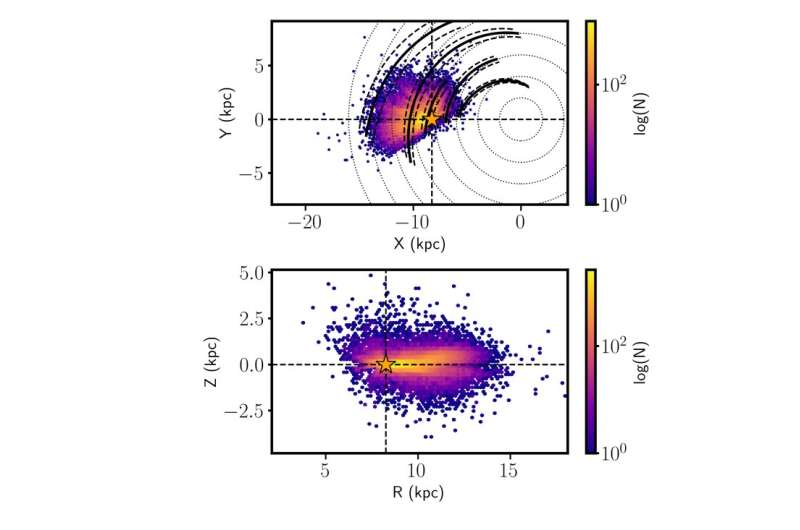
Top: Two dimensional density diagram of the X-Y spatial positions of the hot OBAF star sample in LAMOST. For reference, the solar position is denoted as an orange star. The approximate location of the spiral arms in the Galaxy from Reid et al. (2014) are shown as thick black lines and their extend is marked by thick dashed lines. The color coding represents the number density of stars in log(N). Bottom: Two dimensional density diagram of the R-Z spatial positions of our full sample. The color coding represents the number density of stars in log(N). Credit: arXiv (2022). DOI: 10.48550/arxiv.2207.04542
Keith Hawkins, assistant professor of astronomy at The University of Texas at Austin, has used chemical cartography—also known as chemical mapping—to identify regions of the Milky Way’s spiral arms that have previously gone undetected. His research, published in the Monthly Notices of the Royal Astronomical Society, demonstrates the value of this pioneering technique in understanding the shape, structure, and evolution of our home Galaxy.
Chemical maps of the Galaxy show how the elements of the periodic table are distributed throughout the Milky Way. They enable astronomers to identify the location of celestial objects based on their chemical composition rather than the light they emit. Though the idea of chemical cartography has been around for a while, astronomers have only recently been able to gain significant results from the technique. That’s thanks to increasingly powerful telescopes coming online.
“Much like the early explorers, who created better and better maps of our world, we are now creating better and better maps of the Milky Way,” says Hawkins. “Those maps are revealing things we thought to be true, but still need to check.”
We’ve known since the 1950s that the Milky Way is a spiral galaxy. However, its precise form, structure, and even the number of its arms has been a matter of ongoing investigation. That’s because we live inside of our home Galaxy and are unable to travel far enough to see it from an outsider’s perspective. “It’s like being in a big city,” explains Hawkins. “You can look around at the buildings and you can see what street you’re on, but it’s hard to know what the whole city looks like unless you’re in a plane flying above it.”
Our limited view of the Milky Way hasn’t prevented astronomers from creating well-informed models of it; or artists from drawing beautiful illustrations of it. “But,” says Hawkins, “I wanted to find out how accurate those models and illustrations actually are. And to see if chemical cartography could reveal a clearer view of the Milky Way’s spiral arms.”
Mapping the Milky Way
One traditional way to map the Milky Way is by identifying concentrations of young stars. As the Milky Way rotates, dust and gas in its spiral arms compress, prompting the birth of new stars. So, where there is an abundance of young stars, it’s predicted that there is also an arm.
Astronomers can locate young stars by detecting the light they emit. But sometimes clouds of dust can obscure stars, making it difficult for even the best telescopes to observe their light. As a result, some regions of the Milky Way’s arms have yet to be discovered.
Chemical cartography helps astronomers fill in the missing pieces.
It does so by relying on an astronomical concept called “metallicity.” Metallicity refers to the ratio of metals to hydrogen present on a star’s surface. In astronomy, any element on the periodic table that isn’t hydrogen or helium is called a “metal.” Young stars possess more metals than older stars, and therefore have a higher metallicity. This is because they formed later in the history of our universe, when more metals existed.
After the Big Bang, the only elements in existence were hydrogen, helium, and scant traces of a few metals. In their cores, the first generation of stars fused hydrogen and helium into more and more complex metals (that is, heavier and heavier elements on the periodic table), until they finally died or exploded. But out of chaos comes life. These explosions ejected metals into their surroundings, where they were used as building blocks for the next generation of stars.
As the cycle of stellar birth and destruction repeats, each subsequent generation of stars is enriched with more complex metals than the one before it, giving it a higher and higher metallicity. In theory, the Milky Way’s spiral arms, which contain an abundance of young stars, should have a higher metallicity than the regions between them.
Comparing maps
To create his map, Hawkins identified the distribution of metallicity in the Milky Way. He focused on the area around our sun for which this data exists—a view of up to 32,600 light years. Areas with an abundance of metal-rich objects were expected to line up with spiral arms and those with a scarcity of metal-rich objects to line up with the spaces in between the arms.
When he compared his own map to others of the same area of the Milky Way, the spiral arms lined up with one another. What’s more, because Hawkins’ map identifies the spiral arms based on metallicity rather than the light emitted by young stars, new regions showed up that had previously gone uncharted.
“A big takeaway,” says Hawkins, “is that the spiral arms are indeed richer in metals. This illustrates the value of chemical cartography in identifying the Milky Way’s structure and formation. It has the potential to fully transform our view of the Galaxy.”
Gaia space telescope revolutionizes study of our galaxy
As our telescopes become more powerful, so too does the promise of chemical cartography.
For his research, Hawkins analyzed data from the Large Sky Area Multi-Object Fibre Spectroscopic Telescope (LAMOST) and Gaia space telescope. New data from Gaia (Data Release 3) was particularly insightful. That’s because Gaia offers the most precise and comprehensive survey of the Milky Way to date, including of its chemical composition.
Since it launched in 2013, Gaia has monitored around two billion objects. Astronomers are now able to expand their research from thousands of objects to billions, and for a much larger area of the Galaxy.
“The sheer volume of data available from Gaia allows us to do chemical cartography at a galactic scale now,” says Hawkins. “Data on both the positions for billions of stars and their chemical makeup wasn’t available until recently.”
So far, Gaia has provided chemical data for the largest area of the Milky Way to date. However, this still only accounts for about one percent of the Galaxy. As Gaia continues to survey the heavens, and as new telescopes come online, astronomers can increasingly use chemical cartography to understand fundamental properties of our home Galaxy. These lessons can, in turn, be applied to other galaxies and the universe as a whole. As Hawkins explains, “It’s a completely new era.”
More information:
Keith Hawkins, Chemical Cartography with LAMOST and Gaia Reveal Azimuthal and Spiral Structure in the Galactic Disk, Monthly Notices of the Royal Astronomical Society (2023). DOI: 10.1093/mnras/stad1244. on arXiv: DOI: 10.48550/arxiv.2207.04542
Citation:
Chemical cartography reveals the Milky Way’s spiral arms (2023, July 19)
retrieved 20 July 2023
from https://phys.org/news/2023-07-chemical-cartography-reveals-milky-spiral.html
This document is subject to copyright. Apart from any fair dealing for the purpose of private study or research, no
part may be reproduced without the written permission. The content is provided for information purposes only.
>>> Read full article>>>
Copyright for syndicated content belongs to the linked Source : Phys.org – https://phys.org/news/2023-07-chemical-cartography-reveals-milky-spiral.html



