





* . *
  • About
  • Advertise
  • Privacy & Policy
  • Contact
Tuesday, January 27, 2026
Earth-News
  • Home
  • Business
  • Entertainment

    GlowFest Lights Up Las Vegas with a Magical and Unforgettable Experience

    USF’s Spring Play and New Bouldering Wall Take Center Stage in Entertainment Issue Spring 2026

    Top Things to Do in Pensacola: Pawdi Gras, Great Pages Circus, and Dinosaur World

    Is Flutter Entertainment the Next Big Opportunity? Exploring the 39% Valuation Gap After Recent Share Price Drop

    Unlocking the Future of Entertainment: How Türkiye Can Harness the Economic and Social Power of Livestreaming

    Live Nation Entertainment Stock Surges Ahead, Outperforming Competitors on a Strong Trading Day

  • General
  • Health
  • News

    Cracking the Code: Why China’s Economic Challenges Aren’t Shaking Markets, Unlike America’s” – Bloomberg

    Trump’s Narrow Window to Spread the Truth About Harris

    Trump’s Narrow Window to Spread the Truth About Harris

    Israel-Gaza war live updates: Hamas leader Ismail Haniyeh assassinated in Iran, group says

    Israel-Gaza war live updates: Hamas leader Ismail Haniyeh assassinated in Iran, group says

    PAP Boss to Niger Delta Youths, Stay Away from the Protest

    PAP Boss to Niger Delta Youths, Stay Away from the Protest

    Court Restricts Protests In Lagos To Freedom, Peace Park

    Court Restricts Protests In Lagos To Freedom, Peace Park

    Fans React to Jazz Jennings’ Inspiring Weight Loss Journey

    Fans React to Jazz Jennings’ Inspiring Weight Loss Journey

    Trending Tags

    • Trump Inauguration
    • United Stated
    • White House
    • Market Stories
    • Election Results
  • Science
  • Sports
  • Technology

    Columbus School Launches Innovative Music Technology Program

    DXC Technology and Ripple Join Forces to Transform Digital Asset Custody and Banking Payments

    Israel Bets Big on Quantum Technology in the Heat of the Global Computing Race

    The Most Underrated Chip Stock You Need to Watch and Own in 2026

    Wall Street Week | Chrystia Freeland, Wine Tariffs, Ecuador’s Cocoa Boom, Israel Defense Technology – Bloomberg

    How Restaurant Technology Is Transforming the Way Businesses Adapt to Hybrid Work Demand Fluctuations

    Trending Tags

    • Nintendo Switch
    • CES 2017
    • Playstation 4 Pro
    • Mark Zuckerberg
No Result
View All Result
  • Home
  • Business
  • Entertainment

    GlowFest Lights Up Las Vegas with a Magical and Unforgettable Experience

    USF’s Spring Play and New Bouldering Wall Take Center Stage in Entertainment Issue Spring 2026

    Top Things to Do in Pensacola: Pawdi Gras, Great Pages Circus, and Dinosaur World

    Is Flutter Entertainment the Next Big Opportunity? Exploring the 39% Valuation Gap After Recent Share Price Drop

    Unlocking the Future of Entertainment: How Türkiye Can Harness the Economic and Social Power of Livestreaming

    Live Nation Entertainment Stock Surges Ahead, Outperforming Competitors on a Strong Trading Day

  • General
  • Health
  • News

    Cracking the Code: Why China’s Economic Challenges Aren’t Shaking Markets, Unlike America’s” – Bloomberg

    Trump’s Narrow Window to Spread the Truth About Harris

    Trump’s Narrow Window to Spread the Truth About Harris

    Israel-Gaza war live updates: Hamas leader Ismail Haniyeh assassinated in Iran, group says

    Israel-Gaza war live updates: Hamas leader Ismail Haniyeh assassinated in Iran, group says

    PAP Boss to Niger Delta Youths, Stay Away from the Protest

    PAP Boss to Niger Delta Youths, Stay Away from the Protest

    Court Restricts Protests In Lagos To Freedom, Peace Park

    Court Restricts Protests In Lagos To Freedom, Peace Park

    Fans React to Jazz Jennings’ Inspiring Weight Loss Journey

    Fans React to Jazz Jennings’ Inspiring Weight Loss Journey

    Trending Tags

    • Trump Inauguration
    • United Stated
    • White House
    • Market Stories
    • Election Results
  • Science
  • Sports
  • Technology

    Columbus School Launches Innovative Music Technology Program

    DXC Technology and Ripple Join Forces to Transform Digital Asset Custody and Banking Payments

    Israel Bets Big on Quantum Technology in the Heat of the Global Computing Race

    The Most Underrated Chip Stock You Need to Watch and Own in 2026

    Wall Street Week | Chrystia Freeland, Wine Tariffs, Ecuador’s Cocoa Boom, Israel Defense Technology – Bloomberg

    How Restaurant Technology Is Transforming the Way Businesses Adapt to Hybrid Work Demand Fluctuations

    Trending Tags

    • Nintendo Switch
    • CES 2017
    • Playstation 4 Pro
    • Mark Zuckerberg
No Result
View All Result
Earth-News
No Result
View All Result
Home Science

Einstein’s Enigma: How a Mysterious Cosmic Object in Milky Way Could Test Relativity Like Never Before

January 22, 2024
in Science
Einstein’s Enigma: How a Mysterious Cosmic Object in Milky Way Could Test Relativity Like Never Before
Share on FacebookShare on Twitter

Mysterious Object in Milky Way

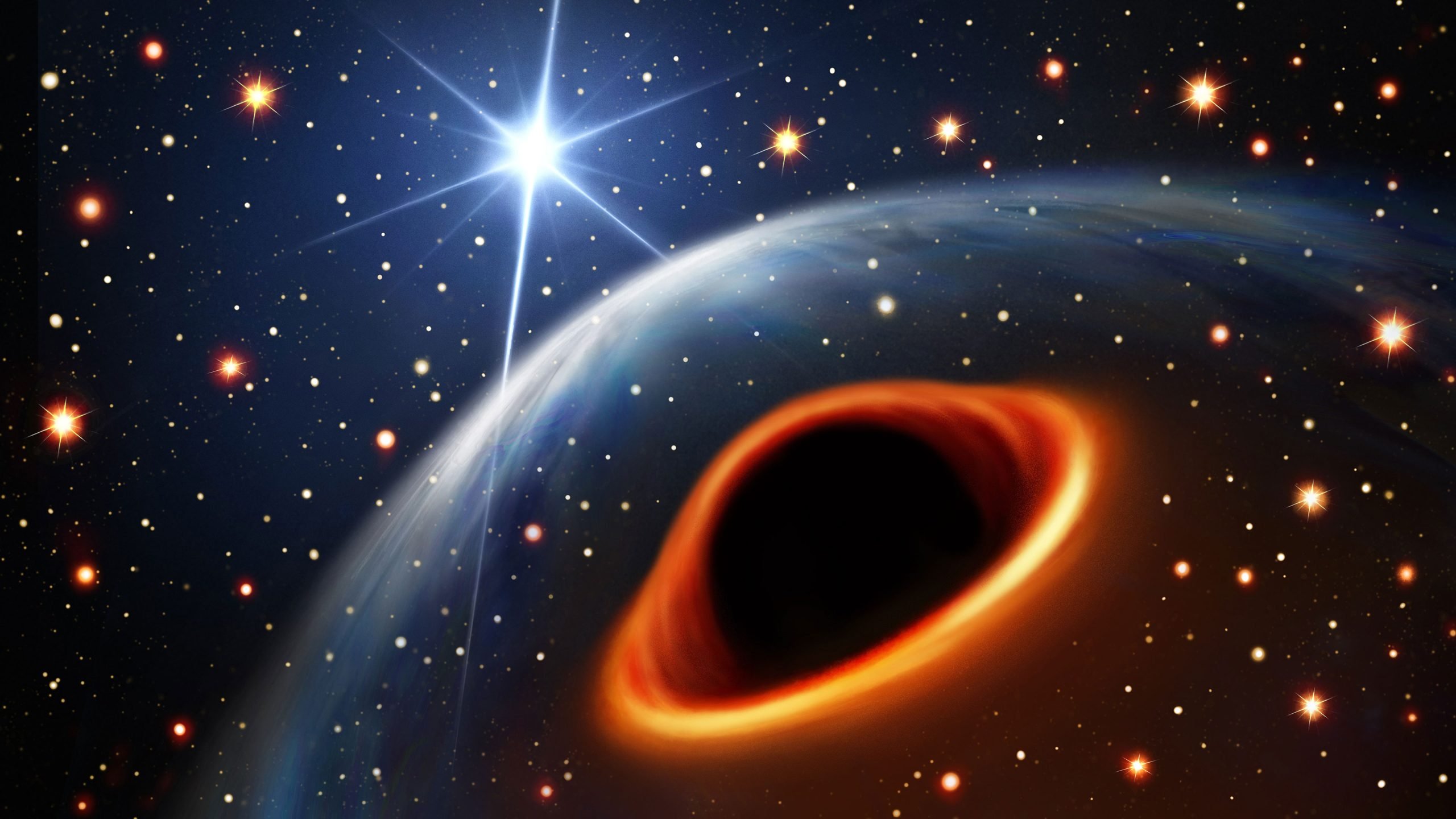
An artist’s impression of the system assuming that the massive companion star is a black hole. The brightest background star is its orbital companion, the radio pulsar PSR J0514-4002E. The two stars are separated by 8 million km and circle each other every 7 days. Credit: Daniëlle Futselaar (artsource.nl)

Using the MeerKAT Telescope, astronomers found a mysterious object in the Milky Way’s black hole mass gap, challenging existing astronomical classifications and offering a unique opportunity to study the universe’s most extreme conditions.

An international team of astronomers has found a new and unknown object in the Milky Way that is heavier than the heaviest neutron stars known and yet simultaneously lighter than the lightest black holes known.

Using the MeerKAT Radio Telescope, astronomers from a number of institutions including The University of Manchester and the Max Planck Institute for Radio Astronomy in Germany found an object in orbit around a rapidly spinning millisecond pulsar located around 40,000 light-years away in a dense group of stars known as a globular cluster.

A Gap in the Mass Spectrum

Using the clock-like ticks from the millisecond pulsar they showed that the massive object lies in the so-called black hole mass gap.

It could be the first discovery of the much-coveted radio pulsar – black hole binary; a stellar pairing that could allow new tests of Einstein’s general relativity and open doors to the study of black holes.

The results were published on January 18 in the journal Science.
MeerKAT Radio Telescope

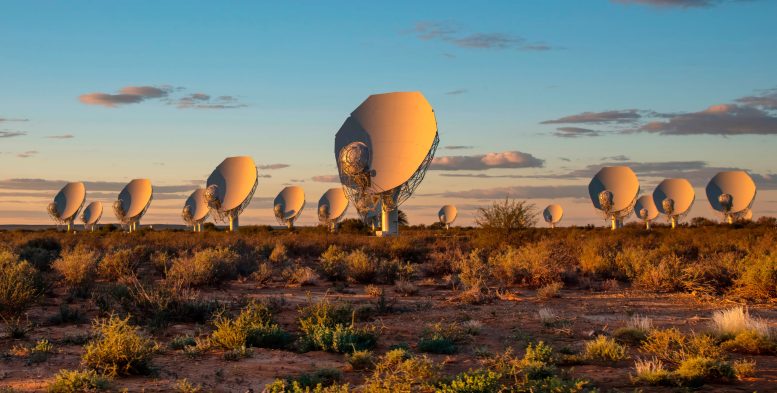
The team used the sensitive MeerKAT radio telescope, located in the Karoo semi-desert in South Africa. Credit: SARAO

Implications for Physics and Astronomy

UK project lead Ben Stappers, Professor of Astrophysics at The University of Manchester, said: “Either possibility for the nature of the companion is exciting. A pulsar–black hole system will be an important target for testing theories of gravity and a heavy neutron star will provide new insights in nuclear physics at very high densities.”

When a neutron star — the ultra-dense remains of dead star – acquire too much mass, usually by consuming or colliding with another star, they will collapse. What they become after they collapse is the cause of much speculation, but it is believed that they could become black holes – objects so gravitationally attractive that even light cannot escape them.

Astronomers believe that the total mass required for a neutron star to collapse is 2.2 times the mass of the sun. Theory, backed by observation, tells us that the lightest black holes created by these stars are much larger, at about five times more massive than the Sun, giving rise to what is known as the ‘black hole mass gap’.

The nature of compact objects in this mass gap is unknown and detailed study has so far proved challenging. The discovery of the object may help finally understand these objects.

Prof Stappers, added: “The ability of the extremely sensitive MeerKAT telescope to reveal and study these objects is enabling a great step forward and provides us with a glimpse of what will be possible with the Square Kilometer Array.”

A zoom into the globular cluster NGC 1851 followed by an orbital simulation showing the original pulsar – white dwarf binary being disrupted by the arrival of a massive third body of unknown nature. The new arrival kicks the white dwarf out of orbit and captures the pulsar for itself, forming a new binary system with a pulsar in orbit around, most likely, either a light black hole or a supermassive neutron star. Credit: OzGrav, Swinburne University of Technology

The Discovery Process

The discovery of the object was made while observing a large cluster of stars known as NGC 1851 located in the southern constellation of Columba, using the MeerKAT telescope.

The globular cluster NGC 1851 is a dense collection of old stars that are much more tightly packed than the stars in the rest of the Galaxy. Here, it is so crowded that the stars can interact with each other, disrupting orbits and in the most extreme cases colliding.

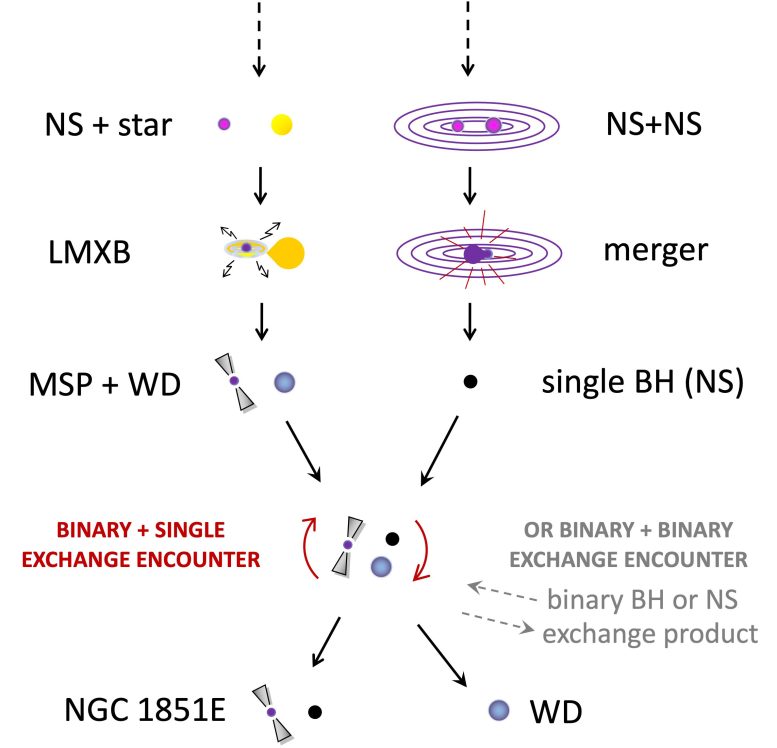
The astronomers, part of the international Transients and Pulsars with MeerKAT (TRAPUM) collaboration, believe that it is one such collision between two neutron stars that is proposed to have created the massive object that now orbits the radio pulsar.

The team was able to detect faint pulses from one of the stars, identifying it as a radio pulsar — a type of neutron star that spins rapidly and shines beams of radio light into the Universe like a cosmic lighthouse.

The pulsar spins more than 170 times a second, with every rotation producing a rhythmic pulse, like the ticking of a clock. The ticking of these pulses is incredibly regular and by observing how the times of the ticks change, using a technique called pulsar timing, they were able to make extremely precise measurements of its orbital motion.
Radio Pulsar NGC 1851E and Exotic Companion Star Formation History

Potential formation history of the radio pulsar NGC 1851E and its exotic companion star. Credit: Thomas Tauris (Aalborg University / MPIfR)

Unveiling Extreme Conditions

Ewan Barr from Max Planck Institute for Radio Astronomy, who led the study with his colleague Arunima Dutta, explained: “Think of it like being able to drop an almost perfect stopwatch into orbit around a star almost 40,000 light years away and then being able to time those orbits with microsecond precision.”

The regular timing also allowed a very precise measurement of the system’s location, showing that the object in orbit with the pulsar was no regular star but an extremely dense remnant of a collapsed star. Observations also showed that the companion has a mass that was simultaneously bigger than that of any known neutron star and yet smaller than that of any known black hole, placing it squarely in the black-hole mass gap.

While the team cannot conclusively say whether they have discovered the most massive neutron star known, the lightest black hole known, or even some new exotic star variant, what is certain is that they have uncovered a unique laboratory for probing the properties of matter under the most extreme conditions in the Universe.

Arunima Dutta concludes: “We’re not done with this system yet.

“Uncovering the true nature of the companion will be a turning point in our understanding of neutron stars, black holes, and whatever else might be lurking in the black hole mass gap.”

Reference: “A pulsar in a binary with a compact object in the mass gap between neutron stars and black holes” by Ewan D. Barr, Arunima Dutta, Paulo C. C. Freire, Mario Cadelano, Tasha Gautam, Michael Kramer, Cristina Pallanca, Scott M. Ransom, Alessandro Ridolfi, Benjamin W. Stappers, Thomas M. Tauris, Vivek Venkatraman Krishnan, Norbert Wex, Matthew Bailes, Jan Behrend, Sarah Buchner, Marta Burgay, Weiwei Chen, David J. Champion, C.-H. Rosie Chen, Alessandro Corongiu, Marisa Geyer, Y. P. Men, Prajwal Voraganti Padmanabh and Andrea Possenti, 18 January 2024, Science.
DOI: 10.1126/science.adg3005

>>> Read full article>>>
Copyright for syndicated content belongs to the linked Source : SciTechDaily – https://scitechdaily.com/einsteins-enigma-how-a-mysterious-cosmic-object-in-milky-way-could-test-relativity-like-never-before/


Tags: Einstein’sEnigmascience
Previous Post

Exposing Dark Matter: Euclid Is on the Trail of the Dark Side of the Universe

Next Post

World’s largest known deep-sea coral reef is bigger than Vermont

The American Dream Is Fading: Why More People Are Losing Faith in the Middle-Class Promise

January 27, 2026

Columbus School Launches Innovative Music Technology Program

January 27, 2026

Fantasy Football Stock Watch: These 5 players are on the rise after the NFL Playoffs – Yahoo Sports

January 27, 2026

Mangrove Conservation Around the World – World Wildlife Fund

January 26, 2026

From Industry to Innovation: The Remarkable Transformation of Warrington’s Northern Economy

January 26, 2026

GlowFest Lights Up Las Vegas with a Magical and Unforgettable Experience

January 26, 2026

University Health Boosts Medical Center Reach with $50M Purchase of Two Towers

January 26, 2026

When Art Defies: The Bold Power of Creativity in Authoritarian Regimes

January 26, 2026

Visual Art: KENGO KUMA: MAKERU Architecture — The Ecology of Rhythm and Particle at New Museum Singapore – Bakchormeeboy

January 26, 2026

Archaeologists Discovered the Oldest Rock Art in the World – Popular Mechanics

January 26, 2026

Categories

Archives

January 2026
M T W T F S S
 1234
567891011
12131415161718
19202122232425
262728293031  
« Dec    
Earth-News.info

The Earth News is an independent English-language daily published Website from all around the World News

Browse by Category

  • Business (20,132)
  • Ecology (1,041)
  • Economy (1,058)
  • Entertainment (21,937)
  • General (19,553)
  • Health (10,100)
  • Lifestyle (1,074)
  • News (22,149)
  • People (1,067)
  • Politics (1,075)
  • Science (16,275)
  • Sports (21,561)
  • Technology (16,044)
  • World (1,050)

Recent News

The American Dream Is Fading: Why More People Are Losing Faith in the Middle-Class Promise

January 27, 2026

Columbus School Launches Innovative Music Technology Program

January 27, 2026
  • About
  • Advertise
  • Privacy & Policy
  • Contact

© 2023 earth-news.info

No Result
View All Result

© 2023 earth-news.info

No Result
View All Result

© 2023 earth-news.info

Go to mobile version
