







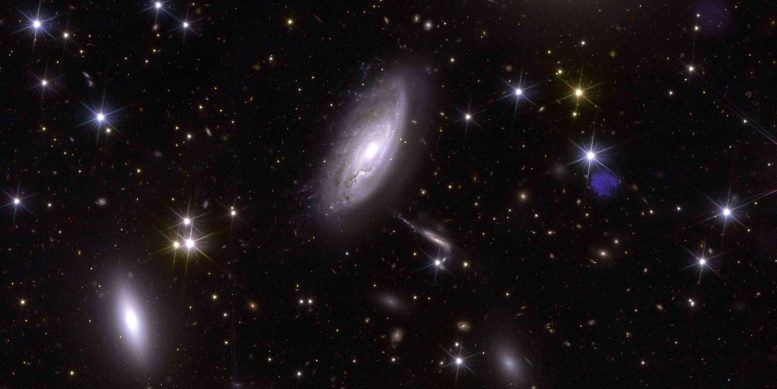
Euclid’s strength lies in its diversity: this small section of Euclid’s large image plane shows a detail of the Perseus galaxy cluster. Clearly recognizable are both the various types and shapes of galaxies as part of the cluster in the foreground at a distance of 240 million light years and a series of faint, diffuse spots in the background – galaxies whose light has been travelling for billions of years before Euclid imaged it. Credit: ESA/Euclid/Euclid Consortium/NASA, Image Processing by J.-C. Cuillandre, G. Anselmi; CC BY-SA 3.0 IGO
Euclid space telescope delivers first scientific images.
Two things are needed to understand how the universe came into being and how it has evolved to its present form. Cosmological computer models employ the laws of physics to depict the universe’s expected appearance today, while observations made with telescopes check whether these models are correct.
The Euclid Space Telescope, for the first time, will have the capability to measure the positions of billions of galaxies in three dimensions, spanning almost the entire observable universe from Earth. The first scientific images have now been published.
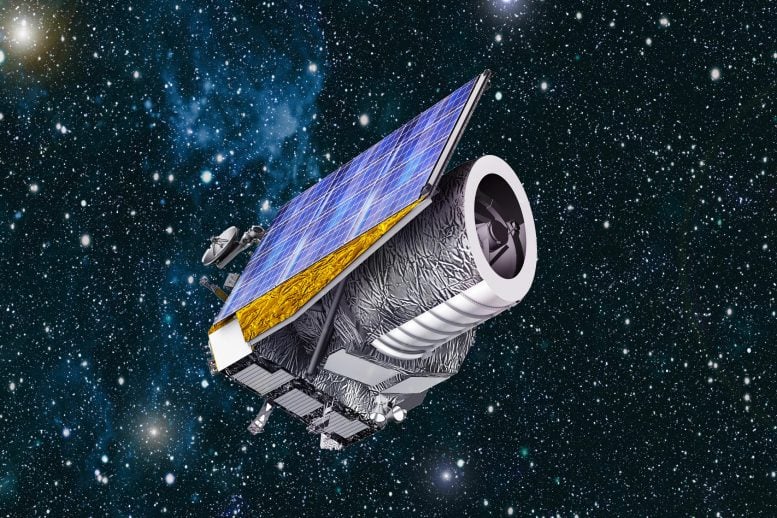
This artist’s impression depicts ESA’s Euclid spacecraft. Euclid is a pioneering mission to observe billions of faint galaxies and investigate the origin of the Universe’s accelerating expansion, as well as the mysterious nature of dark energy, dark matter and gravity. Credit: ESA
Introduction to Euclid Space Telescope
Euclid, the European Space Agency’s (ESA) latest space telescope, has published its first color images from space. These images result from the combination of data from its two instruments: VIS (Visible Instrument) and NISP (Near-Infrared Spectrograph and Photometer), designed to capture visible and near-infrared light using large-area detectors.
Euclid’s most important task is to conduct the most detailed three-dimensional mapping of the universe, thereby unlocking some of its dark secrets. The German members of the Euclid consortium, including the Max Planck Institutes for Astronomy and Extraterrestrial Physics, have developed key technical components of the telescope. They also provide logistical services for managing the immense data streams and ensure the quality of the published data.
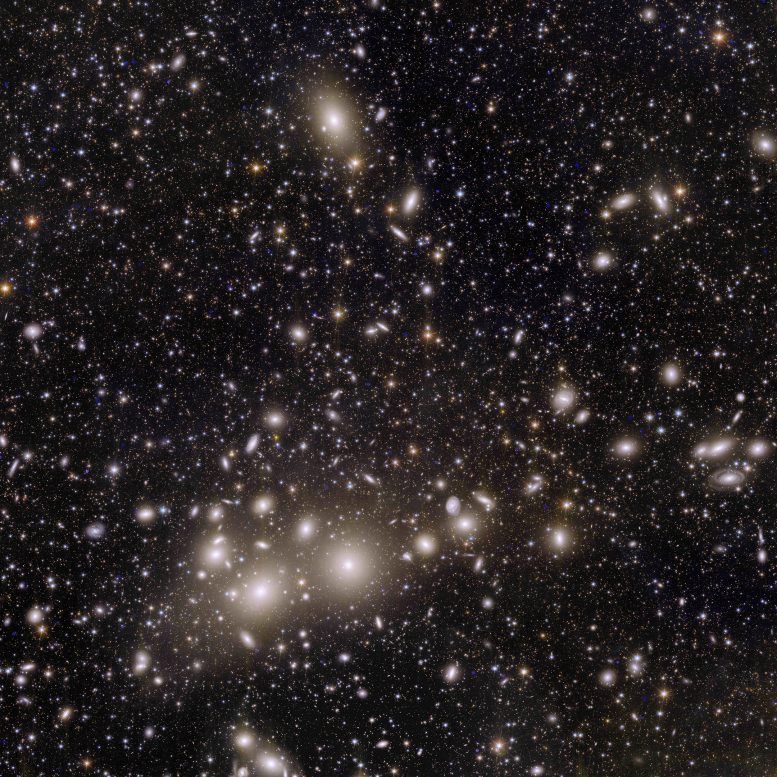
On the trail of dark matter: This image from Euclid is the first to capture so many galaxies of the Perseus galaxy cluster at once in such a large image section and with such a high level of detail. The image shows 1000 galaxies that belong to the Perseus cluster, one of the most massive structures in the universe. More than 50,000 other galaxies at a much greater distance can be recognized in the background. Credit: ESA/Euclid/Euclid Consortium/NASA, image processing by J.-C. Cuillandre (CEA Paris-Saclay), G. Anselmi, CC BY-SA 3.0 IGO
Euclid’s Broad View of the Universe
Previous space telescopes, such as Hubble or James Webb, were built to examine very small areas of the sky in great detail. Euclid, on the other hand, broadens the view with equally high image quality: thanks to its large optics, its sensitive instruments, and its position outside the disturbing Earth’s atmosphere, it delivers images of large sections of the sky in a relatively short observation time, which are also remarkably sharp and contain the faint light of distant galaxies.
With the published images, members of the Euclid consortium demonstrate the full potential of Euclid using five selected objects. Each image covers an area slightly larger than the full moon. By the mission’s end, approximately 40,000 such image sections will be merged, forming a vast area of about 14,000 square degrees in the sky. This constitutes one-third of the entire sky, excluding our own galaxy, the Milky Way.
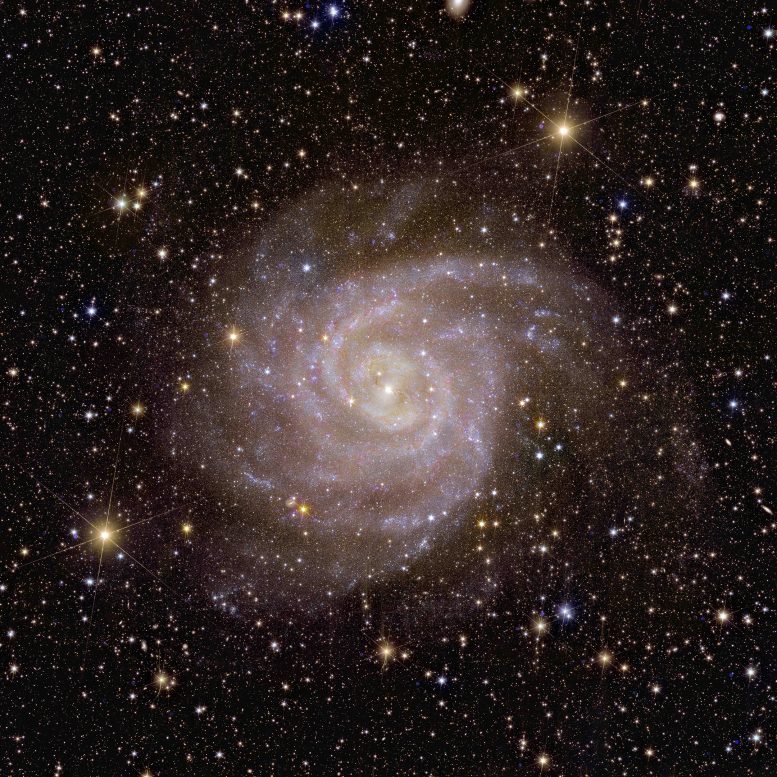
A galaxy reminiscent of our Milky Way: the galaxy IC 342 is eleven million light years away and appears in the sky to be about the size of the full moon. In the course of its operation, Euclid will image billions of other galaxies that are even farther away than IC 342 and that reveal the invisible influence of dark matter and dark energy. Credit: ESA/Euclid/Euclid Consortium/NASA, image processing by J.-C. Cuillandre (CEA Paris-Saclay), G. Anselmi, CC BY-SA 3.0 IGO
Insights From Euclid’s Images
The images that have now been released show one thing very clearly: each image will be a treasure trove of new insights into the physics of individual stars, the Milky Way or distant galaxies.
“The telescope will collect enormous amounts of data and detect more objects than previously possible,” says Maximilian Fabricius from the Max Planck Institute for Extraterrestrial Physics in Garching near Munich and the Ludwig Maximilian University of Munich.
Knud Jahnke, instrument scientist at the Max Planck Institute for Astronomy in Heidelberg, confirms: “We all need to adapt to the wealth of information that Euclid will provide.”
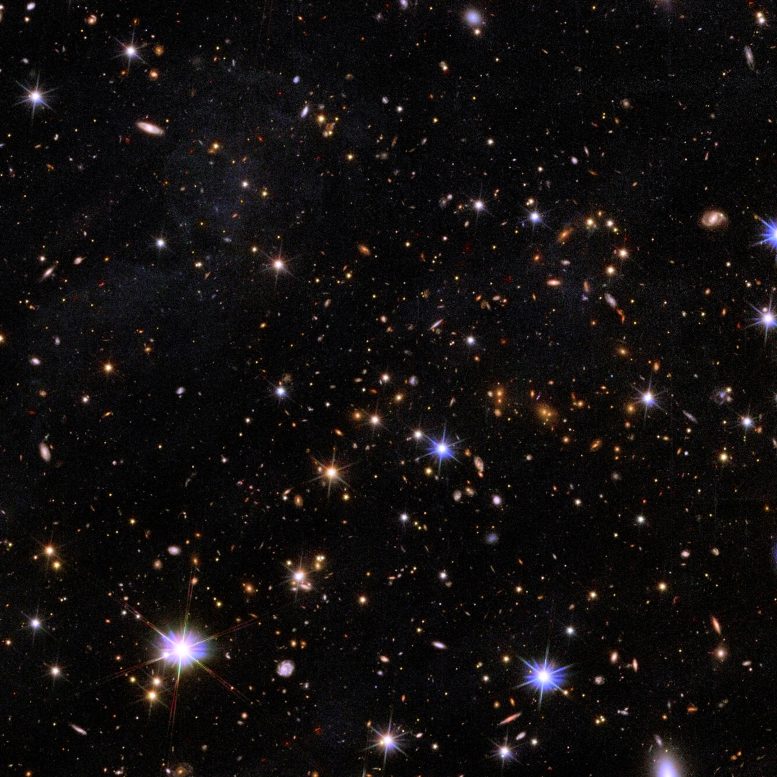
A snapshot with depth: This image section, which is around 200 times smaller than the overall image of the Perseus cluster, gives an impression of the details that are lost next to the magnificent image of the Perseus cluster in the foreground. The brightest points with six star-shaped “spikes” are stars of our galaxy in the foreground. Between them are numerous diffuse and reddish patches that correspond to galaxies from the early days of the universe. Some are so far away that their light has taken 10 billion years to reach us. Credit: ESA/Euclid/Euclid Consortium/NASA, image processing by J.-C. Cuillandre (CEA Paris-Saclay), G. Anselmi, CC BY-SA 3.0 IGO
One example is the Perseus galaxy cluster. These galaxy clusters stand as some of the largest and most massive structures in the universe. Without dark matter networks, the galaxies depicted here would be evenly distributed across the sky.
“With Euclid’s huge field of view and its exceptional sensitivity, the galaxies within the Perseus galaxy cluster can be measured down to their outermost and faintest regions,” explains Matthias Kluge, a scientist at the Max Planck Institute for Extraterrestrial Physics and at Ludwig-Maximilians-Universität.
There are also other galaxies in the same image that are not connected to the Perseus cluster. The farther you look into the universe, the older galaxies you will find, given the finite speed at which light travels, and the more galaxies you will find at various stages of development. This wealth of information will significantly contribute to researchers’ understanding of the universe’s early days, marked by the abundant collisions and mergers of galaxies.”
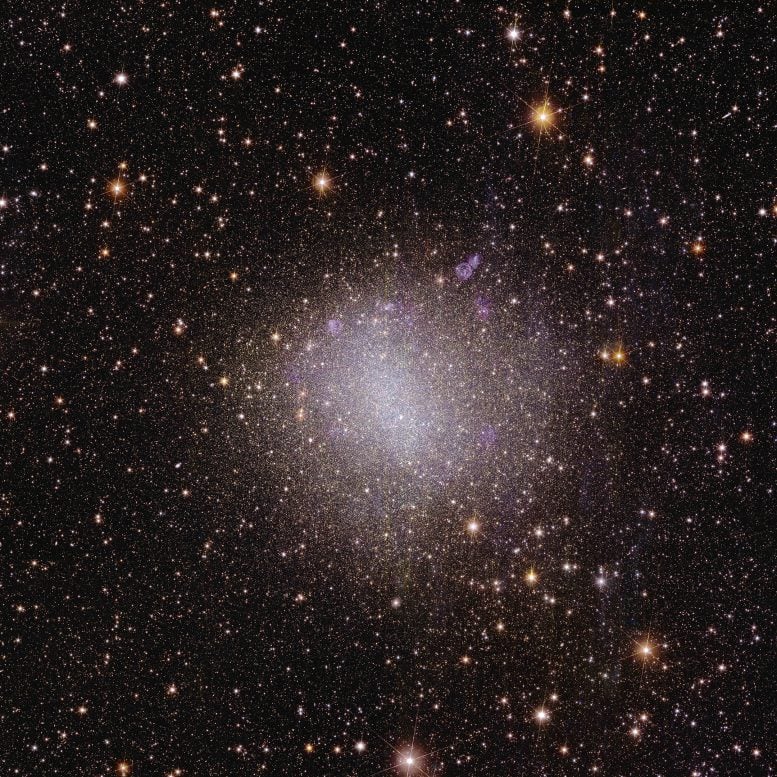
A bizarre galaxy from the neighbourhood of the Milky Way: The irregular galaxy NGC 6822 is an example of a dwarf galaxy that does not have proper spiral arms like our Milky Way. Such galaxies are considered to be the building blocks of full-grown galaxies that can be found in the nearby and young universe – a universe that Euclid will map comprehensively. If you take a closer look, you can recognise individual stars and even supernova remnants. Credit: ESA/Euclid/Euclid Consortium/NASA, image processing by J.-C. Cuillandre (CEA Paris-Saclay), G. Anselmi, CC BY-SA 3.0 IGO
Unraveling the Mystery of Dark Matter and Dark Energy
Approximately 95 percent of our universe appears to consist of mysterious “dark” elements, which also play a part in the formation of the Perseus galaxy cluster. While dark matter determines the gravitational effect between and within galaxies and initially slowed down the expansion of the universe, dark energy is driving the current accelerated expansion of the cosmos.
However, the nature of dark matter and dark energy remains elusive. What scientists do know is that these substances cause subtle alterations in the appearance and movements of observable objects through telescopes. To detect the ‘dark’ influence on the visible universe, Euclid will observe the shapes, distances, and movements of billions of galaxies up to 10 billion light years away over the next six years.
Here, the spectral information from the NIST infrared instrument is supplemented with optical spectra from ground-based telescopes, which will very accurately determine the distances and movements of the galaxies imaged by Euclid and translate Euclid’s two-dimensional photos into the most comprehensive three-dimensional map of the visible universe ever created.
Background Information
Euclid is a space mission of the European Space Agency (ESA) with contributions from the National Aeronautics and Space Administration (NASA). It is part of ESA’s Cosmic Vision program.
The cameras VIS and NISP were developed and built by a consortium of scientists and engineers from 17 countries, many from Europe, but also from the USA, Canada, and Japan. From Germany, the Max Planck Institute for Astronomy in Heidelberg, the Max Planck Institute for Extraterrestrial Physics in Garching, the Ludwig Maximilian University in Munich, the University of Bonn, the Ruhr University Bochum and the German Space Agency at the German Aerospace Centre in Bonn are participating.
The German Space Agency at DLR coordinates the German ESA contributions and also provides funding for the participating German research institutes. With around 21 percent, Germany is the largest contributor to the ESA science program.
>>> Read full article>>>
Copyright for syndicated content belongs to the linked Source : SciTechDaily – https://scitechdaily.com/exposing-dark-matter-euclid-is-on-the-trail-of-the-dark-side-of-the-universe/



