







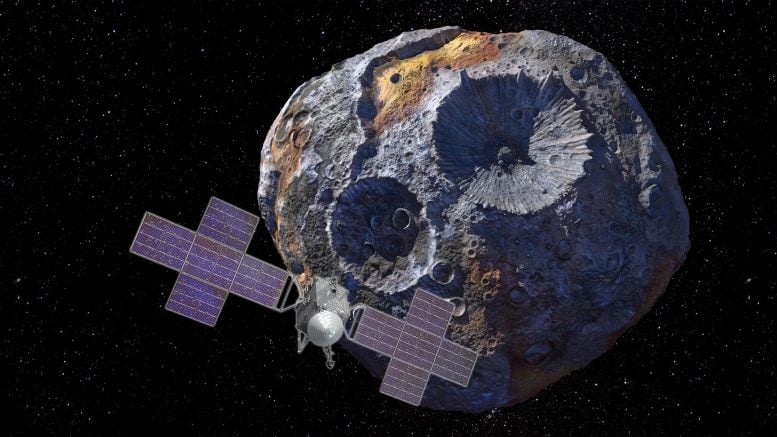
NASA’s Psyche spacecraft, launched on October 13, has been successfully performing operations in space, including activating scientific instruments and setting a record with its electric thrusters. The spacecraft, currently millions of miles from Earth, captured its first images using twin cameras. Significant milestones include testing various instruments like a magnetometer and a gamma-ray spectrometer, and using Hall-effect thrusters for deep space travel. Credit: NASA/JPL-Caltech/ASU
The mission team has celebrated several successes since its launch from Kennedy Space Center on October 13. The latest is the operation of the spacecraft’s cameras.
NASA’s Psyche spacecraft is on a roll. In the eight weeks since it left Earth on October 13, the orbiter has performed one successful operation after another, powering on scientific instruments, streaming data toward home, and setting a deep-space record with its electric thrusters. The latest achievement: On Monday, December 4, the mission turned on Psyche’s twin cameras and retrieved the first images – a milestone called “first light.”
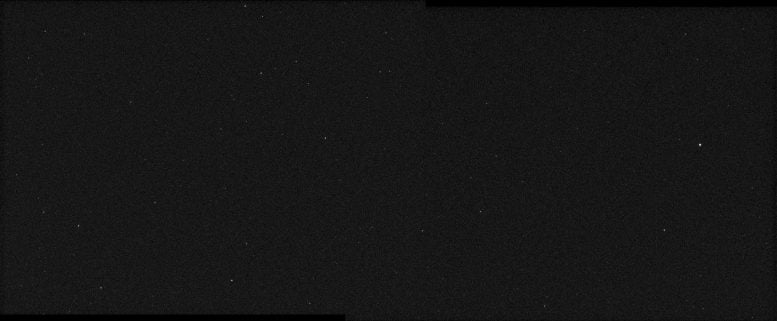
This mosaic of a star field in the constellation Pisces was made from “first light” images acquired on December 4 by both of the cameras on NASA’s Psyche spacecraft. Credit: NASA/JPL-Caltech/ASU
Already 16 million miles (26 million kilometers) from Earth, the spacecraft will arrive at its destination – the asteroid Psyche in the main asteroid belt between Mars and Jupiter – in 2029. The team wanted to test all of the science instruments early in the long journey to make sure they are working as intended, and to ensure there would be plenty of time to calibrate and adjust them as needed.
The imager instrument, which consists of a pair of identical cameras, captured a total of 68 images, all within a star field in the constellation Pisces. The imager team is using the data to verify proper commanding, telemetry analysis, and calibration of the images.
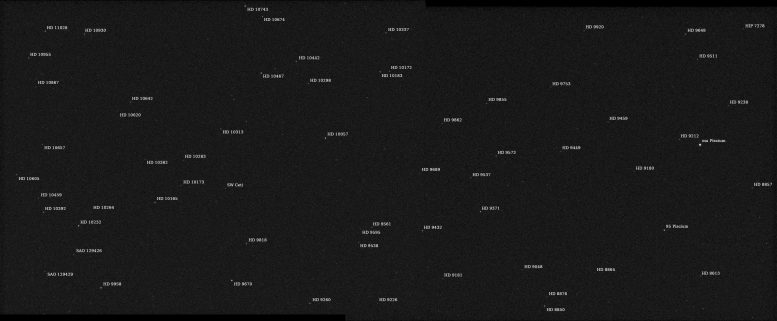
This is the same image as above, but with star names labeled. Credit: NASA/JPL-Caltech/ASU
“These initial images are only a curtain-opener,” said Arizona State University’s Jim Bell, the Psyche imager instrument lead. “For the team that designed and operates this sophisticated instrument, first light is a thrill. We start checking out the cameras with star images like these, then in 2026 we’ll take test images of Mars during the spacecraft’s flyby. And finally, in 2029 we’ll get our most exciting images yet – of our target asteroid Psyche. We look forward to sharing all of these visuals with the public.”
The imager takes pictures through multiple color filters, all of which were tested in these initial observations. With the filters, the team will use photographs in wavelengths of light both visible and invisible to the human eye to help determine the composition of the metal-rich asteroid Psyche. The imager team will also use the data to create 3D maps of the asteroid to better understand its geology, which will give clues about Psyche’s history.
NASA’s Psyche spacecraft will use highly sensitive cameras to allow scientists to see a metal-rich asteroid that’s never been imaged up close before. Credit: NASA/JPL-Caltech/ASU
Solar Surprise
Earlier in the mission, in late October, the team powered on the magnetometer, which will provide crucial data to help determine how the asteroid formed. Evidence that the asteroid once had a magnetic field would be a strong indication that the body is a partial core of a planetesimal, a building block of an early planet. The information could help us better understand how our own planet formed.
Shortly after being powered on, the magnetometer gave scientists an unexpected gift: It detected a solar eruption, a common occurrence called a coronal mass ejection, where the Sun expels large quantities of magnetized plasma. Since then, the team has seen several of these events and will continue to monitor space weather as the spacecraft travels to the asteroid.
The good news is twofold. Data collected so far confirms that the magnetometer can precisely detect very small magnetic fields. It also confirms that the spacecraft is magnetically “quiet.” The electrical currents powering a probe of this size and complexity have the potential to generate magnetic fields that could interfere with science detections. Because Earth has its own powerful magnetic field, scientists obtained a much better measurement of the spacecraft magnetic field once it was in space.
The Psyche spacecraft includes many unavoidable magnetic field sources, which must be accounted for to measure the magnetic field signature of the Psyche metal-rich asteroid. The visual illustrates the complex nature of the spacecraft’s magnetic field, modeled as the sum of over 200 individual sources arising from various spacecraft subsystems and instruments. Magnetic sources include hard magnets as well as current loops that generate variable magnetic fields in the two solar array wings which extend outward from the spacecraft. Magnetic field lines that originate from these sources are spatially color-coded by their strength, where red colors indicate higher field strengths and blue colors indicate lower strengths. Credit: NASA/JPL-Caltech
In the Zone
On November 8, amid all the work with the science instruments, the team fired up two of the four electric propulsion thrusters, setting a record: the first-ever use of Hall-effect thrusters in deep space. Until now, they’d been used only on spacecraft going as far as lunar orbit. By expelling charged atoms, or ions, of xenon gas, the ultra-efficient thrusters will propel the spacecraft to the asteroid (a 2.2-billion-mile, or 3.6-billion-kilometer journey) and help it maneuver in orbit.
Less than a week later, on November 14, the technology demonstration built into the spacecraft, an experiment called Deep Space Optical Communications (DSOC), set its own record. DSOC achieved first light by sending and receiving optical data from far beyond the Moon. The instrument beamed a near-infrared laser encoded with test data from nearly 10 million miles (16 million kilometers) away – the farthest-ever demonstration of optical communications.
The Psyche team has also successfully powered on the gamma-ray detecting component of its third science instrument, the gamma-ray and neutron spectrometer. Next, the instrument’s neutron-detecting sensors will be turned on the week of December 11. Together those capabilities will help the team determine the chemical elements that make up the asteroid’s surface material.
More About the Mission
Arizona State University (ASU) leads the Psyche mission. A division of Caltech in Pasadena, NASA’s Jet Propulsion Laboratory is responsible for the mission’s overall management, system engineering, integration and test, and mission operations. Maxar Technologies in Palo Alto, California, provided the high-power solar electric propulsion spacecraft chassis. ASU leads the operations of the imager instrument, working in collaboration with Malin Space Science Systems in San Diego on the design, fabrication, and testing of the cameras.
JPL manages DSOC for the Technology Demonstration Missions program within NASA’s Space Technology Mission Directorate and the Space Communications and Navigation program within the Space Operations Mission Directorate.
Psyche is the 14th mission selected as part of NASA’s Discovery Program, managed by the agency’s Marshall Space Flight Center in Huntsville, Alabama. NASA’s Launch Services Program, based at Kennedy, managed the launch service.
>>> Read full article>>>
Copyright for syndicated content belongs to the linked Source : SciTechDaily – https://scitechdaily.com/first-light-for-nasas-psyche-mission-initial-images-and-a-solar-surprise/



