







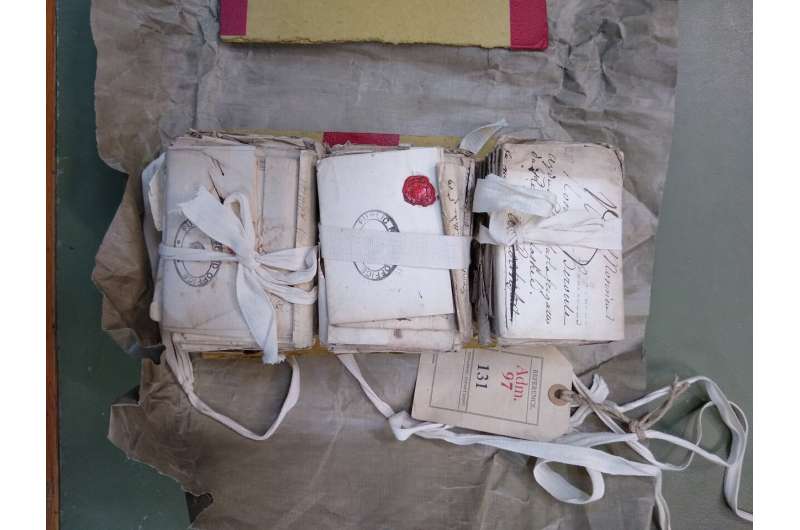
The letters before they were opened and read by Renaud Morieux at The National Archives, Kew. Credit: The National Archives / Renaud Morieux
Over 100 letters sent to French sailors by their fiancées, wives, parents and siblings—but never delivered—have been opened and studied for the first time since they were written in 1757–8.
The messages offer extremely rare and moving insights into the loves, lives and family quarrels of everyone from elderly peasants to wealthy officer’s wives. The messages were seized by Britain’s Royal Navy during the Seven Years’ War, taken to the Admiralty in London and never opened. The collection is now held at the National Archives in Kew. The letters provide precious new evidence about French women and laborers, as well as different forms of literacy.
“I could spend the night writing to you … I am your forever faithful wife. Good night, my dear friend. It is midnight. I think it is time for me to rest,” wrote Marie Dubosc to her husband, the first Lieutenant of the Galatée, a French warship, in 1758. She didn’t know where Louis Chambrelan was, or that his ship had been captured by the British. He would never receive her letter and they would never meet again. Marie died the following year in Le Havre, almost certainly before Louis was released. In 1761, he remarried, safely back in France.
“I cannot wait to possess you,” wrote Anne Le Cerf to her husband, a non-commissioned officer on the Galatée. She perhaps meant “embrace” but also “to make love to you.” She signed her letter “Your obedient wife Nanette,” an affectionate nickname. Imprisoned somewhere in England, Jean Topsent would never receive Nanette’s love letter.
Professor Renaud Morieux, from Cambridge University’s History Faculty and Pembroke College, spent months decoding these and 102 other letters written with wild spelling, no punctuation or capitalization and filling every inch of the expensive paper they appear on. He has published his findings in the journal Annales Histoire Sciences Sociales.
“I only ordered the box out of curiosity,” Morieux said. “There were three piles of letters held together by ribbon. The letters were very small and were sealed so I asked the archivist if they could be opened and he did. I realized I was the first person to read these very personal messages since they were written. Their intended recipients didn’t get that chance. It was very emotional.
“These letters are about universal human experiences; they’re not unique to France or the 18th century. They reveal how we all cope with major life challenges. When we are separated from loved ones by events beyond our control like the pandemic or wars, we have to work out how to stay in touch, how to reassure, care for people and keep the passion alive. Today we have Zoom and WhatsApp. In the 18th century, people only had letters, but what they wrote about feels very familiar.”
Captured and out of luck
During the Seven Years’ War (1756–1763), France commanded some of the world’s finest ships but lacked experienced sailors. Britain exploited this by imprisoning as many French sailors as it could for the duration of the war. In 1758, out of 60,137 French sailors, a third (19,632) were detained in Britain. Across the period of the Seven Years’ War as a whole, there were 64,373 French sailors imprisoned in Britain.
Some of these men died from disease and malnutrition, but many others were released. In the meantime, their families waited and repeatedly tried to contact them and exchange news.
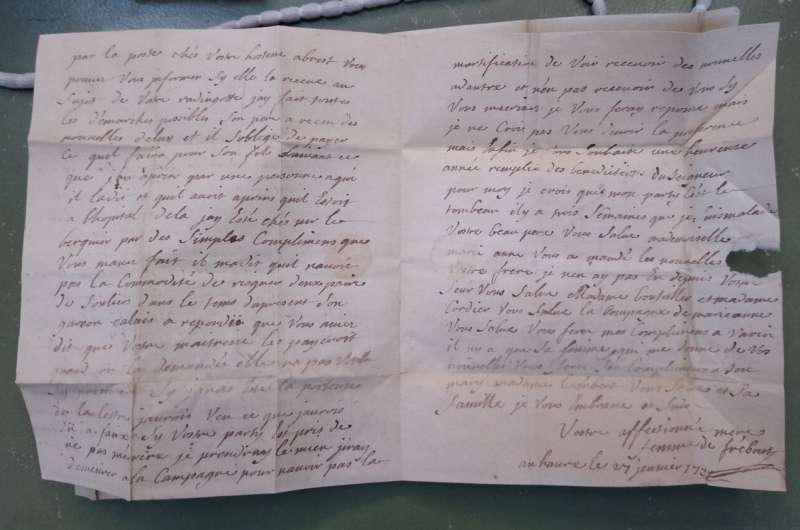
Marguerite’s letter to her son Nicolas Quesnel (27 Jan 1758), in which she says ‘I am for the tomb’. Credit: The National Archives / Renaud Morieux
Morieux said, “These letters show people dealing with challenges collectively. Today we would find it very uncomfortable to write a letter to a fiancée knowing that mothers, sisters, uncles, neighbors would read it before it was sent, and many others would read it upon receipt. It’s hard to tell someone what you really think about them with people peering over your shoulder. There was far less of a divide between intimate and collective.”
In the 18th century, sending letters from France to a ship, a constantly moving target, was incredibly difficult and unreliable. Sometimes people sent multiple copies of letters to different ports hoping to reach a sailor. Relatives also asked the families of crewmates to insert messages to their loved one in their letters. Morieux found extensive evidence of these strategies in the Galatée letters, which—like so many others—never reached their intended recipients.
The Galatée was sailing from Bordeaux to Quebec, when in 1758, it was captured by the British ship the Essex, and sent to Portsmouth. The crew was imprisoned and the ship sold.
The French postal administration had tried to deliver the letters to the ship, sending them to multiple ports in France but always arrived just too late. When they had heard that the ship had been captured, they forwarded the letters to England, where they were handed to the Admiralty in London.
“It’s agonizing how close they got,” Morieux said. Morieux believes that officials opened and read two letters to see if they had any military value, but deciding they only contained “family stuff,” gave up and put them into storage.
Morieux identified every member of the Galatée’s 181-strong crew from simple sailors to carpenters to superior officers. The letters were addressed to a quarter of them. Morieux carried out genealogical research into these men and their correspondents to learn more about their lives than the letters alone revealed.
Quarrels and tensions
The letters convey both romantic love and more often family love, but also offer rare insights into family tensions and quarrels at a time of war and prolonged absence.
Some of the most remarkable letters were sent to the young sailor, Nicolas Quesnel, from Normandy. On 27 January 1758, his 61-year-old mother, Marguerite—who was almost certainly illiterate—sent a message written by an unknown scribe to complain, “On the first day of the year [i.e. January 1st] you have written to your fiancée […]. I think more about you than you about me. […] In any case I wish you a happy new year filled with blessings of the Lord. I think I am for the tomb, I have been ill for three weeks. Give my compliments to Varin [a shipmate], it is only his wife who gives me your news.”
A few weeks later, Nicolas’ fiancée, Marianne, wrote to instruct him to write to his mother to be a good son and stop putting her in an awkward situation. It seems that Marguerite had blamed Marianne for Nicolas’s silence. Marianne wrote, “…the black cloud has gone, a letter that your mother has received from you, lightens the atmosphere.”
But on 7 March 1758, Marguerite wrote to Nicolas again to complain, “In your letters you never mention your father. This hurts me greatly. Next time you write to me, please do not forget your father.”
Morieux discovered that in fact, this man was Nicolas’s stepfather. His biological father had died and his mother remarried.
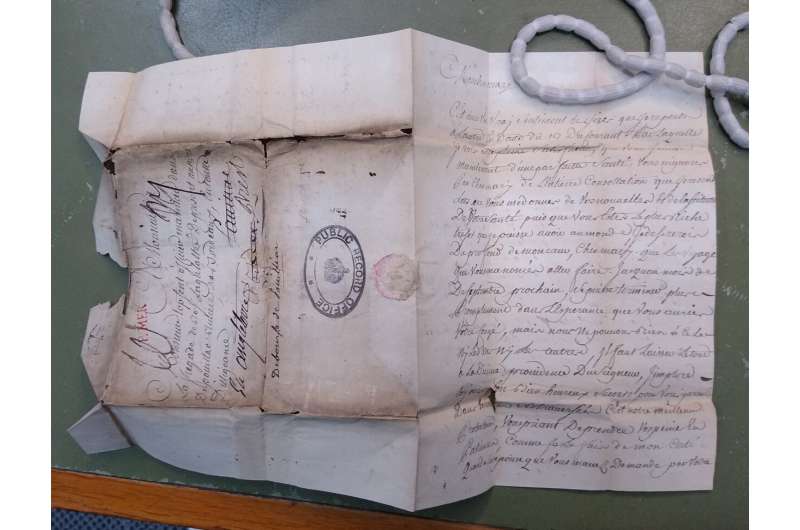
Anne Le Cerf love letter to her husband Jean Topsent in which she says “I cannot wait to possess you”and signs “Your obedient wife Nanette”. Credit: The National Archives / Renaud Morieux
“Here is a son who clearly doesn’t like or acknowledge this man as his father,” Morieux said. “But at this time, if your mother remarried, her new husband automatically became your father. Without explicitly saying it, Marguerite is reminding her son to respect this by sharing news about ‘your father.’ These are complex but very familiar family tensions.”
Nicolas Quesnel survived his imprisonment in England, and as Morieux found, joined the crew of a transatlantic slave trade ship in the 1760s.
Women in wartime
Over half (59%) of the letters were signed by women and provide precious insights into female literacy, social networks, and experiences in wartime.
“These letters shatter the old-fashioned notion that war is all about men,” Morieux said. “While their men were gone, women ran the household economy and took crucial economic and political decisions.”
In this period, the French navy manned its warships by forcing most men living near the coast to serve for 1 year every 3 or 4 years. This system was as unpopular as press-ganging in Britain and many French sailors ran away once in port or applied to be released on the basis of injury.
The sister of Nicolas Godefroy, a trainee pilot, wrote, “What would bring me more pain is if you leave for the islands.” She meant the Caribbean, where thousands of European sailors died from disease in this period. Nevertheless, Godefroy’s sister and mother both refused to apply for his release from the navy. They feared that his proposed strategy could backfire and force him to stay at sea “even longer.”
Who are you calling illiterate?
Morieux’s study calls for a more inclusive definition of literacy.
“You can take part in a writing culture without knowing how to write nor read,” he said. “Most of the people sending these letters were telling a scribe what they wanted to say, and relied on others to read their letters aloud. This was someone they knew who could write, not a professional. Staying in touch was a community effort.”
More information:
Lettres perdues Communautés épistolaires, guerres et liens familiaux dans le monde maritime atlantique du xviiie siècle, Annales Histoire Sciences Sociales (2023). DOI: 10.1017/ahss.2023.75
Citation:
French love letters confiscated by Britain finally read after 265 years (2023, November 6)
retrieved 6 November 2023
from https://phys.org/news/2023-11-french-letters-confiscated-britain-years.html
This document is subject to copyright. Apart from any fair dealing for the purpose of private study or research, no
part may be reproduced without the written permission. The content is provided for information purposes only.
>>> Read full article>>>
Copyright for syndicated content belongs to the linked Source : Phys.org – https://phys.org/news/2023-11-french-letters-confiscated-britain-years.html



