






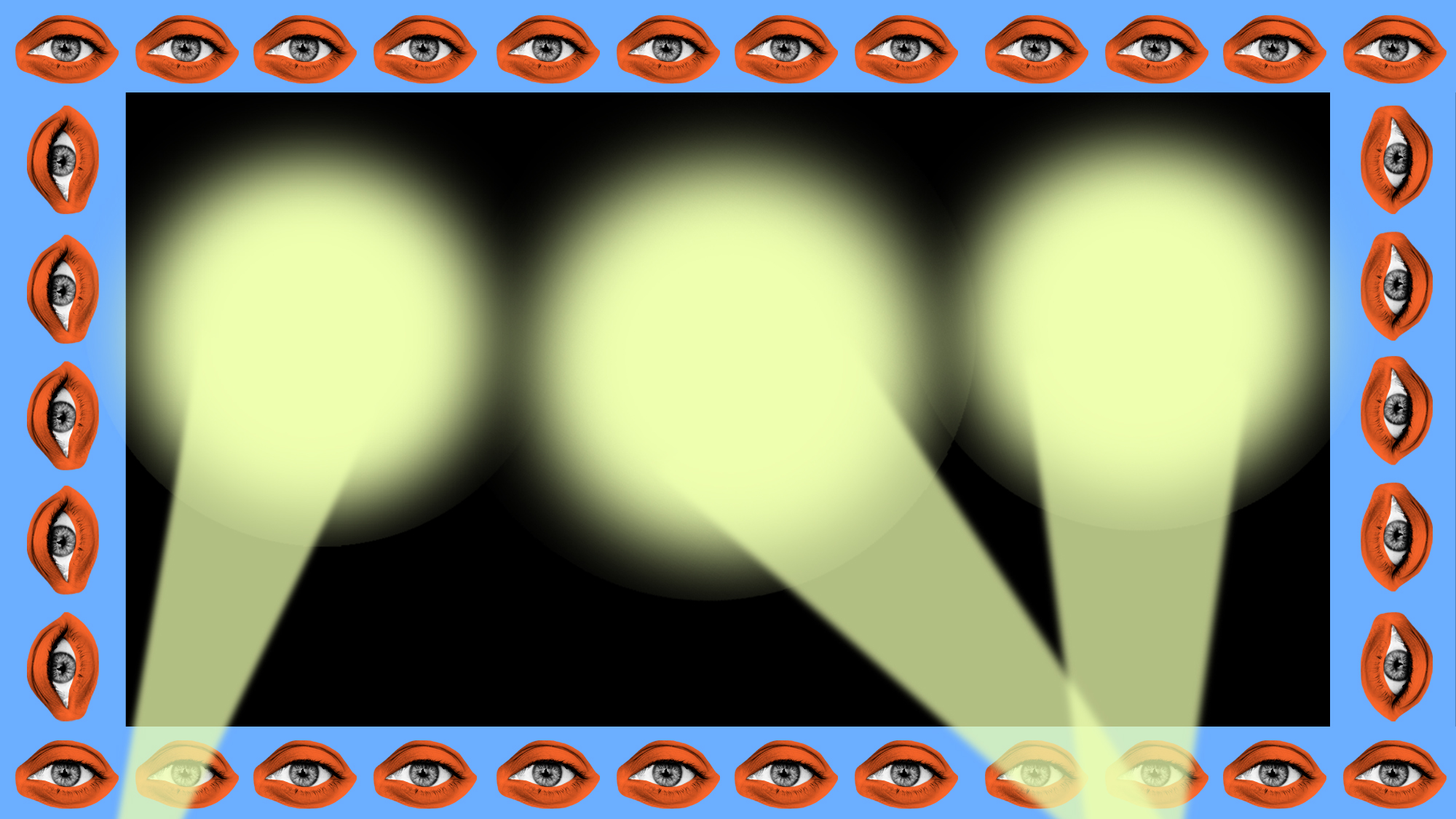
There’s a misalignment between the information the brain expects from the senses, and the information that it actually receives. Credit: Tyler Spanger/Popular Science
In Head Trip, PopSci explores the relationship between our brains, our senses, and the strange things that happen in between.
Imagine this. You’re sitting… somewhere. You have no idea where, because it’s pitch black. But then, out of nowhere, you see three flashes of light in rapid succession. They appear to occur along a straight line, each a short distance from the next: the first flash to your left, the second right in front of you, and the third to your right.
But wait, what did you see? If you’re experiencing the visual saltation illusion, the second flash actually occurred in the exact same place as the first. There was no flash in the center of your vision; your brain just expected that there should be a flash there, so that’s what you saw.
This illusion is also referred to as the visual rabbit illusion, a name it owes to the closely related cutaneous saltation illusion–in which instead of seeing flashes of light, participants are tapped quickly on the arm. The second tap feels like it occurs between the first and third, and in an early paper on the illusion–even though it isn’t. Researchers likened the sensation to a rabbit “hopping” along the arm. (Another version involves a similar aural effect.)
One recurring theme with illusions is the way that many seem to manifest when there’s a misalignment between the information the brain expects from the senses, and the information that it actually receives. The stopped clock illusion, for instance is induced by a situation where a clock’s second hand moves while the eyes are in motion, and thus don’t actually see the movement. In that case, the brain steps in to “fill in” the perceptual gap, based on its expectation of when the movement is likely to happen–an expectation that can be incorrect.
[ Related: Why do clock hands seem to slow down? ]
In the stopped clock illusion, there’s a clear absence of information: the eyes are moving when the clock ticks, and thus miss the actual moment when the movement occurs. Is something similar happening with the visual saltation illusion? Yes and no, says Sheryl Anne Manaligod de Jesus, a doctoral student at Kyushu University’s Graduate School of Design and lead author on a new paper on the visual saltation illusion published on May 21 in i-Perception.
 Credit: Kyushu University
IN THIS 2024 IMAGE: Researchers at Kyushu University have further explored the visual rabbit illusion. The three rabbits represent the actual flashes, while the dots above them show where people perceive the light points. The second dot is usually perceived near the center.
“In [this illusion],” she explains, “The subject does ‘see’ all three flashes, but [they] mislocalize the second flash.” How does the mislocalization happen? De Jesus explains that “the brain misinterprets the information it receives into a pattern that makes the most sense.”
Why the brain does this, however, remains relatively mysterious. The new research carried out by de Jesus and her colleagues at Kyushu University aimed to look further into the illusion’s subtleties. It did so by making slight variations to the experiment’s setup, and examining whether these variations affected participants’ perception of the illusion. The team’s results suggest that the brain’s desire to place the second flash between the first and third–the location that “makes the most sense”–is remarkably strong.
In the classic experiment, the second flash happens in the same place as the first. The first modification that the team made to that experiment was to move the second flash to the same place as the third, a setup referred to as the “backwards” configuration. The second modification increased the number of potential locations for the second flash: in some cases, it was placed outside the space between the first and third. The idea of both these changes, de Jesus explains, was “to test the strength of the illusion … would going ‘out of bounds’ still produce the same effect?”
In both cases, the answer seems to be “yes.” Even when the second flash was located beyond the space bounded by the first and third, participants perceived it in the middle of that space. A third modification moved the second flash out of linear alignment with the first and third. Again, participants saw the second flash midway between first and third.
There are two main hypotheses to explain this illusion. One is that the brain’s inclination to mislocalize the second flash is based on so-called “motion-based position shifts,” while the other is that it is due to “perceptual grouping.” As de Jesus explains, the former describes the phenomenon whereby “the position of an object or stimulus … is affected by motion in the background;” in these cases, participants “would perceive the target object to be displaced in the direction of motion.”
According to this explanation, the sequential nature of the flashes creates a sense of the flashes being a single object moving across a participant’s field of vision. The new research–and the backward configuration, in particular–seems to raise questions for this idea: “If [it] held true,” de Jesus muses, “The second flash would have been perceived to appear after the third flash’s position, and the third flash would have possibly been misperceived as well.”
Perceptual grouping, meanwhile, is a more philosophical explanation: it’s based on Gestalt psychology, and the idea that “the sum of the parts equal the whole.” This, de Jesus explains, is how we can “see a face in certain art pieces, instead of a bunch of random dots or brush strokes.” (Another example is Kanisza shapes.)
[ Relate: The mystery of cats and their love of imaginary boxes ]
De Jesus explains that this idea demystifies the visual saltation illusion by suggesting that while the eye sees the three flashes as separate events, the brain interprets that visual information as describing three parts of a straight line. In other words, as de Jesus puts it, the brain interprets visual data in a manner that it deems “to be most fitting.”

IN THIS 2018 VIDEO: This video, from a paper by a team at Caltech, demonstrates a similar phenomenon to the visual saltation effect. In this case, the perception of a second flash between the first and third is induced by the accompanying beeps—but in both cases, the illusion arises from the brain’s expectation of a second flash in a location that makes ‘most sense‘ to the brain.
Either way, de Jesus cautions that the answer to the question of why the brain errs in this case is not as simple as either/or: “Based on the overall results, we cannot discredit one [theory] or the other.” Instead, she says, more research is needed: “[Using] other devices to measure brain and eye activity would be interesting,” she says, as would investigating multiple saltation illusions simultaneously: “I think it would be interesting to test these same parameters through sound and touch or even a combination of both.”
There are also tantalizing hints of links to other, similar illusions: the Kappa effect, for instance, which uses a similar setup to the visual saltation illusion but displaces the flashes in time rather than space. “There is definitely a connection,” de Jesus agrees, “although I cannot explicitly say what [it is]. Both [illusions] are attributed to motion signals and cognitive priors, and perhaps they are tied to the same neural mechanism which manifests in different effects.”
>>> Read full article>>>
Copyright for syndicated content belongs to the linked Source : Popular Science – https://www.popsci.com/science/rabbit-illusion-flashes/



