







Last year’s United Nations climate conference in the United Arab Emirates ended on a surprising high note as the world’s countries endorsed a landmark agreement to transition away from fossil fuels. After weeks of tense negotiation, the conference produced a slew of unprecedented commitments to ramp up the deployment of renewables, adapt to climate disasters, and move away from the use of coal, oil, and gas.
The question at this year’s COP29 conference in Baku, Azerbaijan, is just how much that massive effort will cost. After years of global debate over the scale of funding that developed countries owe less fortunate nations for decarbonization and disaster aid, negotiators have until the end of the conference in December to agree on a hard-fought financial target for climate assistance over the next few decades. This new target, referred to as the New Collective Quantified Goal by climate negotiators, is critical to upholding the 2015 Paris Agreement and addressing the harm of fossil fuel emissions from industrialized countries like the United States. Without funding, some of the poorest nations in Asia and Africa, which have contributed negligibly to the climate crisis, stand little chance of transitioning their economies away from fossil fuels and adapting to a warmer world.
The last time the world set such a goal, it didn’t work out well. Back in 2009, wealthy countries agreed to send poorer countries $100 billion in climate finance every year by 2020. Though the figure was less than half of the annual global need, according to World Bank estimates, rich countries didn’t even come close to meeting their target until last year. Even then, some aid organizations like Oxfam contend that these countries have overstated or double-counted their aid by tens of billions of dollars. In the meantime, international estimates of total aid needs have ballooned into the trillions. As a result, the talks around climate finance are still marked by frustration and mistrust, and diplomats debating the goal over the past two years have made little progress toward consensus.
As dozens of negotiators head to Colombia later this month for the first in a series of pre-conference talks that will lay the groundwork for the new goal, developing countries are trying to use the failures of the $100 billion promise as leverage for a much bigger commitment. After years of advocacy from climate-vulnerable nations, the economic heavyweights of India and Saudi Arabia are making a formal demand for climate aid to reach $1 trillion per year, broaching a number that will send negotiations into uncharted territory.
Increasing climate aid by more than tenfold could alter the life prospects of millions of people staring down imminent climate impacts in poor countries in Africa and Asia, but experts say the astronomical number will be a hard sell for many wealthy nations dealing with inflation and domestic turmoil. Plus, the commitment itself won’t mean much without strong safeguards to ensure the money reaches the vulnerable communities that most need it.
“It’s good that countries are using the t-word because that’s grappling with the scale of ambition that we need,” said Joe Thwaites, a climate finance expert at the nonprofit Natural Resources Defense Council. “But the key question is the political one of how you break that up.”
The world has known for years that the $100 billion goal was fundamentally flawed: The target number was far too low to match the mounting toll of climate change in the developing world, which one recent estimate pegged at around $2.4 trillion per year. And more than two-thirds of the aid from wealthy countries has been through loans rather than grants, forcing poor states to take on higher debt loads to respond to climate disasters. Some countries also tried to count aid to seaside hotels and gelato stores as climate assistance, exaggerating their contributions.
The slow pace of United Nations diplomacy has forced developing countries to wait more than a decade for the opportunity to hash out a new number with their counterparts in the United States and the European Union. Now that that chance has arrived, many of these countries are seeking to raise the floor for climate finance by scaling up their demands to a level that once would have sounded ludicrous.
In a letter to fellow negotiators in February, India argued that “developed countries need to provide at least USD 1 trillion per year, composed primarily of grants and concessional finance,” or very low-interest loans. Saudi Arabia, writing on behalf of a group of countries in the Middle East, said just a few days later that “we set a [target] of USD 1.1 trillion from developed to developing countries,” plus arrears for the failure of the last goal. There are just 19 countries in the world whose economies are larger than $1 trillion, according to data from the International Monetary Fund.
The fact that India and Saudi Arabia have endorsed this number is significant. India is the world’s most populous country and one of its largest emitters, and it has significant political clout in climate talks as the largest country that still needs aid to finance its energy transition. Saudi Arabia, meanwhile, is one of the wealthiest countries in the world, and it has faced immense pressure to join the United States and the European Union in sending aid to poorer countries. They are the only two countries to name a number so far.
Setting such an ambitious goal comes with pros and cons, experts say. On the one hand, shooting for the moon with a very high target provides poor countries with some cushion against the possibility that rich countries may fail to meet their promises. On the other hand, if voters and political leaders in wealthy countries don’t back the goal, the strategy might backfire and poor countries may end up receiving very little aid.
The United States Congress, for instance, has fought for months over whether to send around $60 billion in new aid to Ukraine, and it’s a safe bet that many lawmakers would balk at helping with a trillion-dollar global commitment. Mobilizing climate aid in a divided Congress has proven to be a challenging endeavor in previous years. Endorsing a new goal could even become a liability for President Biden and other climate-forward leaders as they stare down an election year.
Developed countries like the United States, the United Kingdom, and those within the European Union haven’t proposed a numerical target for the goal in their missives to fellow negotiators. Instead, they’ve urged a broader conversation about how to mobilize private money and how to ensure aid contributions are reaching the right communities, with Canada for instance advocating a “pragmatic approach to establishing a quantum [goal size].” The U.S. has shied away from discussion of the size, focusing in its letters on questions about which nations should contribute aid money and which nations should receive it.
“Although this [trillion] number better reflects the needs of developing countries, it will be a difficult outcome to achieve given the current constraints of developed countries — shifting geopolitics, energy security concerns, stagflation, and internal politics,” said Aman Srivatstava, a climate finance expert at the Centre for Policy Research, an India-based think tank.
But negotiators and climate advocates told Grist that the structure of the new goal matters just as much as the eventual size. The $100 billion goal was too low, but it was also too vague about what counts as “climate finance,” and many wealthy countries focused on doling out loans and private investment rather than no-strings-attached grants. These countries also tended to provide much more assistance for renewables and energy projects rather than the flood and drought aid that many countries have demanded.
“We don’t need to talk only about the quantum in terms of the money, but also about the quality of the money,” said Sandra Guzmán Luna, the founder of the Climate Finance Group for Latin America and the Caribbean, which helps developing countries in the region track and access climate aid money.
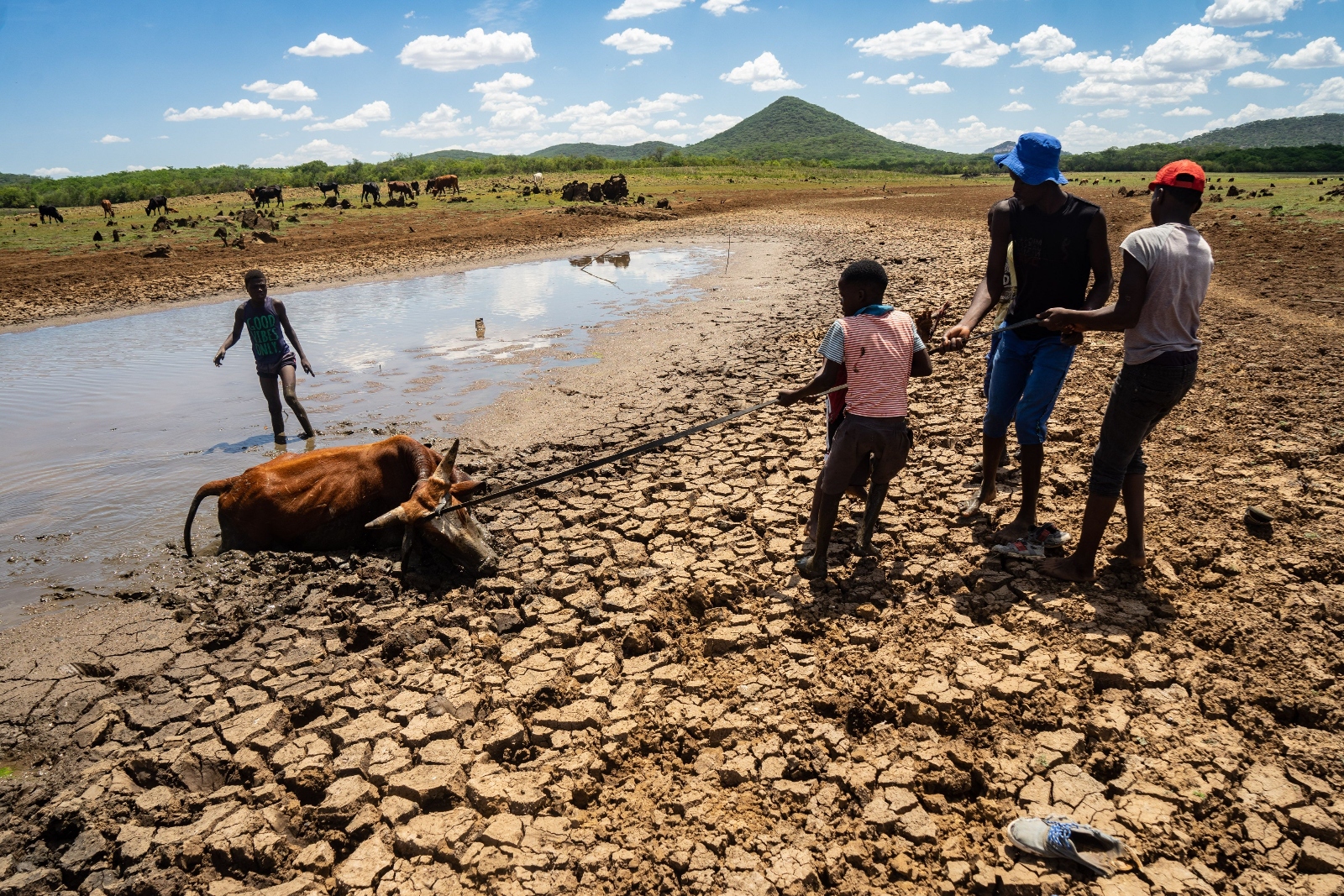
Herd boys pull out an ox stuck in the muddy waters of a drying reservoir in southern Zimbabwe. The county has declared a national emergency due to a drought caused by climate change and El Niño.
Zinyange Auntony / AFP via Getty Images
The most likely outcome is a structure that some negotiators liken to an onion with multiple concentric layers. The United States, the European Union, and other wealthy countries would contribute a chunk of public funding in the form of grants for unprofitable projects like sea walls and drinking water systems. The other layers could include additional grants from new contributors like Saudi Arabia and the United Arab Emirates, which have ample wealth but have never donated much climate aid, or private loans from investors and banks. This approach would mimic the Kunming-Montreal Global Biodiversity Framework, a 2022 agreement to protect nature and endangered species that also featured a “layered” set of commitments.
But creating such a complex structure for climate aid ahead of COP29 will be a Herculean task. Despite new endorsements for a $1 trillion goal, rich and poor countries still have huge disagreements about who should contribute to the goal, how much money should come from grants and loans, and how rich countries should be held accountable for their share. Rich countries are advocating a broader group of contributors that would include Saudi Arabia and the United Arab Emirates, as well as more flexibility to include private money in their aid contributions. Countries like China and Saudi Arabia, which have huge economies but account for a low share of carbon emissions historically, are pushing for the U.S. and the E.U. to bear the greatest burden.
With COP29 just seven months away, negotiators still haven’t even put their ideas to paper, and drafts of the potential text likely won’t appear until the summer. From there the world’s climate leaders will sprint to settle as many details as possible before the conference clock in Baku runs out. Thwaites likened the process to the puzzle game Rush Hour, where a player has to move several cars around on a grid in order to clear space for one car to escape.
“Even when you think that it’s a done deal, things can fall apart, so it’s hard to make predictions,” said Eleonora Cogo, a climate finance expert at ECCO, an Italian think tank. (Cogo has negotiated on behalf of the European Union in previous climate finance talks.)
Given how far apart the sides are right now, Cogo says that she doubts countries will be able to work out all the details by the end of COP29. The most likely outcome is a basic agreement on “some core elements” like an approximate size and a promise to work the rest out later. This could produce any number of commitments — a strong promise from rich countries to scale up their grants, a weakened framework like the $100 billion goal, or something in between.
“The asks on the table are so different, and the points of departure are so far away,” said Cogo. “It’s all open.”
Editor’s note: The Natural Resources Defense Council is an advertiser with Grist. Advertisers have no role in Grist’s editorial decisions.
>>> Read full article>>>
Copyright for syndicated content belongs to the linked Source : Grist – https://grist.org/international/cop29-climate-finance-new-collective-quantified-goal-trillion-india-saudi-arabia/



