







There is little enforcement or legal culpability.
By
Marina Wang / Hakai Magazine
|
Published Mar 9, 2024 1:00 PM EST
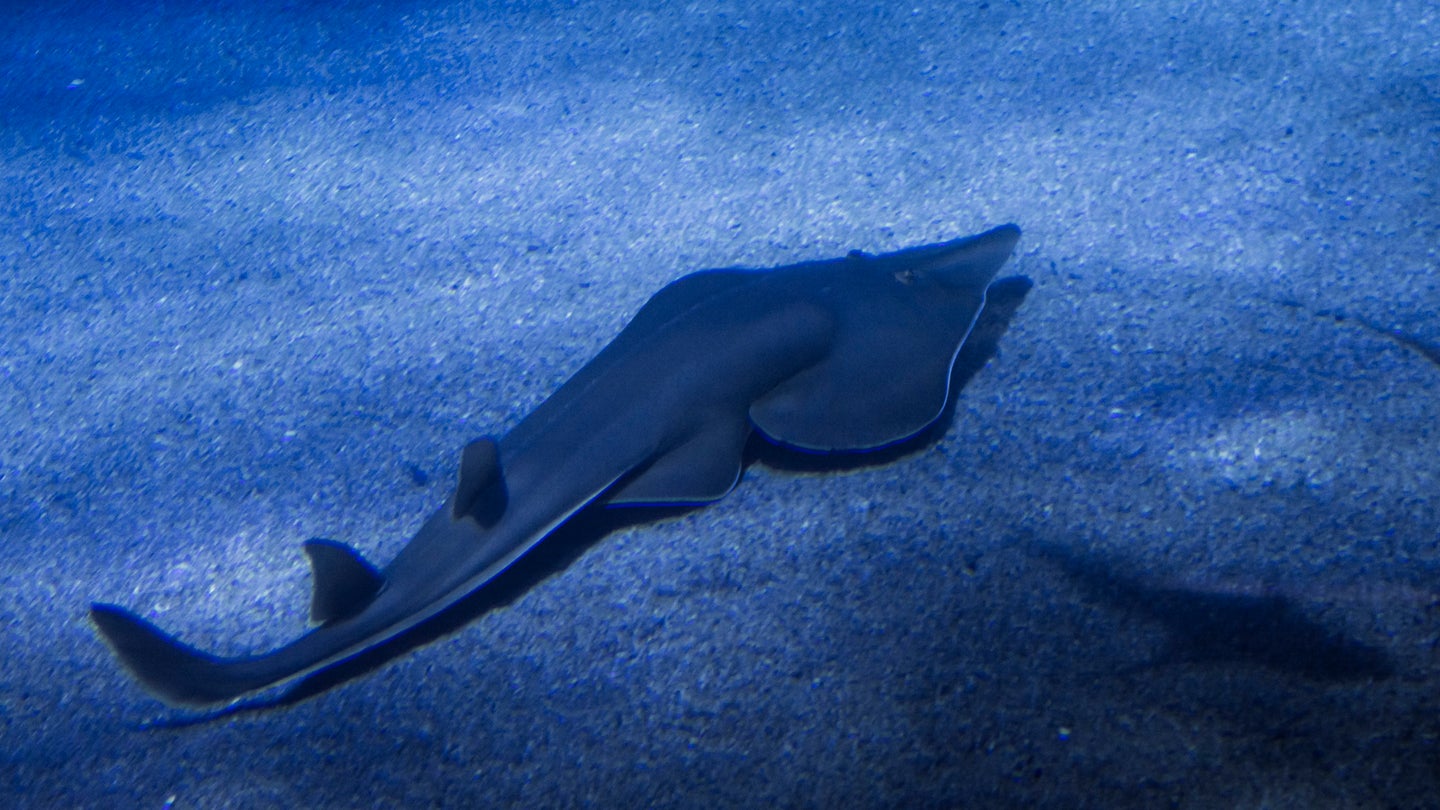
In Thailand, thorns from the spines and brows of critically endangered bowmouth guitarfish are made into amulets believed to have protective powers. DepositPhotos
This article was originally featured on Hakai Magazine, an online publication about science and society in coastal ecosystems. Read more stories like this at hakaimagazine.com.
In the summer of 2020, Jennifer Pytka spent three and a half hours a day sleuthing the internet for evidence of wildlife trafficking. She’d type กระเบนท้องน้ำ, a Thai word that loosely translates to stingray, into Google, and her search would immediately yield images of rings, each studded with an ornate white thorn about the size of a thumbnail. Pytka, a doctoral candidate at the Università di Padova in Italy, is investigating the previously undocumented trade of bowmouth guitarfish—a critically endangered ray whose spine and brows are adorned with these thorns. In Thailand, the horns are made into amulets, such as rings and bracelets, believed to have protective properties. In a 2023 study, Pytka notes how she pinpointed 977 of these items on online vending platforms, such as Facebook Marketplace, eBay, and the Alibaba-owned e-commerce site Lazada, over 21 days.
Bowmouth guitarfish amulets are just one example of the boundless number of protected wildlife products sold online, where a global Grand Bazaar of seedy vendors hawk their wildlife wares, and anyone with internet access can find products from rhino horns to exotic orchids to tiger claws with just a few clicks. With lax regulations, even weaker enforcement, and a lack of legal culpability, not only is wildlife trafficking able to fester online, but algorithms actually amplify sales, boosting the platforms’ profits.
Products sourced from protected species can be found across all manner of vending platforms, but with three billion active monthly users, Facebook is the grand pooh-bah. Pytka found 30 percent of the bowmouth guitarfish products on Facebook and 65 percent spread across other e‑commerce sites, such as Shopee and Lazada. “I’ve come to believe that Facebook is a driver of the global extinction crisis,” says Gretchen Peters, director of the Alliance to Counter Crime Online (ACCO), a nonprofit whistle-blower organization.
Prior to the emergence of the internet and online trading, vendors selling wildlife products had to connect with their customers largely through in-person networking, says David Roberts, a conservation scientist at the University of Kent in England who researches wildlife trafficking. But in the early 2000s, an increasing number of transactions in the physical world went digital, with wildlife trafficking being no exception. Today, nearly 6,000 species of plants and animals are traded illicitly, and the trafficking is worth up to US $23-billion annually. It is the fourth-largest illegal market, and many animals, such as rhinos, pangolins, and some species of parrots and sharks, are at risk of extinction due to their popularity on the black market.
The Convention on International Trade in Endangered Species of Wild Fauna and Flora (CITES) identifies at-risk species and designates protections and trade prohibitions. On-the-ground enforcement of CITES rules, however, is another matter.
Glenn Sant, a senior adviser on fisheries trade for TRAFFIC, a nonprofit aiming to reduce illegal trafficking, describes a hypothetical example of what might play out when someone catches a protected species of shark. “The fins will potentially be going to Hong Kong or China, and the meat might be going to Europe,” he says, adding that the skin might become leather and the oils sold for cosmetic products. Sant says that processing, shipping, and distribution around the world can make illicit animal harvesting nearly impossible to trace and therefore convict. That’s part of the reason Pytka chose to study bowmouth guitarfish—their unique thorns are easy to distinguish.
eBay was the first to acknowledge the growing problem of online trafficking and banned all ivory sales on its platform in 2009. Another milestone was reached in 2018 with the creation of the Coalition to End Wildlife Trafficking Online. This alliance, spearheaded by animal welfare groups TRAFFIC, the World Wildlife Fund (WWF), and the International Fund for Animal Welfare, advises technology platforms on how to identify and prevent wildlife trafficking. So far, 47 companies have joined the coalition, including Meta—the parent company of Facebook and Instagram—eBay, TikTok, and other international giants like Alibaba. The coalition’s most recent report, from 2021, found that between all the platforms, more than 11.6 million products made from prohibited wildlife have been removed or banned. A spokesperson from eBay said that over 350,000 listings for prohibited wildlife items were blocked or removed in 2022. Giavanna Grein, a wildlife specialist at WWF, encourages platforms to be more transparent with the public and concedes that the efforts undertaken by the coalition are just one small part of the picture. “We fully acknowledge this is a very complex and challenging issue, and there’s no one organization or effort that can tackle this,” she says.
Even with all the efforts, loopholes remain. Despite eBay’s ivory ban, for instance, a quick search by Roberts identified what he believes to be elephant ivory being sold under a code name. The product is still so readily available, in fact, that he centers his students’ projects on it. Similarly, a quick search on Facebook Marketplace for rhino horns for sale in southeast Asia immediately yields several posts.
Meta’s own policy prohibits “attempts to buy, sell, trade, donate, gift, or solicit endangered species or their parts,” and in a statement, a spokesperson said that content that violates their policies is removed. However, whistle-blower reports published since Facebook joined the Coalition to End Wildlife Trafficking Online have been scathing. “Facebook policy and public comments about countering illicit content are rendered virtually meaningless by the firm’s ineffective follow-up and enforcement,” reads a 2020 report from the ACCO. To assess the severity of wildlife trafficking on Facebook, the report used search terms such as “exotic + animal + for sale” in English, Arabic, Vietnamese, and Indonesian, turning up 473 Facebook pages and 281 groups openly selling wildlife products. Over half the pages were created since Facebook joined the coalition, showing that online trafficking appears to have increased.
In part, researchers were able to find so many illicit items because the Facebook algorithm is designed to recommend similar products and thus amplify the connections between vendors and prospective clients. (While looking at bowmouth guitarfish rings on Facebook Marketplace in Thailand, for instance, I saw posts for tiger claw amulets. After clicking to view them, my marketplace page automatically filled with curios made from guitarfish, tiger claw, and elephant ivory.) The ACCO report found 29 percent of the wildlife trafficking pages through Facebook’s “Related Pages” feature. Avaaz, a nonprofit that supports global activism, carried out a similar investigation and found that Facebook’s algorithm directed the researchers to dozens of wildlife groups, more than half of which contained potentially harmful wildlife trafficking content. Since it appears that Facebook’s algorithms are able to identify wildlife products, the algorithms should be able to hide these posts rather than promote them. When I asked about the discrepancy, Meta did not respond to this or any other question.
Peters says Meta is also passively profiting from the illegal activity. The platform makes money from embedded advertisements, and the online storefront Facebook Shops takes a small transaction fee from sales—including those of trafficked animals.
“[Facebook’s] platform is so big … and it’s in so many different languages that it’s really going to take a Herculean effort and a huge investment,” says Peters. “I don’t think Facebook is prepared to make the investments to clean up their own mess.” Peters also notes that Facebook could be more proactive in collaborating with law enforcement to dismantle criminal networks. “Facebook is sitting on a huge amount of information about some of the world’s biggest wildlife trafficking networks,” she says, and in many circumstances, the platform is not proactively showing that intelligence to law enforcement, claiming they’re protecting user privacy. Yet she says the firm is renowned for harvesting user data to sell to private companies. “It’s completely contradictory to me.” eBay is attempting to tackle this problem by implementing a regulatory portal that allows law enforcement authorities easy access to suspected criminal activity.
For the benefit of regular citizens looking to report posts on these platforms, I ask Roberts if taking down posts is akin to a game of whack-a-mole—with new posts cropping up as others are removed. “I don’t think we actually have the mallet to hit the mole,” replies Roberts.
In spite of the efforts of animal welfare and social justice groups like WWF and the ACCO, illicit wildlife sales are able to thrive online because platforms are protected from civil liability by section 230 of the Communications Decency Act in the United States. The act generally protects the platforms from being liable for the nefarious content they host.
“The way section 230 works is [that] any content created by a user like you or me or anybody else is considered free expression,” explains Peters. But she argues that illegal sales occurring over online platforms aren’t free speech—they’re felonies, and implementing something like a duty-of-care law would require platforms to remove criminal activity.
“I think [the platforms] should be held accountable,” says Roberts, who compares online trafficking to a bar allowing drugs to be sold in the bathrooms. The establishment is liable for allowing illicit activity on its premises. “How is that any different [from] a platform allowing illegal trade to take place?”
Both ACCO and Avaaz suggest simple measures for Facebook to reduce online wildlife crime. For example, when a user searches “bowmouth guitarfish amulets,” the algorithm could fail to return a search or trigger a pop-up explaining that the amulets come from a protected species. AI algorithms could also automatically flag questionable content or be used to trace trafficking activity. Pytka says it would be relatively simple to design such a system for bowmouth guitarfish rings because they’re so visually distinct. In early 2023, eBay acquired an AI-based software that will supposedly make the marketplace safer. In the meantime, though, my Facebook Marketplace home page swims with skeletal amulets, while researchers like Pytka can only speculate about how many of the endangered fish remain in the sea.
This article first appeared in Hakai Magazine and is republished here with permission.
>>> Read full article>>>
Copyright for syndicated content belongs to the linked Source : Popular Science – https://www.popsci.com/environment/social-media-endangered-animals-for-sale/



