






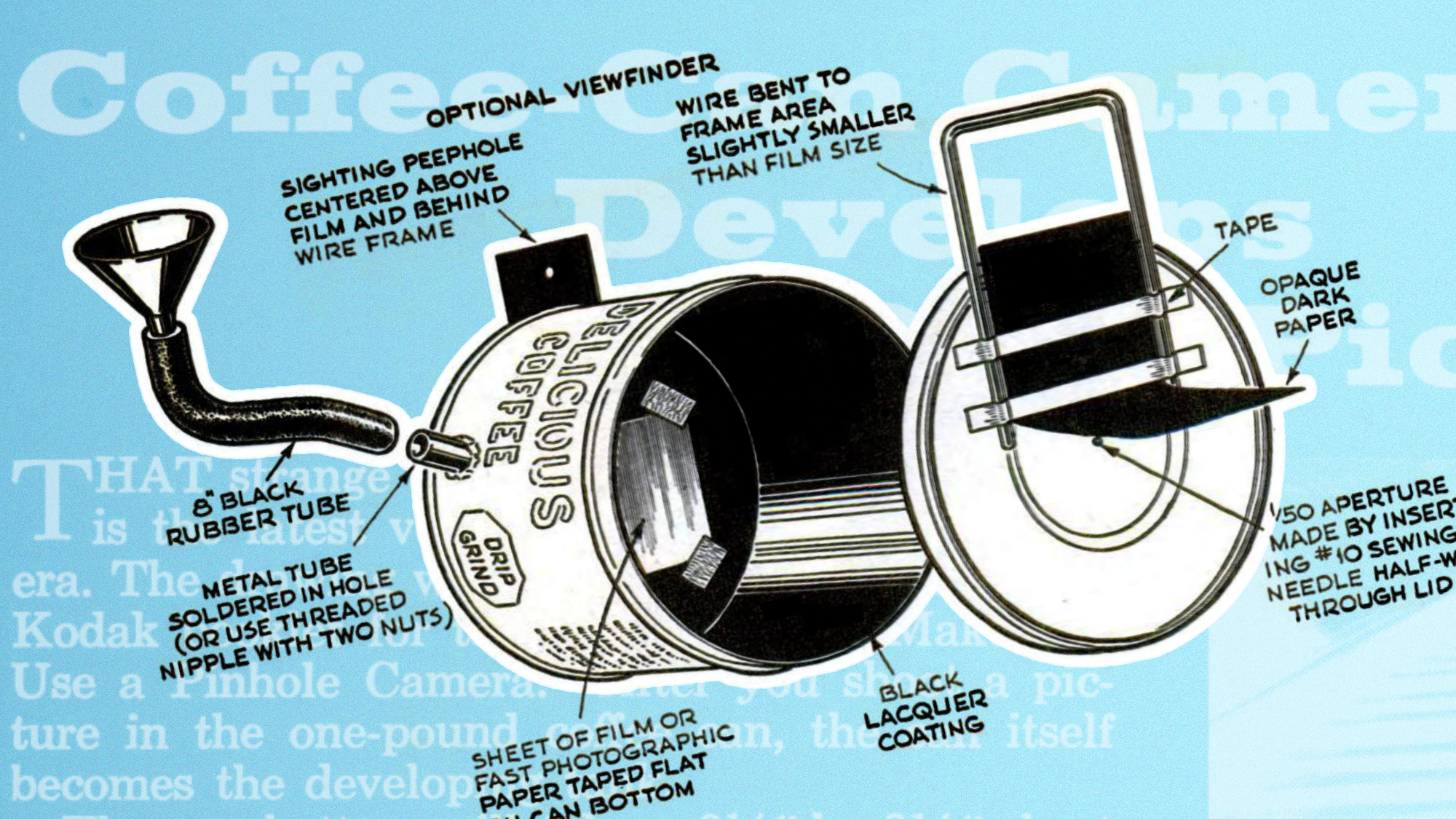
Since Popular Science published the project, photography has come a long way (for better or for worse).

Posted on Jun 16, 2024 1:00 PM EDT
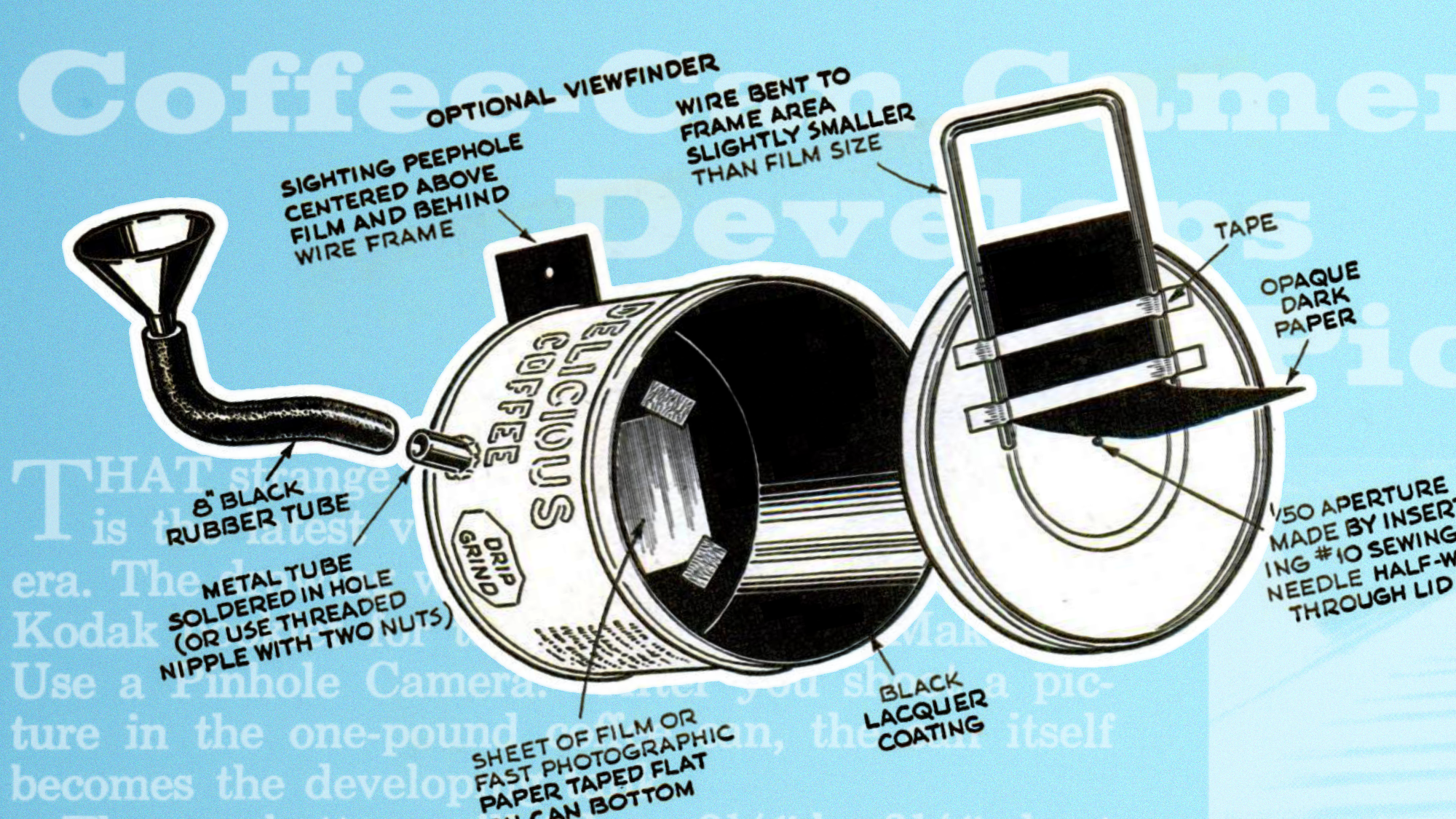
From the January 1961 issue. Credit: Popular Science
At about the time when coffee gained ground across the Near East in the 16th century—giving rise to coffee houses which quickly became important cultural centers—optical inventions like the compound microscope and telescope were also making their debut. Among these, the camera obscura became an essential tool for artisans to capture relatively detailed real-world images. Much later, in January 1961, Popular Science published instructions that leveraged the physics of the camera obscura to build a homemade coffee-can camera, combining unlikely staples with Renaissance origins. It was novel then—and still is now—to use a coffee can to make a camera capable of also being a developing tank for the film, oran “instant” photo, just like a Polaroid. Let’s dive into the technique.
Popular Science and the camera obscura
The camera obscura, ancestor of the photographic camera, was typically a wooden box fitted with a lens on one side and an angled mirror inside that projected real-world images onto a frosted plate of glass or drawing paper, which could be traced by artists to capture fine details. It was Joseph Nicéphore Niépce, an inventor from France, who was among the first to transform the manual process of tracing camera obscura projections into an automated process that used chemistry to fix the image on a plate.
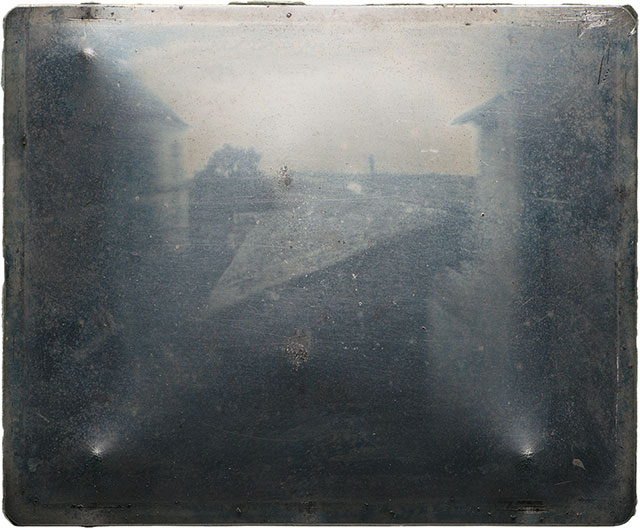 Joseph Nicéphore Niépce (French, 1765–1833), Untitled ‘point de vue,’ 1827. Heliograph on pewter, 16.7 x 20.3 x .15 cm. Gernsheim Collection, purchase, 964:0000:0001. Harry Ransom Center.
The earliest surviving photo was recorded by Niépce in 1826. Soon after, he teamed up with Louis Jacques Mandé Daguerre, a Romantic Period painter, to perfect the chemical process of capturing images. In 1839, Daguerre revealed his eponymous daguerreotype, which set in motion decades of photographic innovation. Eastman Kodak introduced its popular Brownie camera in 1900 to anyone who could afford its $1 price tag.
[ Related: Inside look: This vault holds the world’s greatest collection of historic cameras ]
But even as manufactured cameras spread, homemade cameras, or pinhole cameras, modeled after photography’s ancestor, the camera obscura, remained popular. All it required was a small container, like a shoebox, and some photographic paper. In fact, more than a century ago, Popular Science started offering do-it-yourself instructions for homemade pinhole cameras. A 1918 story recommended a cardboard box with “a sheet of tinfoil and pillbox” for the lens. A needle was used to poke a hole in the tinfoil to allow light into the chamber.
 September 1918, Popular Science
The editor, John F. Mahoney, explained just how the camera worked:
“If the room is darkened except for the one light, an inverted image of the lamp filament will appear on the second sheet of cardboard, incidentally proving that light travels in straight lines. From each point on the lamp filament, a light ray passes through the hole, and registers itself on the dark sheet of cardboard. Joining together, these points of light make up the image, its size depending on the distance from the light source, which may be an open gas flame as well as an incandescent lamp.”
It’s worth noting that even though human eyes work like pinhole cameras—the pupil for the aperture, the retina for the film—fortunately for us, we don’t see the world upside down. That’s because our brain leverages myriad inputs that tell us which direction is up, thereby inverting images before they register. Plus, having two lenses (eyes) slightly separated enables us to see the world in 3D.
Toward the end of the 20th century, the chemistry of photography gave way to computational photography, simplifying and accelerating the process of capturing images. By coupling cameras with phones, photography became so accessible it sparked photo and video sensations such as Facebook, YouTube, Instagram, and TikTok, which may be too much of a good thing, according to recent reports.
Long before social media, American writer and critic Susan Sontag made no secret of her general distaste for photography, predicting that our culture would be consumed by it. In her 1977 essay “The Image-World,” she suggested that “photographs are a way of imprisoning reality,” of subsuming reality itself by packaging the real world into convenient, digestible chunks. In the late 1970s, when digital cameras were still the size of toaster ovens—making coffee-can cameras look sleek—her ideas were provocative. Today with smartphones in more than half the world’s hands, they seem prescient. And yet, even Sontag might have admitted that there’s something very Renaissance about imprisoning reality in a coffee can.
No doubt, snapping a photo with your phone beats whipping out your coffee can to capture those important moments, although you might elicit some startled expressions. And yet, like a Polaroid, your coffee-can camera will serve up an on-the-spot physical image (just make sure you’re not in a hurry and have some chemicals handy) that your phone can’t produce. If that notion appeals to you, these steps will liberate your repressed do-it-yourself longings. Although the original instructions date back more than half a century, all of the supplies are still readily available, thanks to—you guessed it—digital media and online shopping.
 January 1961, Popular Science
Step 1: Build your instant camera
While the scant instructions offered in our 1961 story provide the basic parts and schematic, all of which can be obtained at grocery and hardware stores (or online), you might want to view contemporary videos like a coffee can camera tutorial and written instructions that will take you through the steps for assembling a pinhole camera, while explaining important features. For instance, it’s essential to have a chamber that is black and completely sealed from light—except when the shutter is opened to snap a picture. Note that the 1961 version includes a tube and funnel to pour in the developer and fixer solutions. (Also note that it suggests using black lacquer to coat the interior. Lacquer likely holds up against the solutions, whereas flat paint might not.)
Step 2: Prepare your film and solutions
There are several companies that still make photographic paper for film, such as Ilford. Remember, though, that whenever you work with photographic film, darkness is essential, which means cutting the paper down to size and inserting it in the camera in a dark room. If you’re working with black and white film, red light is okay to help you see what you’re doing. Otherwise, you’ll need a darkroom safelight.
To develop the film, you’ll need developer and fixer solutions, offered by companies like Kodak and Dektol. If they’re too pricey, a video from The Royal Institution explains how to make your own homemade solutions using common household ingredients like mint, baking soda, chewable Vitamin C tablets, and lemon juice.
Step 3: Light! Camera! Action!
Once your camera is loaded with film and ready to take pictures, some trial and error will be required to find the right exposure time, which depends on a number of factors like the size of your pinhole and the lighting—the brighter the day, the less exposure time required.
The unique feature of the 1961 coffee-can camera is the ability to use the can as the darkroom. Once you’ve taken your photo, you’ll want to pour in some developer solution through the funnel and tube, keeping the lid on tight and bending the tube to prevent light from entering. Let it set for several minutes. Again, you’ll have to find the right interval through trial and error. Pour out the developer solution through the tube then pour in some water to rinse it. After pouring out the water, you’ll want to add the fixer solution and let that sit for several minutes. At this point, it’s safe to open the can. You should see your image on the film. Rinse the can with water, carefully remove your image, and let it dry.
For a true Renaissance experience, take your coffee-can camera down to your local café or coffeehouse and set it up. No one will get the connection, but you’ll be in good company, sipping coffee, exchanging heady ideas with friends, and snapping their portraits on your replica of a camera obscura—traditions that date back more than half a millennium.
>>> Read full article>>>
Copyright for syndicated content belongs to the linked Source : Popular Science – https://www.popsci.com/diy/coffee-can-camera/



