







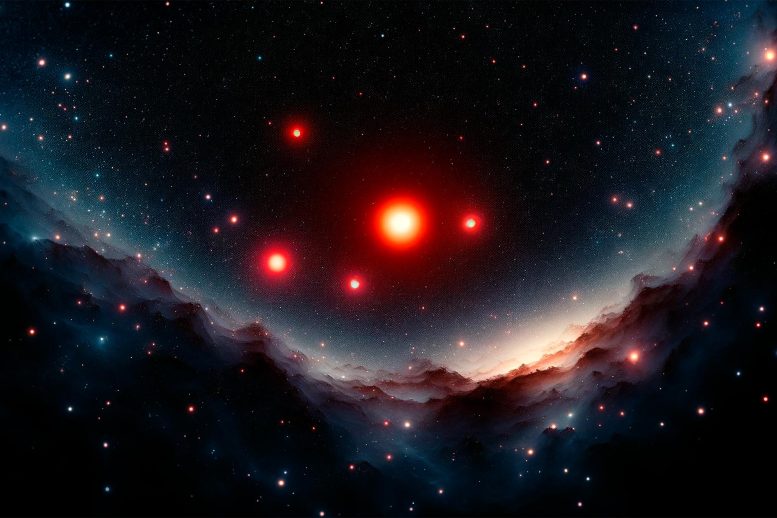
The James Webb Space Telescope identified small red dots in the night sky, revealing new insights into the formation of supermassive black holes, challenging existing astronomical theories about their rapid growth in the universe’s early days. (Artist’s concept.) Credit: SciTechDaily.com
The James Webb Space Telescope makes one of the most unexpected findings within its first year of service: A high number of faint little red dots in the distant Universe could change the way we understand the genesis of supermassive black holes. The research, led by Jorryt Matthee, Assistant Professor in astrophysics at the Institute of Science and Technology Austria (ISTA), is now published in The Astrophysical Journal.
A bunch of little red dots found in a tiny region of our night sky might be an unexpected breakthrough for the James Webb Space Telescope (JWST) within its first year of service. These objects were indistinguishable from normal galaxies through the ‘eyes’ of the older Hubble Space Telescope.
“Without having been developed for this specific purpose, the JWST helped us determine that faint little red dots–found very far away in the Universe’s distant past–are small versions of extremely massive black holes. These special objects could change the way we think about the genesis of black holes,” says Jorryt Matthee, Assistant Professor at the Institute of Science and Technology Austria (ISTA), and lead author of the study.
“The present findings could bring us one step closer to answering one of the greatest dilemmas in astronomy: According to the current models, some supermassive black holes in the early Universe have simply grown ‘too fast’. Then how did they form?”
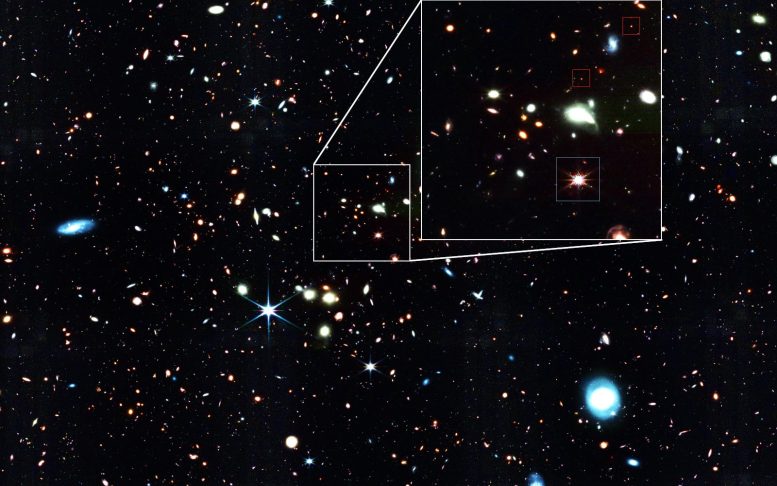
Giant quasar and little red dots. A NASA/ESA/CSA James Webb Space Telescope (JWST) NIRCam picture of the luminous quasar J1148+5251, an extremely rare active supermassive black hole of 10 billion solar masses. The quasar’s light, the orange star-like source with six clear diffraction spikes, was emitted 13 billion years ago. The existence of such massive black holes in the young Universe poses an important challenge to black hole and galaxy formation theories. Simultaneously, the image captured small, point-like red objects, the so-called little red dots. Several such objects appear in virtually every deep JWST image. Like the quasar J1148+5251, the light from these objects (that in these cases was emitted 12.5 billion years ago) is also powered by supermassive black holes. However, these black holes are a factor of hundred to a thousand lower in mass and heavily obscured by dust (making them appear red). The little red dots could represent galaxies that are in an evolutionary phase that predates the luminous quasar phase, and therefore help researchers understand the formation and role of supermassive black holes in distant galaxies.
The image was taken as part of the EIGER project.
Credit: NASA, ESA, CSA, J. Matthee (ISTA), R. Mackenzie (ETH Zurich), D. Kashino (National Observatory of Japan), S. Lilly (ETH Zurich)
The cosmic points of no return
Scientists have long considered black holes a mathematical curiosity until their existence became increasingly evident. These strange cosmic bottomless pits could have such compact masses and strong gravities that nothing can escape their force of attraction–they suck in anything, including cosmic dust, planets, and stars, and deform the space and time around them such that even light cannot escape.
The general theory of relativity, published by Albert Einstein over a century ago, predicted that black holes could have any mass. Some of the most intriguing black holes are the supermassive black holes (SMBHs), which could reach millions to billions of times the mass of the Sun. Astrophysicists agree that there is an SMBH at the center of almost every large galaxy. The proof that Sagittarius A* is an SMBH in the center of our Galaxy with over four million times the Sun’s mass, earned the 2020 Nobel Prize in Physics.
Too massive to be there
However, not all SMBHs are the same. While Sagittarius A* could be compared to a sleeping volcano, some SMBHs grow extremely rapidly by engulfing astronomic amounts of matter. Thus, they become so luminous that they can be observed until the edge of the ever-expanding Universe. These SMBHs are called quasars and are among the brightest objects in the Universe.
“One issue with quasars is that some of them seem to be overly massive, too massive given the age of the Universe at which the quasars are observed. We call them the ‘problematic quasars,’” says Matthee. “If we consider that quasars originate from the explosions of massive stars–and that we know their maximum growth rate from the general laws of physics, some of them look like they have grown faster than is possible. It’s like looking at a five-year-old child that is two meters tall. Something doesn’t add up,” he explains.
Could SMBHs perhaps grow even faster than we originally thought? Or do they form differently?

Jorryt Matthee, Assistant Professor at the Institute of Science and Technology Austria (ISTA). Credit: © Peter Rigaud / ISTA
Small versions of giant cosmic monsters
Now, Matthee and his colleagues identify a population of objects that appear as little red dots in JWST images. Also, they demonstrate that these objects are SMBHs, but not overly massive ones. Central in determining that these objects are SMBHs was the detection of Hα spectral emission lines with wide line profiles. Hα lines are spectral lines in the deep-red region of visible light that are emitted when hydrogen atoms are heated. The width of the spectra traces the motion of the gas.
“The wider the base of the Hα lines, the higher the gas velocity. Thus, these spectra tell us that we are looking at a very small gas cloud that moves extremely rapidly and orbits something very massive like an SMBH,” says Matthee.
However, the little red dots are not the giant cosmic monsters found in overly massive SMBHs. “While the ‘problematic quasars’ are blue, extremely bright, and reach billions of times the mass of the Sun, the little red dots are more like ‘baby quasars.’ Their masses lie between ten and a hundred million solar masses. Also, they appear red because they are dusty. The dust obscures the black holes and reddens the colors,” says Matthee.
But eventually, the outflow of gas from the black holes will puncture the dust cocoon, and giants will evolve from these little red dots. Thus, the ISTA astrophysicist and his team suggest that the little red dots are small, red versions of giant blue SMBHs in the phase that predates the problematic quasars. “Studying baby versions of the overly massive SMBHs in more detail will allow us to better understand how problematic quasars come to exist.”
A “breakthrough” technology
Matthee and his team could find the baby quasars thanks to the datasets acquired by the EIGER (Emission-line galaxies and Intergalactic Gas in the Epoch of Reionization) and FRESCO (First Reionization Epoch Spectroscopically Complete Observations) collaborations. These are a large and a medium JWST program in which Matthee was involved. Last December, the Physics World magazine listed EIGER among the top 10 breakthroughs of the year for 2023.
“EIGER was designed to study specifically the rare blue supermassive quasars and their environments. It was not designed to find the little red dots. But we found them by chance in the same dataset. This is because, by using the JWST’s Near Infrared Camera, EIGER acquires emission spectra of all objects in the Universe,” says Matthee. “If you raise your index finger and extend your arm completely, the region of the night sky we explored corresponds to roughly a twentieth of the surface of your nail. So far, we have probably only scratched the surface.”
Matthee is confident that the present study will open up many avenues and help answer some of the big questions about the Universe. “Black holes and SMBHs are possibly the most interesting things in the Universe. It’s hard to explain why they are there, but they are there. We hope that this work will help us lift one of the biggest veils of mystery about the Universe,” he concludes.
Shortly before publication of this article, the Space Telescope Science Institute (STScI) announced the selected program proposals for JWST’s third year of science operations. Among the programs that passed the competitive selection was Matthee’s proposal “Dissecting Little Red Dots: the connection between early SMBH growth and cosmic reionization”, which will total 45 hours on JWST.
Reference: “Little Red Dots: An Abundant Population of Faint Active Galactic Nuclei at z ∼ 5 Revealed by the EIGER and FRESCO JWST Surveys” by Jorryt Matthee, Rohan P. Naidu, Gabriel Brammer, John Chisholm, Anna-Christina Eilers, Andy Goulding, Jenny Greene, Daichi Kashino, Ivo Labbe, Simon J. Lilly, Ruari Mackenzie, Pascal A. Oesch, Andrea Weibel, Stijn Wuyts, Mengyuan Xiao, Rongmon Bordoloi, Rychard Bouwens, Pieter van Dokkum, Garth Illingworth, Ivan Kramarenko, Michael V. Maseda, Charlotte Mason, Romain A. Meyer, Erica J. Nelson, Naveen A. Reddy, Irene Shivaei, Robert A. Simcoe and Minghao Yue, 7 March 2024, The Astrophysical Journal.
DOI: 10.3847/1538-4357/ad2345
>>> Read full article>>>
Copyright for syndicated content belongs to the linked Source : SciTechDaily – https://scitechdaily.com/infant-giants-webb-unveils-the-growth-of-supermassive-black-holes/



