






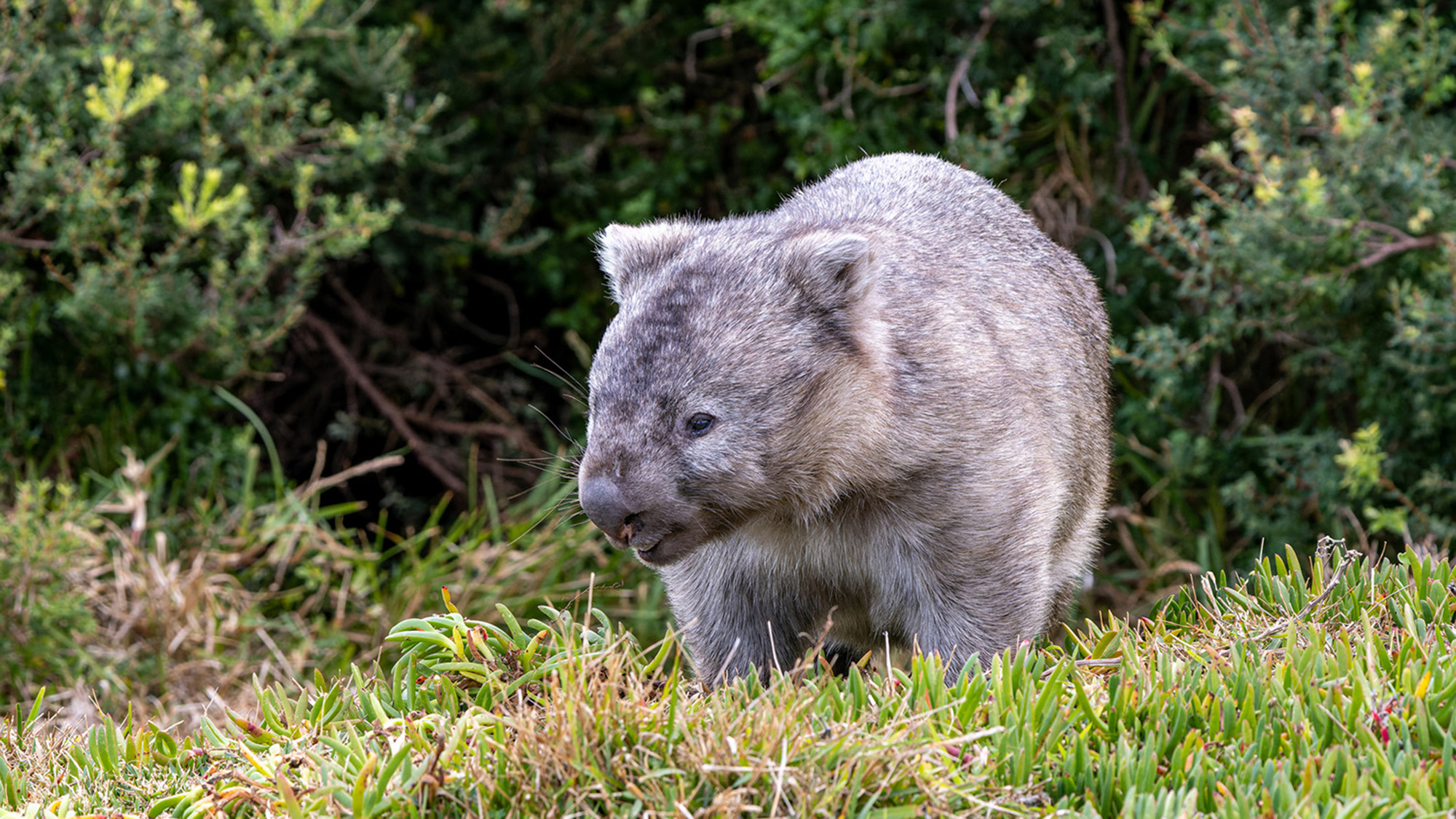

“This is a species that everyone loves, but just doesn’t know too much about.” Credit: JAMES CHURCHES / iNATURALIST
This article was originally featured on Knowable Magazine.
When Sydney hosted the 2000 Summer Olympics, an unlikely hero emerged: an unofficial mascot known as Fatso the Fat-Arsed Wombat. Introduced by comedians, it helped to kick off a wave of love for a critter not always adored by human Australians. Over the centuries, the native marsupial has been eaten in stew and maligned as a pest. Now, it’s a focus of conservation and animal welfare efforts.
Wombats are closely related to koalas and nurture their young in pouches like other marsupials. Of the three species, one is threatened and another endangered, but the bare-nosed wombat (Vombatus ursinus), found in Southeast Australia and Tasmania and thought to number more than a million, is neither. So it’s been studied less than its hairy-nosed cousins.
“This is a species that everyone loves, but just doesn’t know too much about,” says Georgia Stannard, an archaeologist at La Trobe University in Bundoora/Melbourne.
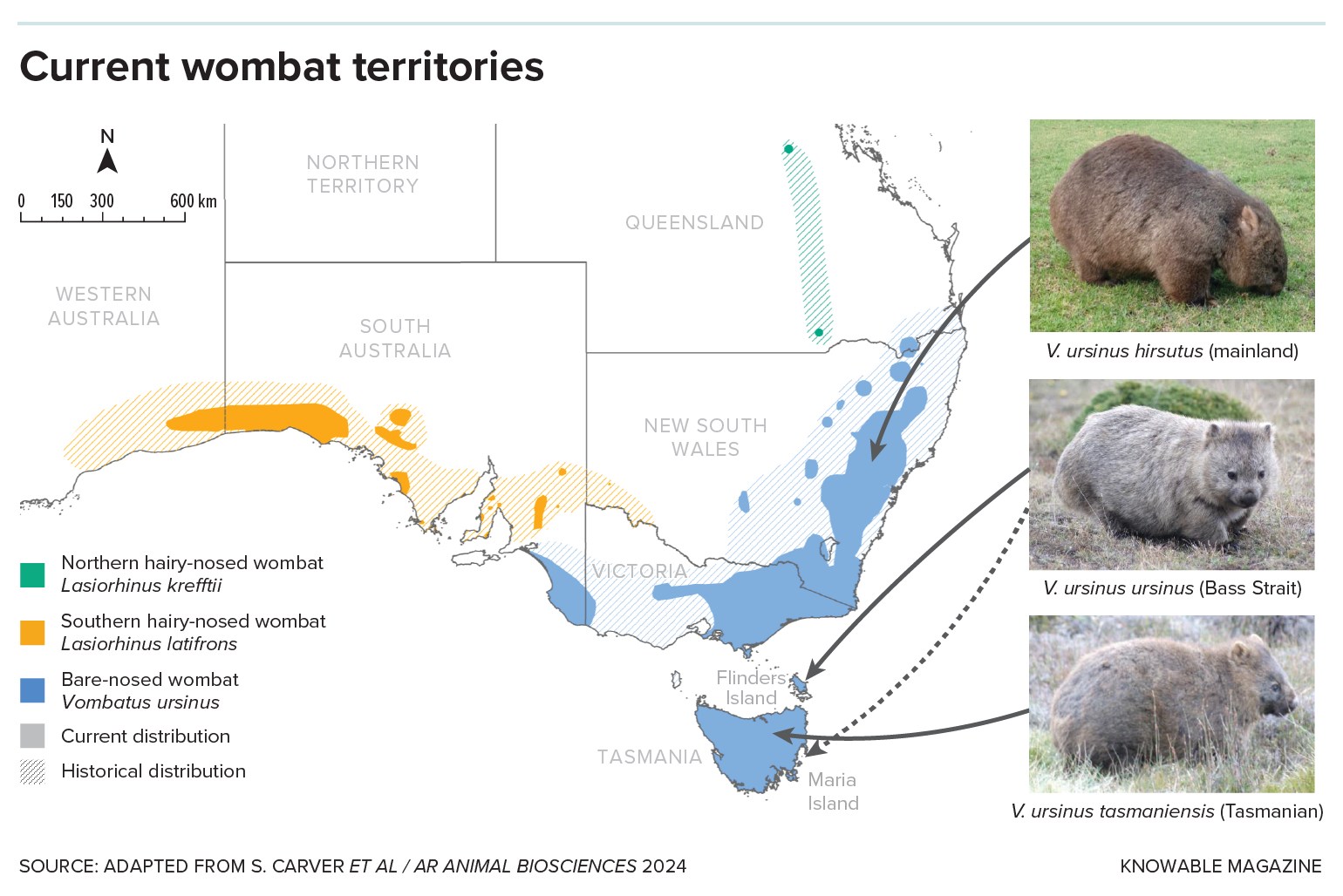 Although bare-nosed wombats have seen their range shrink, they are still the most widely distributed wombat species, inhabiting the southeastern region of Australia, Flinders Island and Tasmania (three varieties pictured). Populations of the two hairy-nosed species have dwindled to alarming levels.
Stannard is one of a handful of scientists working to change that, and the efforts are bearing fruit. Over the past decade, research on bare-nosed wombats has revealed characteristics of its subterranean habitat (as explored by robot), the meat cuts most favored by Tasmanian Aboriginal peoples thousands of years ago (head, chest and forelimbs were brought home to the cave), and the intestinal methods responsible for its startling, cube-shaped droppings (which earned a tongue-in-cheek Ig Nobel Prize in 2019). Recent work has also illuminated the worrisome effects of a parasitic disease that first came to the continent with European colonists.
Stannard, along with Scott Carver of the University of Georgia in Athens and Alynn Martin of Texas A&M University-Kingsville, summarized the state of knowledge on the bare-nosed wombat in the 2024 Annual Review of Animal Biosciences. In addition to noting its prodigious digging prowess and busting wombat myths (it does not have a square-shaped anus and is unlikely to attain speeds of 25 miles per hour), the authors write that bare-nosed wombats could be in trouble due to dangers from roads and conflicts with people. Climate change and the spread of mange also pose hazards to the remaining populations.
“It’s not a big stretch of the imagination to say within, potentially, I guess 50 to 100 years, that wombats could decline to a point that they would be considered endangered,” Stannard says.
Human-wombat relations: It’s complicated
The wombat’s relationship with people goes back millennia. For example, researchers found wombat remains in a Tasmanian cave used by humans 20,000 to 15,000 years ago. Wombats were good eats, Stannard says — “little casseroles on legs.” (Stannard hasn’t had a taste, but the journals of George Augustus Robinson, a Briton and liaison to Indigenous populations in the 1800s, report that wombat rump made a yummy stew with onions and potatoes.)
Colonists and early visitors to Australia appreciated wombats at first, along with other iconic species such as the platypus. “They were one of the most popular Australian animals,” says Carver, an ecologist who began studying the creatures while at the University of Tasmania in Hobart.
But that fascination soured when wombats, prolific diggers, got caught up in the general rage against pesky, non-native rabbits. Rabbits were introduced for hunting in 1859 and spread like, well, rabbits, excavating warrens and causing extensive ecological damage across most of the continent. Wombat burrowing is good for the soil because it turns over nutrients. But beleaguered farmers, worried about their crops, fences and dams, didn’t always make the distinction between burrowing wombats and burrowing rabbits. By the mid-1900s, officials in the state of Victoria were offering a bounty of one dollar per wombat head.
Even in the late 1900s, says Stannard, “wombats were considered a big pest” — and in some parts of Australia, they still are.
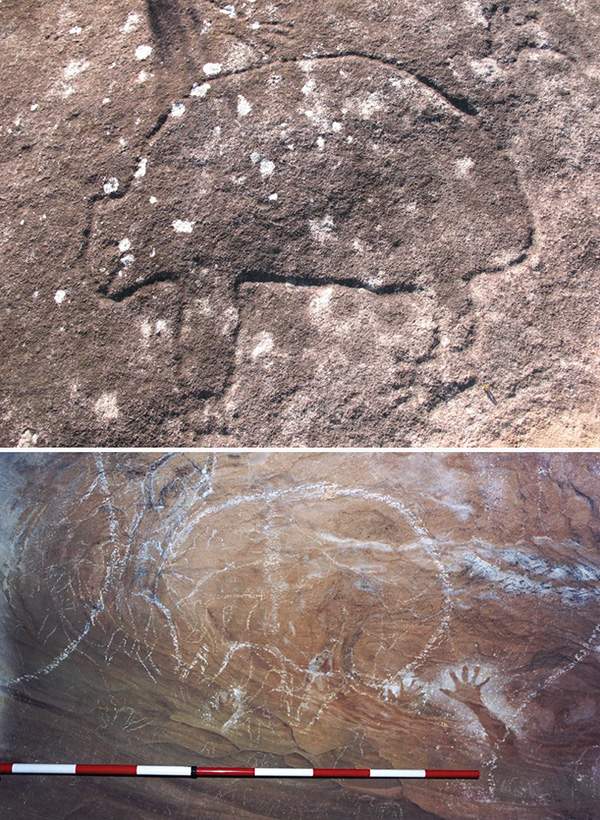 Wombats feature in Aboriginal rock art discovered in a cavern at Wollemi National Park, northwest of Sydney. CREDIT: S. CARVER ET AL / AR ANIMAL BIOSCIENCES 2024
But wombats are again feeling the love, and experts, at least, appreciate their benefits. “They are ecological engineers,” says Julie Old, a biologist at Western Sydney University. “Their burrowing makes habitat for other animals and supports plant growth through aeration of the soil and making water more accessible.”
Some people still kill wombats to protect their buildings or crops, but this typically requires a license, and conservationists have found ways to protect infrastructure. If wombats dig under fencing, farmers can add wombat-sized gates. Made of wire mesh and swinging like doggy doors, they’re weighted to allow wombats to push through but to block undesirable critters, such as wallabies that eat grass meant for sheep. Other one-way gates can be draped across entries to burrows in places where the wombats are not wanted so that any of the animals inside can escape but not get back in, Old says.
Digging into wombat science
Bare-nosed wombats now inhabit a crescent-shaped swath of southeastern Australia, plus Tasmania and Flinders Island, which lies between Tasmania and the mainland. While their subterranean habitats make them difficult to count, Carver and others estimate there are more than 1.3 million of them around. Using genetic markers, Carver has found that the mainland, Tasmania and Flinders Island populations are genetically distinct.
Even with new efforts to protect them, their populations still face many dangers. They frequently end up as roadkill. Climate change may force the cool-weather-loving critters to higher elevations. And colonists, presumably, introduced the mite Sarcoptes scabiei to the landscape. The mite causes annoying scabies in people and similar symptoms in other mammals, but a debilitating “crusted mange” in wombats, records of which go back a century.
 Wombats share their underground burrows, which provide a cool, humid environment in which the mite Sarcoptes scabiei can survive. Thus, a healthy wombat can pick up the mange-causing mite when it visits a burrow previously used by an infected animal. CREDIT: E. BROWNE ET AL / INTERNATIONAL JOURNAL FOR PARASITOLOGY: PARASITES AND WILDLIFE 2021
The mites burrow into the wombat’s skin. The marsupial’s fur falls out, and it becomes emaciated and disoriented. Cracks fracture the skin, and if not treated, the creature eventually dies of secondary infections. “It is horrific,” says Old.
Carver and other researchers are working to understand the bare-nosed wombat to better gauge which threats are the most pressing. Carver names vehicle collisions, mange and encounters with landowners as key issues.
To gather more information, Old runs a citizen science project, WomSAT, that tracks wombat sightings, collects population data and raises awareness about the animals. She expects it will help scientists to understand the rates of mange and to identify roadkill hotspots, so they can use this information to support wombats.
WomSAT has mapped more than 23,000 wombat sightings from as far north as Brisbane and as far west as Adelaide, with occasional reports beyond today’s typical range. One citizen-scientist caught wombats mating on video. The data so far show that many wombats die on roads, particularly during late winter and early spring. In response, Australians have erected cautionary road signs at some common wombat crossings.
Historical records and more recent research show that wombats share burrows as they travel their home ranges, helping to spread mange. When Carver investigated those burrows using a robot called the WomBot, he discovered that the cool, humid underground environment is ideal for mite survival and transmission. Conservationists are trying to protect the wombats with wire contraptions rigged over burrow entrances so that exiting wombats will trigger a deluge of topical medication, but it’s not clear how much this helps. Researchers are field-testing longer-lasting medications, Carver says.
Although his research has expanded to include other hosts that are also infected by the mange mite, he says he wouldn’t have missed the 10-plus years he spent chasing the shy, solitary creatures and investigating their geometrical scat (even including the times he caught scabies from his subjects). Studies on bare-nosed wombats, he hopes, will continue to waddle along, like the creatures do.
“They’re a fascinating animal,” says Carver.
This article originally appeared in Knowable Magazine, an independent journalistic endeavor from Annual Reviews. Sign up for the newsletter.
>>> Read full article>>>
Copyright for syndicated content belongs to the linked Source : Popular Science – https://www.popsci.com/science/inside-the-secret-lives-of-wombats/



