







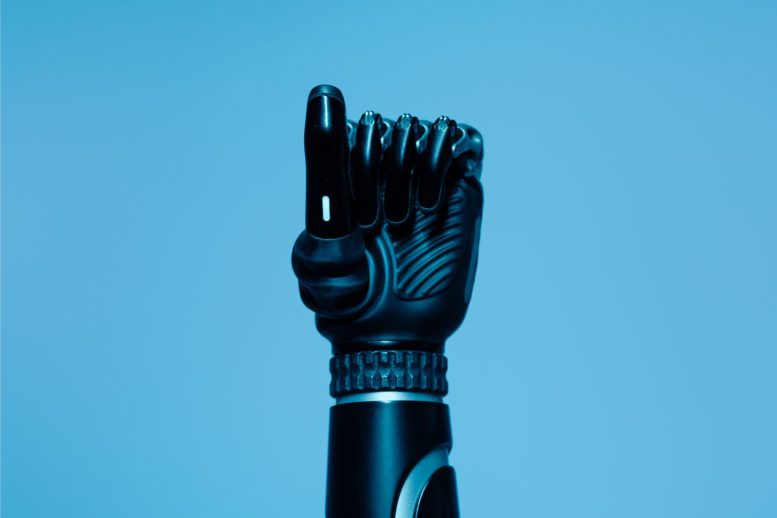
Researchers have developed the thin-film thermoelectric cooler (TFTEC), one of the world’s smallest and fastest refrigeration devices, for applications like improved prosthetics and augmented reality. Collaboration with neuroscientists has allowed amputees to perceive temperature with phantom limbs, a first-of-its-kind advancement that has implications for prostheses, haptics, and other applications like cooling electronics and energy harvesting in satellites. (Artist’s Concept)
Researchers at Johns Hopkins Applied Physics Laboratory (APL) have developed one of the smallest, most intense, and fastest refrigeration devices, known as the wearable thin-film thermoelectric cooler (TFTEC). They have joined forces with neuroscientists to help amputees feel temperature with their phantom limbs.
This pioneering development opens up a wide range of beneficial new functionalities, including enhanced prosthetics, tactile feedback in novel augmented reality (AR) formats, and thermally-regulated therapies for use cases like pain relief. The technology is also potentially valuable in an array of industrial and research contexts, such as cooling electronics and lasers, and energy harvesting in satellites.
TFTEC development at APL started in 2016, when Rama Venkatasubramanian, a semiconductor device engineer and chief technologist for APL’s thermoelectrics research, began developing advanced nano-engineered thermoelectric materials and devices for the Defense Advanced Research Projects Agency (DARPA) MATRIX program. To support MATRIX, APL developed advanced thin-film thermoelectric materials called Controlled Hierarchically Engineered Superlattice Structures (CHESS), to enable an entirely new set of transduction capabilities for several Department of Defense applications, including cooling computer chips and engine components.
Venkatasubramanian’s strides in CHESS thermoelectrics were so significant by the end of 2019 that Bobby Armiger, who supervises APL’s Exploratory Science Branch, wondered if his devices could be used to facilitate temperature sensation in phantom limbs of amputees for improved prostheses. Since 2006, APL had been leading DARPA’s Revolutionizing Prosthetics program, an effort focused on creating a mentally controlled artificial limb that will restore near-natural motor and sensory capability to upper-extremity amputee patients.
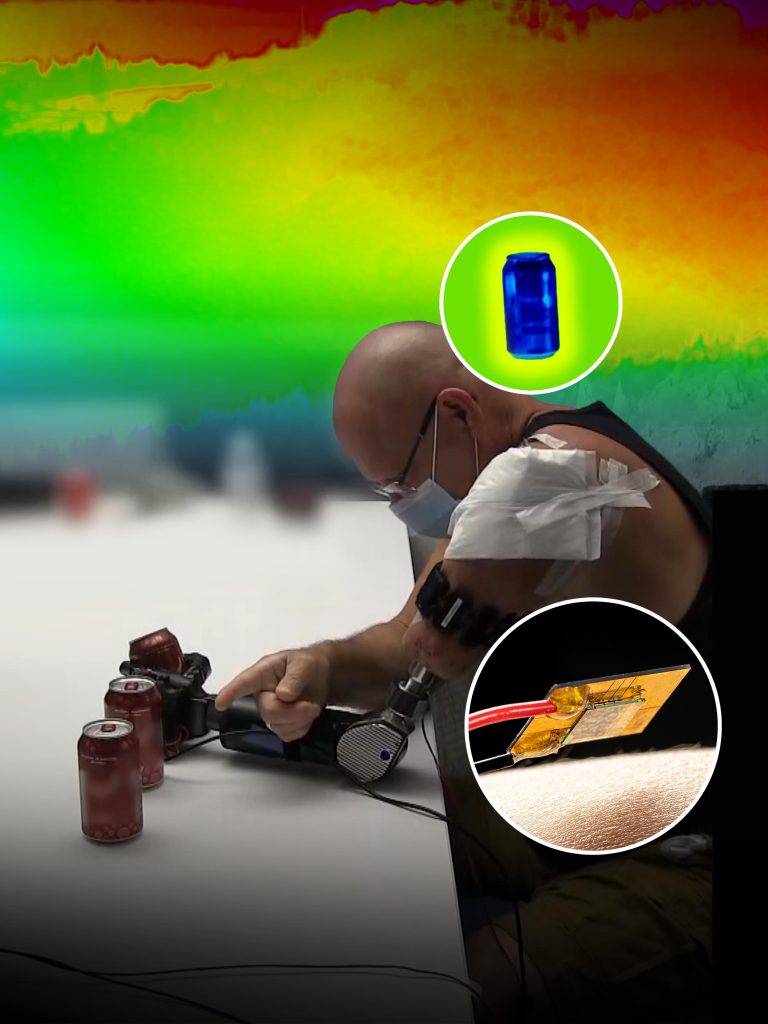
Johnny Matheny, a prosthetics tester, determines which cola can is the coldest using a modular prosthetic limb and thin-film thermoelectric device, both developed by the Johns Hopkins Applied Physics Laboratory. Credit: Ed Whitman / Johns Hopkins University Applied Physics Laboratory
“We’ve known that we can stimulate specific parts of someone’s amputated limb to feel sensations of touch and vibration, but no one has been able to create a cooling sensation with the speed, intensity, and efficiency to restore natural thermal perception with a prosthetic system,” Armiger said. “Restoring temperature sensation has practical applications — like identifying a cold beverage — as well as having the potential to improve the emotional embodiment of the prosthetic device, perhaps by feeling the warmth of a loved one’s hand.”
Venkatasubramanian and the thermoelectrics team began collaborating with Armiger and a team of neuroscientists and roboticists as part of a study supported by the Center for Rehabilitation Sciences Research within the Department of Physical Medicine & Rehabilitation (PM&R) at the Uniformed Services University of the Health Sciences (USU), through a sub-award from The Henry M. Jackson Foundation for the Advancement of Military Medicine to create a wearable thermoelectric cooler fast and intense enough to match the human body’s ability to rapidly sense temperature changes.
From that, the wearable TFTEC was created.
“Our TFTEC is just a little more than one millimeter thick, weighs only 0.05 grams, similar to a thin adhesive bandage, and can provide intense cooling in less than a second,” said Venkatasubramanian. “It’s also two times more energy efficient than today’s most common thermoelectric devices, and can be readily manufactured using semiconductor tools that are also used for manufacturing light-emitting diodes [LEDs]. It’s an exciting development that could have huge implications for prostheses and haptics applications.”
To test the TFTEC’s efficacy, researchers mapped thermal sensations in the phantom hands of four amputees.
“When someone loses part of a limb, the nerves within the residual limb are still there, which can lead to the ‘phantom’ limb sensation,” said Luke Osborn, a neuroengineering researcher who leads much of APL’s noninvasive nerve simulation work. “You can place electrodes on different parts of an amputee’s upper arm where those nerves have regrown and stimulate sensation — typically pressure, but in the current case, temperature —and the individual can tell us where in their phantom hand they feel those sensations.”
Nature Biomedical Engineering recently published results from APL’s extensive TFTEC research for such sensory applications, which included lab-scale characterization, trials with amputees, and a real-life demonstration of the approach. The study notes that the TFTEC elicited cooling sensations in the phantom limbs of all participants during a cold detection task, whereas traditional thermoelectric technology only did so in half of them — and the TFTEC did so eight times faster and with three times the intensity. Additionally, TFTEC used half the energy compared to current thermoelectric devices.
“We found that the TFTEC device was significantly better at creating faster and more intense cooling sensations compared to traditional devices, even though the target temperature was the same,” said Osborn. “And that helped participants make faster decisions and observations.”
The stimulation sites on test participants remained the same over 48 weeks of testing, suggesting that the technology could enable users to feel the temperature in their missing hands for years. This temporal stability along with a wearable noninvasive procedure are attractive for adoption to real-world use.
“When we started our work in March 2020, we realized that within just a couple of trials, we could stimulate the phantom limbs of an amputee,” said Venkatasubramanian. “We heard participants say, ‘Yes, I felt an immediate cold feeling here and a tingle there.’”
The APL team continued to perfect its approach through testing on several individuals with amputation along with those with an intact limb. “These are the developments we dream of as scientists,” Venkatasubramanian continued. “We spend years in the lab, and to see our technology have an impact on someone’s quality of life, like an amputee to perceive the natural thermal world, is incredibly satisfying.”
Capable of generating realistic and informative thermal signals for human perception — at a fraction of the energy and size compared to today’s cooling technologies — the devices’ low profile, high-speed, and lightweight nature make them suitable for skin surface applications without hindrances that could affect movement.
“It has been great to see the translation of this APL-developed thermoelectric technology into the healthcare domain through this first-of-kind demonstration in an amputee,” said David Drewry, a biomedical engineer and program manager within APL’s National Health Mission Area. “We look forward to expanding the results in more robust clinical trials and integrating the device into other wearable form factors that can be readily deployed to individuals in need of sensory restoration or haptic feedback.”
Katy Carneal, a biomedical engineer and assistant program manager a biomedical engineer and assistant program manager who leads innovative health-related research at APL sees a vast set of future applications for the miniaturized thermoelectric technology. “There are so many ways that pressure and temperature sensations impact the human body,” said Carneal. “In addition to improving the quality of life for amputees, we’ve opened a lot of research doors that can help us study and find new treatments for neuromuscular diseases or chronic pain.”
Dr. Paul Pasquina, the chair of PM&R at USU, echoed that enthusiasm while praising the work of the APL team. “What a privilege it is to work with such expert engineers to come up with solutions to help real-world patients, including our wounded warriors with limb loss,” he said.
APL is uniquely qualified to advance the art-of-the-possible for novel health applications by exploring this intersection of materials science and electronic device engineering with biology and neuroscience. In addition to the Revolutionizing Prosthetics program, APL is making significant advances in neural interface research, improving genomics tools, and monitoring physical fatigue to prevent warfighter injuries among many other advancements in the National Health Mission Area.
Reference: “Evoking natural thermal perceptions using a thin-film thermoelectric device with high cooling power density and speed” by Luke E. Osborn, Rama Venkatasubramanian, Meiyong Himmtann, Courtney W. Moran, Jonathan M. Pierce, Priya Gajendiran, Jared M. Wormley, Richard J. Ung, Harrison H. Nguyen, Adam C. G. Crego, Matthew S. Fifer and Robert S. Armiger, 27 July 2023, Nature Biomedical Engineering.
DOI: 10.1038/s41551-023-01070-w
>>> Read full article>>>
Copyright for syndicated content belongs to the linked Source : SciTechDaily – https://scitechdaily.com/new-technology-restores-cold-sensation-in-amputees-phantom-limbs/



