





* . *
  • About
  • Advertise
  • Privacy & Policy
  • Contact
Thursday, January 29, 2026
Earth-News
  • Home
  • Business
  • Entertainment

    Live Nation, DF Entertainment, and Dale Play Live Join Forces for Long-Term Partnership with Club Atlético River Plate at Mâs Monumental Stadium

    O’Dowd, Dolphin Entertainment CEO, buys $4.9k in DLPN stock – Investing.com

    Sacramento Boosts Small Businesses with Exciting Live Entertainment Opportunities

    The Westerlies Share Exciting News on Grammy 2026 Nominations and Upcoming Albums

    GlowFest Lights Up Las Vegas with a Magical and Unforgettable Experience

    USF’s Spring Play and New Bouldering Wall Take Center Stage in Entertainment Issue Spring 2026

  • General
  • Health
  • News

    Cracking the Code: Why China’s Economic Challenges Aren’t Shaking Markets, Unlike America’s” – Bloomberg

    Trump’s Narrow Window to Spread the Truth About Harris

    Trump’s Narrow Window to Spread the Truth About Harris

    Israel-Gaza war live updates: Hamas leader Ismail Haniyeh assassinated in Iran, group says

    Israel-Gaza war live updates: Hamas leader Ismail Haniyeh assassinated in Iran, group says

    PAP Boss to Niger Delta Youths, Stay Away from the Protest

    PAP Boss to Niger Delta Youths, Stay Away from the Protest

    Court Restricts Protests In Lagos To Freedom, Peace Park

    Court Restricts Protests In Lagos To Freedom, Peace Park

    Fans React to Jazz Jennings’ Inspiring Weight Loss Journey

    Fans React to Jazz Jennings’ Inspiring Weight Loss Journey

    Trending Tags

    • Trump Inauguration
    • United Stated
    • White House
    • Market Stories
    • Election Results
  • Science
  • Sports
  • Technology

    The Next Frontier of AI: Unveiling Technology, Infrastructure, and Policy Trends for 2025-2026

    Expanding advanced heart rhythm care with updated technology – news.llu.edu

    Columbus School Launches Innovative Music Technology Program

    DXC Technology and Ripple Join Forces to Transform Digital Asset Custody and Banking Payments

    Israel Bets Big on Quantum Technology in the Heat of the Global Computing Race

    The Most Underrated Chip Stock You Need to Watch and Own in 2026

    Trending Tags

    • Nintendo Switch
    • CES 2017
    • Playstation 4 Pro
    • Mark Zuckerberg
No Result
View All Result
  • Home
  • Business
  • Entertainment

    Live Nation, DF Entertainment, and Dale Play Live Join Forces for Long-Term Partnership with Club Atlético River Plate at Mâs Monumental Stadium

    O’Dowd, Dolphin Entertainment CEO, buys $4.9k in DLPN stock – Investing.com

    Sacramento Boosts Small Businesses with Exciting Live Entertainment Opportunities

    The Westerlies Share Exciting News on Grammy 2026 Nominations and Upcoming Albums

    GlowFest Lights Up Las Vegas with a Magical and Unforgettable Experience

    USF’s Spring Play and New Bouldering Wall Take Center Stage in Entertainment Issue Spring 2026

  • General
  • Health
  • News

    Cracking the Code: Why China’s Economic Challenges Aren’t Shaking Markets, Unlike America’s” – Bloomberg

    Trump’s Narrow Window to Spread the Truth About Harris

    Trump’s Narrow Window to Spread the Truth About Harris

    Israel-Gaza war live updates: Hamas leader Ismail Haniyeh assassinated in Iran, group says

    Israel-Gaza war live updates: Hamas leader Ismail Haniyeh assassinated in Iran, group says

    PAP Boss to Niger Delta Youths, Stay Away from the Protest

    PAP Boss to Niger Delta Youths, Stay Away from the Protest

    Court Restricts Protests In Lagos To Freedom, Peace Park

    Court Restricts Protests In Lagos To Freedom, Peace Park

    Fans React to Jazz Jennings’ Inspiring Weight Loss Journey

    Fans React to Jazz Jennings’ Inspiring Weight Loss Journey

    Trending Tags

    • Trump Inauguration
    • United Stated
    • White House
    • Market Stories
    • Election Results
  • Science
  • Sports
  • Technology

    The Next Frontier of AI: Unveiling Technology, Infrastructure, and Policy Trends for 2025-2026

    Expanding advanced heart rhythm care with updated technology – news.llu.edu

    Columbus School Launches Innovative Music Technology Program

    DXC Technology and Ripple Join Forces to Transform Digital Asset Custody and Banking Payments

    Israel Bets Big on Quantum Technology in the Heat of the Global Computing Race

    The Most Underrated Chip Stock You Need to Watch and Own in 2026

    Trending Tags

    • Nintendo Switch
    • CES 2017
    • Playstation 4 Pro
    • Mark Zuckerberg
No Result
View All Result
Earth-News
No Result
View All Result
Home Science

Next Generation Satellites and Sensors to Counter Hypersonic Missiles

December 25, 2023
in Science
Next Generation Satellites and Sensors to Counter Hypersonic Missiles
Share on FacebookShare on Twitter

A new, elevated sensor architecture is required to detect, identify, and track a spectrum of maneuvering missile threats with sufficient quality to support missile defense fire control. These threats combine high speeds, unpredictable, non-ballistic trajectories, and large raid sizes to stress legacy defense designs. SpaceX has already place over 5000 Starlink satellites into orbit. Placing hundreds to thousands of military defense satellites will be one their next jobs.

▪ The future of missile defense and missile defeat will be contingent on the development, characteristics, and fielding timeline of this architecture. One cannot defend against what one cannot see.
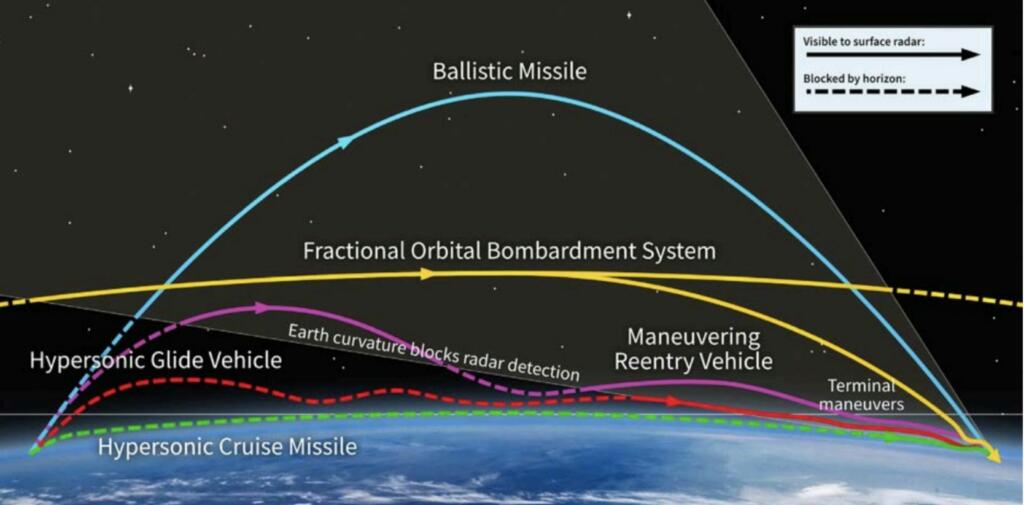

▪ There is no such thing as a perfect sensor architecture design. Designing an elevated sensor architecture is rather an exercise in tradeoffs. Given this multiplicity of trades, architecture design is as much an art as a science. The application of this art to specific designs reflects
various institutional and policy assumptions.
▪ Unpacking these tradeoffs and assumptions—making them explicit—can help policymakers, budgeteers, and system architects, and better inform the public discussion related to missile tracking and missile defense. Doing so is the purpose of this report. This report does not advocate a particular architecture, but instead elaborates these tradeoffs, identifies principles to inform future architectures, and highlights temptations to avoid.
▪ No single orbit or domain represents an optimal approach for missile defense sensing. Low (LEO), medium (MEO), geosynchronous (GEO), and highly elliptical orbits (HEO) each contribute varied advantages for coverage, schedule, cost, and resilience.
▪ Proliferating space sensors in LEO is one way to improve resilience, assuming large numbers and low-cost replacement. It is not the only way. Reliance on a single orbital regime, or on any single approach to resilience, invites disruption. LEO constellations can be degraded by area- or domain-wide effects, including electronic attack, nuclear or radiological means, and the intentional generation of debris.
▪ The Department of Defense’s recently updated plan to deploy a mixed-orbit missile tracking constellation is thus a welcome step for enhancing resilience. Sensor architectures should complicate adversary targeting by leveraging the unique benefits and drawbacks of multiple orbits and domains.
▪ The deployment phasing of a sensor architecture is as critical as its final delivery date. Choices over orbital configurations not only affect final sensor coverage but how coverage develops over time. Sensor constellations optimized purely for coverage efficiencies do not necessarily generate persistent coverage until most elements are deployed. For nearer-term coverage, especially for the lower latitudes relevant to the Indo-Pacific and other theaters, policymakers should be attentive to the pacing of sensor fielding, not only the final product—graceful deployment as well as graceful degradation.
▪ While a space-based sensor architecture is necessary for global missile tracking coverage, a suborbital underlay of airborne sensors could improve point or regional coverage, hedge against schedule or capability gaps of orbiting sensors, and enhance overall system-level survivability. Airborne sensors offer unique detection modalities and could support persistent, localized coverage unbounded by the predictability and rigidity of orbital mechanics.
▪ Sensor fusion is a major and underappreciated source of schedule risk. Delays in developing sensor fusion software and infrastructure contributed significantly to past space program cost and schedule overruns. Further steps are needed to prioritize command and control and fusion algorithm development for larger satellite constellations and multiple sensor types.
▪ Fire control-quality tracking must be a fundamental requirement for the emergent elevated sensing architecture. The technical requirements for fire control tracks are relative measures, contingent on the performance of other elements in the missile defense kill chain. Less stringent track data requirements would require interceptors with costlier, more capable seekers or more ability to maneuver to compensate for positional uncertainties. Conversely, more accurate sensor data would both improve the performance of existing systems and ease design requirements for future interceptors.
▪ Infrared sensor performance is a function of the target’s signature and the sensor’s resolution, sensitivity, and field of view. Both wide- and medium-field-of-view sensors share promise for fire control-quality tracking. In recent years, Congress has prudently scrutinized and sustained efforts to deploy fire control sensors, including the Hypersonic and Ballistic Tracking Space Sensor (HBTSS), which is slated to transfer from the Missile Defense Agency to the Space Force around 2026. Whatever the sensor configuration and type, it is imperative that fire control efforts cross the valley of death and deploy at scale.
▪ Many of the technologies and programs to realize an elevated sensor architecture are in place, but a disciplined acquisition and systems engineering authority will be needed to align its many components. Policymakers must exert oversight to ensure schedule discipline, orbital and systems diversity, and continued attention to missile defense fire control requirements.
▪ Acquiring this new elevated sensor architecture will be an exercise in avoiding certain temptations. These include temptations to optimize global coverage efficiencies at the expense of schedule and resilience, to consolidate assets into a single orbital regime, and to abdicate fire control requirements.

Brian Wang is a Futurist Thought Leader and a popular Science blogger with 1 million readers per month. His blog Nextbigfuture.com is ranked #1 Science News Blog. It covers many disruptive technology and trends including Space, Robotics, Artificial Intelligence, Medicine, Anti-aging Biotechnology, and Nanotechnology.

Known for identifying cutting edge technologies, he is currently a Co-Founder of a startup and fundraiser for high potential early-stage companies. He is the Head of Research for Allocations for deep technology investments and an Angel Investor at Space Angels.

A frequent speaker at corporations, he has been a TEDx speaker, a Singularity University speaker and guest at numerous interviews for radio and podcasts.  He is open to public speaking and advising engagements.

>>> Read full article>>>
Copyright for syndicated content belongs to the linked Source : Next Big Future – https://www.nextbigfuture.com/2023/12/next-generation-satellites-and-sensors-to-counter-hypersonic-missiles.html


Tags: generationSatellitesscience
Previous Post

Poem: ‘Baby Crocodile’

Next Post

Future AI Data Center Energy Needs

The ‘Ritz’ for horses: World Equestrian Center keeps animals comfortable during Florida cold snap – fox35orlando.com

January 29, 2026

Maine Union Leaders Slam ICE Raids as a Distraction from Real Economic Issues

January 29, 2026

Live Nation, DF Entertainment, and Dale Play Live Join Forces for Long-Term Partnership with Club Atlético River Plate at Mâs Monumental Stadium

January 29, 2026

AHCJ Stands Strong with Minneapolis in a Powerful Show of Support and Solidarity

January 29, 2026

Federal Judge Blocks Controversial USDA Pilot Program Affecting Colorado Food Aid

January 29, 2026

Rapidly Growing Trees Are Reshaping Forests-But at What Cost to Biodiversity and Climate Resilience?

January 29, 2026

Scientists Unite to Protect the ‘Mothership’ of Atmospheric Research Amid Government Scrutiny

January 29, 2026

Opinion: How MAHA Exposes the Hidden Flaws of Modern Science

January 29, 2026

If You’ve Reached These 9 Life Milestones, You’re Living More Intentionally Than Most People

January 28, 2026

The Next Frontier of AI: Unveiling Technology, Infrastructure, and Policy Trends for 2025-2026

January 28, 2026

Categories

Archives

January 2026
M T W T F S S
 1234
567891011
12131415161718
19202122232425
262728293031  
« Dec    
Earth-News.info

The Earth News is an independent English-language daily published Website from all around the World News

Browse by Category

  • Business (20,132)
  • Ecology (1,045)
  • Economy (1,062)
  • Entertainment (21,941)
  • General (19,594)
  • Health (10,104)
  • Lifestyle (1,077)
  • News (22,149)
  • People (1,071)
  • Politics (1,079)
  • Science (16,279)
  • Sports (21,564)
  • Technology (16,046)
  • World (1,054)

Recent News

The ‘Ritz’ for horses: World Equestrian Center keeps animals comfortable during Florida cold snap – fox35orlando.com

January 29, 2026

Maine Union Leaders Slam ICE Raids as a Distraction from Real Economic Issues

January 29, 2026
  • About
  • Advertise
  • Privacy & Policy
  • Contact

© 2023 earth-news.info

No Result
View All Result

© 2023 earth-news.info

No Result
View All Result

© 2023 earth-news.info

Go to mobile version
