






* . *
  • About
  • Advertise
  • Privacy & Policy
  • Contact
Wednesday, June 10, 2026
Earth-News
  • Home
  • Business
  • Entertainment

    5 Unexpected Hollywood Projects Shaped by New ’60 Minutes’ Boss Nick Bilton

    Paul Anthony Kelly’s Stunning Transformation into JFK Jr. for “Love Story

    Andy Cohen Opens Up About New Boyfriend: “I Still Can’t Believe I Found Him

    Magicians: The Devil’s Deal Revealed in an Epic Xbox Games Showcase 2026 Reveal

    Oakland First Fridays Rallies for Sponsors as Funding Falls and Entertainment Faces Cuts

    Boss’s New Fiancé Has a Way with Words That Everyone Can’t Stop Talking About

  • General
  • Health
  • News

    Cracking the Code: Why China’s Economic Challenges Aren’t Shaking Markets, Unlike America’s” – Bloomberg

    Trump’s Narrow Window to Spread the Truth About Harris

    Trump’s Narrow Window to Spread the Truth About Harris

    Israel-Gaza war live updates: Hamas leader Ismail Haniyeh assassinated in Iran, group says

    Israel-Gaza war live updates: Hamas leader Ismail Haniyeh assassinated in Iran, group says

    PAP Boss to Niger Delta Youths, Stay Away from the Protest

    PAP Boss to Niger Delta Youths, Stay Away from the Protest

    Court Restricts Protests In Lagos To Freedom, Peace Park

    Court Restricts Protests In Lagos To Freedom, Peace Park

    Fans React to Jazz Jennings’ Inspiring Weight Loss Journey

    Fans React to Jazz Jennings’ Inspiring Weight Loss Journey

    Trending Tags

    • Trump Inauguration
    • United Stated
    • White House
    • Market Stories
    • Election Results
  • Science
  • Sports
  • Technology

    Anthropic Releases ‘Safe’ Version of Its Mythos A.I. Technology – The New York Times

    Breakthrough Flexible Solar Technology Hits 30.04% Efficiency with Innovative Submicron Pyramid Design in Perovskite/Silicon Tandem Cells

    Paciolan to Revolutionize Ticketing and Marketing Technology at North Carolina A&T State

    Transforming Maternal Care: How Technology is Creating Healthier Moms and Babies

    Guangdong Wenke Green Technology and Horizon Unite to Power the Future of Green Energy Innovation

    Dr. Matthew Willsey: Revolutionizing Healthcare Innovation in Detroit

    Trending Tags

    • Nintendo Switch
    • CES 2017
    • Playstation 4 Pro
    • Mark Zuckerberg
No Result
View All Result
  • Home
  • Business
  • Entertainment

    5 Unexpected Hollywood Projects Shaped by New ’60 Minutes’ Boss Nick Bilton

    Paul Anthony Kelly’s Stunning Transformation into JFK Jr. for “Love Story

    Andy Cohen Opens Up About New Boyfriend: “I Still Can’t Believe I Found Him

    Magicians: The Devil’s Deal Revealed in an Epic Xbox Games Showcase 2026 Reveal

    Oakland First Fridays Rallies for Sponsors as Funding Falls and Entertainment Faces Cuts

    Boss’s New Fiancé Has a Way with Words That Everyone Can’t Stop Talking About

  • General
  • Health
  • News

    Cracking the Code: Why China’s Economic Challenges Aren’t Shaking Markets, Unlike America’s” – Bloomberg

    Trump’s Narrow Window to Spread the Truth About Harris

    Trump’s Narrow Window to Spread the Truth About Harris

    Israel-Gaza war live updates: Hamas leader Ismail Haniyeh assassinated in Iran, group says

    Israel-Gaza war live updates: Hamas leader Ismail Haniyeh assassinated in Iran, group says

    PAP Boss to Niger Delta Youths, Stay Away from the Protest

    PAP Boss to Niger Delta Youths, Stay Away from the Protest

    Court Restricts Protests In Lagos To Freedom, Peace Park

    Court Restricts Protests In Lagos To Freedom, Peace Park

    Fans React to Jazz Jennings’ Inspiring Weight Loss Journey

    Fans React to Jazz Jennings’ Inspiring Weight Loss Journey

    Trending Tags

    • Trump Inauguration
    • United Stated
    • White House
    • Market Stories
    • Election Results
  • Science
  • Sports
  • Technology

    Anthropic Releases ‘Safe’ Version of Its Mythos A.I. Technology – The New York Times

    Breakthrough Flexible Solar Technology Hits 30.04% Efficiency with Innovative Submicron Pyramid Design in Perovskite/Silicon Tandem Cells

    Paciolan to Revolutionize Ticketing and Marketing Technology at North Carolina A&T State

    Transforming Maternal Care: How Technology is Creating Healthier Moms and Babies

    Guangdong Wenke Green Technology and Horizon Unite to Power the Future of Green Energy Innovation

    Dr. Matthew Willsey: Revolutionizing Healthcare Innovation in Detroit

    Trending Tags

    • Nintendo Switch
    • CES 2017
    • Playstation 4 Pro
    • Mark Zuckerberg
No Result
View All Result
Earth-News
No Result
View All Result
Home Science

The future is bright for astronomy, and very expensive (op-ed)

May 27, 2024
in Science
The future is bright for astronomy, and very expensive (op-ed)
Share on FacebookShare on Twitter

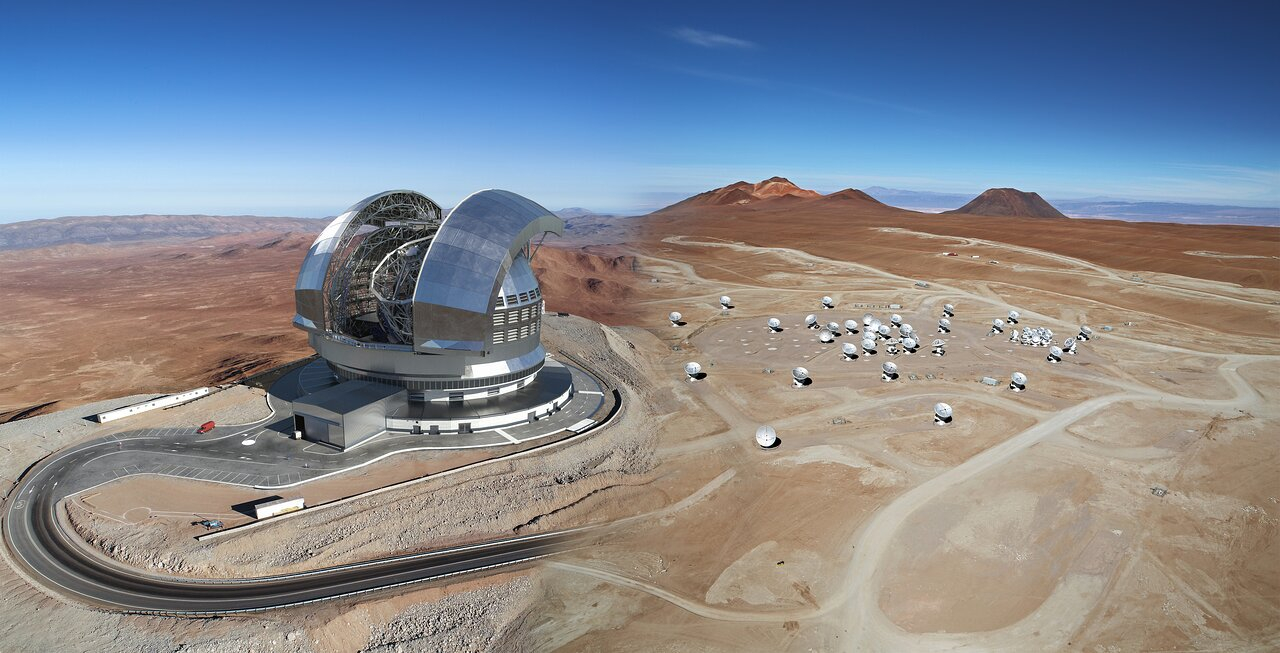
a giant domed building with a open ceiling sits atop a sandy hill in a desert landscape, with a road winding down a hill.

(Image credit: ELT: ESO / Imagen ALMA: Clem & Adri Bacri-Normier (wingsforscience.com) / Montaje: David Fernández – ALMA (ESO/NAOJ/NRAO))

Astronomy has a bright future. 

The universe is being revealed in exquisite detail with the current generation of large optical telescopes, reaching back close to the big bang. There’s hope that the mysteries of dark matter and dark energy will be solved. Thousands of exoplanets have been discovered, and astronomers may be closing in on the first detection of life beyond Earth.

However, observations into the cosmic frontier involve extremely faint targets and astronomers are always hungry for more light. In order to keep peering farther into unknown reaches of the universe, the next generation of giant telescopes on the ground and in orbit will each cost billions of dollars. That price tag is leading to a collision between scientific aspirations and fiscal realities.

Related: The 10 biggest telescopes on Earth

The Cost of Big Glass 

For most of the history of astronomy until 1980, there was an approximate scaling of telescope cost with mirror diameter, where cost was equal to the telescope’s  diameter multiplied to the 2.8 power. That meant if the size doubled, the cost went up by a factor of seven — and if the size tripled, the cost went up by a factor of twenty-two. Many people doubted that a telescope larger than the Palomar 5-meter would ever be built.

In the past four decades, however, telescope costs have gone up at a shallower rate with size, breaking the previous cost curve. The innovations that led to this change were thinner and lighter mirrors, the practice of making a large collecting area from a mosaic of smaller mirrors, using fast optics to enable more compact telescope designs, and shrinking the sizes of telescope enclosures. Thanks to these innovations, sixteen telescopes with diameters between 6 meters and 12 meters were built between 1993 and 2006.

The Quest for Gigantic Telescopes 

The next generation of extremely large telescopes will have 100 times the light-gathering power and 10 times the image quality of the Hubble Space Telescope. However, they’re running into serious funding problems. There are two American-led projects with international partners. The Thirty Meter Telescope (TMT) project uses a design with 492 mirror segments. It faces headwinds from the opposition of native Hawaiians to construction of another large telescope on Mauna Kea, which they consider to be a sacred site. Another project, the Giant Magellan Telescope (GMT), is combining seven 8.4-meter mirrors to make an effective 25-meter aperture.

Breaking space news, the latest updates on rocket launches, skywatching events and more!

The TMT project is stalled as it negotiates a way to begin construction in Hawaii. The GMT and another large telescope being built in Chile, the Rubin Observatory, are facing escalating costs. The pandemic, inflation, and supply chain problems are to blame. TMT and GMT will each cost around $3 billion. Both have philanthropic support, but they also rely on federal funding. For a while, the National Science Foundation (NSF) supported both projects. But recently, the National Science Board set a cap of $1.6 billion on federal support for large telescopes and gave the NSF until May to decide which project to support. One large telescope will be left out in the cold.

Meanwhile, the Europeans are sitting pretty. The Extremely Large Telescope (ELT) is a third gigantic telescope, currently under construction in Chile. The ELT doesn’t face financial hurdles since it’s being built by the European Southern Observatory, which is funded by an intergovernmental treaty. At 39-meters in diameter, the ELT is the largest of the three telescopes, and it will be completed first, in 2028. 

The Telescope that Ate Astronomy 

Space telescopes cost a thousand times more per kilogram than ground-based telescopes, but they’re worth their high price. These telescopes gain the benefit of the total darkness of a space environment, and many forms of radiation that these telescopes can observe such as gamma rays, ultraviolet light, and infrared radiation cannot penetrate the Earth’s atmosphere to reach ground-based telescopes. 

One such instrument, the Hubble Space Telescope has run up a total cost of $16 billion since the U.S. Congress approved its mission in 1977. Another, NASA’s James Webb Telescope, faced delays and technical challenges, and its budget ballooned to $5 billion. Its price tag helped it earn the nickname “the telescope that ate astronomy” — and that was in 2010. By the time of its launch in 2021, the price tag had doubled to $10 billion. 

NASA has other exciting missions in the pipeline. The Roman Space Telescope, with a 2.4-meter mirror but a hundred times Hubble’s field of view, is likely to cost over $3 billion, and the Habitable Worlds Observatory, designed to “sniff” the atmospheres of Earth-like planets for traces of biology, will come in around $11 billion.

These space telescope missions take a big bite out of a NASA budget that has been declining for twenty years. Just as is the case with the NSF’s budget caps, big capital projects leave less money to spend on other forms of research. But the private sector may come to the rescue. SpaceX’s Starship could be used to launch a 6.5-meter mirror in one piece, avoiding the complicated and expensive folding mirrors used by JSWT. The same innovations used with ground-based telescopes could cut the cost of telescopes in space.

As they face the costs of viewing the distant universe and returning rocks from a nearby planet, astronomers and planetary scientists are being brought back down to Earth with a bump. While it seems to be a golden age for astronomy, the glitter is dimmed by the cost of all that gold and the hard trade-offs that must be made in a time of fiscal austerity. 

Join our Space Forums to keep talking space on the latest missions, night sky and more! And if you have a news tip, correction or comment, let us know at: [email protected].

>>> Read full article>>>
Copyright for syndicated content belongs to the linked Source : Space.com – https://www.space.com/bright-and-expensive-future-of-astronomy


Tags: brightFuturescience
Previous Post

Scandals, party loyalists and the youth: experts weigh in on what influences voters

Next Post

Starmus 2024: Scientists and musicians unite in Bratislava to celebrate planet Earth

Hawaii Kids Face Growing Challenges in Housing, Economy, and Education

June 10, 2026

Innovative Public Health Vending Machine Delivers Free Wellness Resources to York County

June 10, 2026

5 Unexpected Hollywood Projects Shaped by New ’60 Minutes’ Boss Nick Bilton

June 10, 2026

Jersey Teen Politician Praised by Trump Opens Up About His True Feelings

June 9, 2026

Anthropic Releases ‘Safe’ Version of Its Mythos A.I. Technology – The New York Times

June 9, 2026

WMO: Prepare for El Niño – Inside Ecology

June 9, 2026

Where to watch Los Angeles Dodgers vs. Pittsburgh Pirates: Live stream, start time, TV channel, odds for Tuesday, June 9 – Yahoo Sports

June 9, 2026

The AI Revolution in Weather and Climate Science: Cutting Through the Hype to Reveal the Truth

June 9, 2026

From Breakthrough Discoveries to Life-Changing Treatments: Understanding Why Science Requires Patience

June 9, 2026

The Gen X Files: Why Aren’t We Flying Cars Yet?

June 9, 2026

Categories

Archives

June 2026
M T W T F S S
1234567
891011121314
15161718192021
22232425262728
2930  
« May    
Earth-News.info

The Earth News is an independent English-language daily published Website from all around the World News

Browse by Category

  • Business (20,132)
  • Ecology (1,257)
  • Economy (1,280)
  • Entertainment (22,156)
  • General (21,997)
  • Health (10,314)
  • Lifestyle (1,290)
  • News (22,149)
  • People (1,281)
  • Politics (1,299)
  • Science (16,493)
  • Sports (21,777)
  • Technology (16,264)
  • World (1,270)

Recent News

Hawaii Kids Face Growing Challenges in Housing, Economy, and Education

June 10, 2026

Innovative Public Health Vending Machine Delivers Free Wellness Resources to York County

June 10, 2026
  • About
  • Advertise
  • Privacy & Policy
  • Contact

© 2023 earth-news.info

No Result
View All Result

© 2023 earth-news.info

No Result
View All Result

© 2023 earth-news.info

Go to mobile version
