






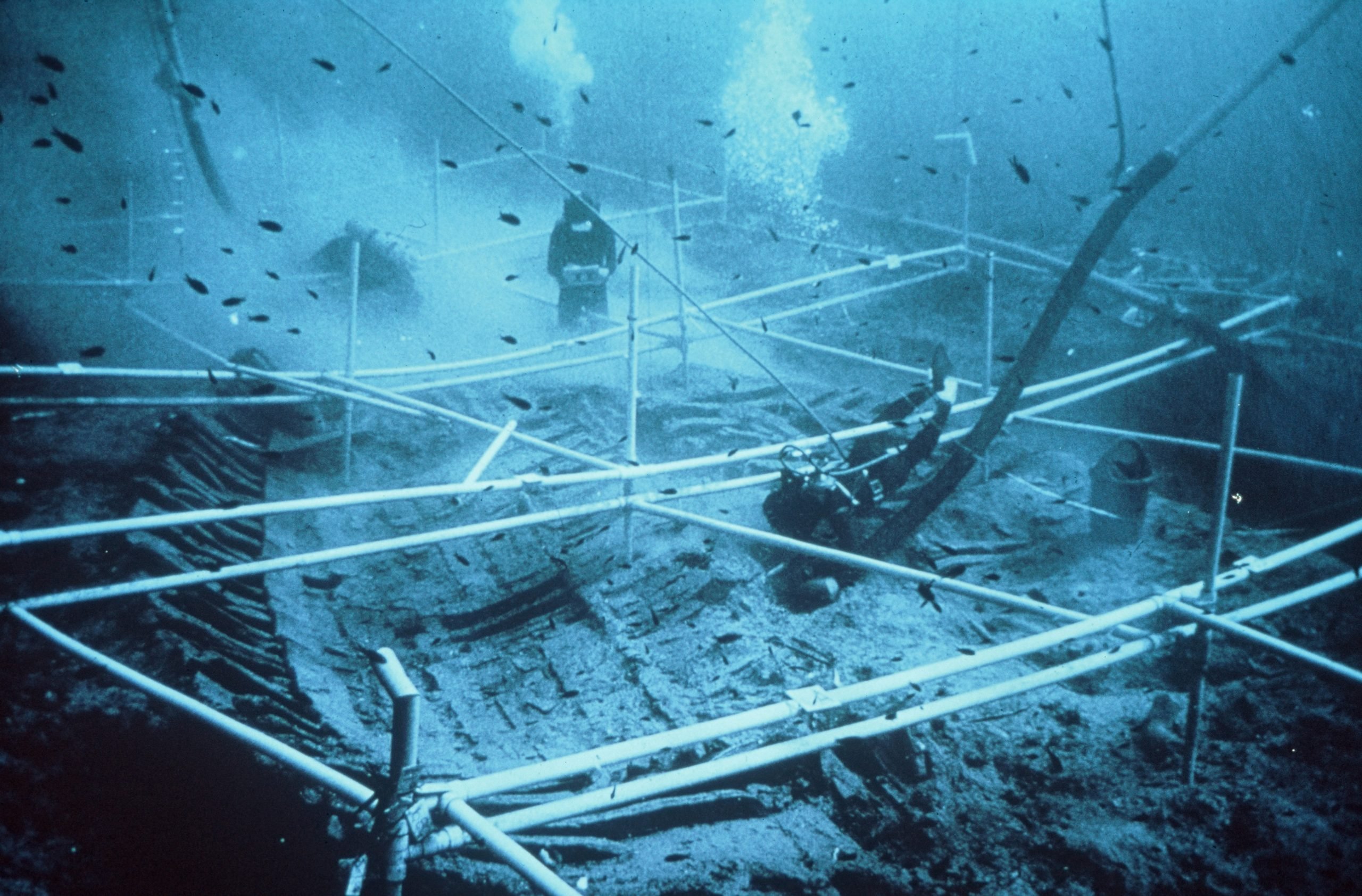
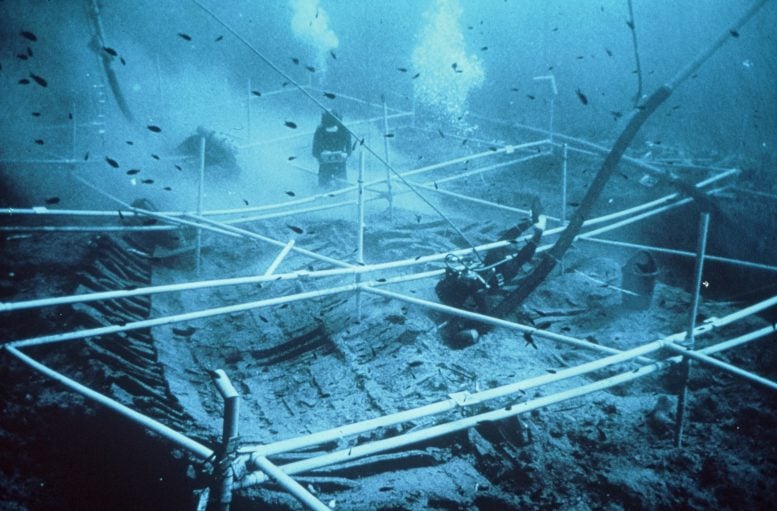
Kyrenia Ship Hull during excavation. Kyrenia Ship hull on the seabed off northern Cyprus during underwater excavation in the later 1960s. Credit: Image provided to authors by Kyrenia Ship Excavation team for use with this paper, CC-BY 4.0
Cornell researchers have refined the estimated sinking period of the Kyrenia shipwreck to between 286-272 BCE by overcoming dating challenges such as contaminant removal and revising the radiocarbon calibration curve, enhancing both historical understanding and broader scientific research.
Historic shipwrecks often evoke dreams of sunken riches waiting on the bottom of the ocean to be reclaimed.
For the Cornell researchers trying to date the famous Hellenistic-era Kyrenia shipwreck, which was discovered and recovered off the north coast of Cyprus in the 1960s, the real treasure was not gold coins, but thousands of almonds found in jars among the cargo.
The almonds, combined with newly cleaned wood samples and the team’s modeling and radiocarbon-dating expertise, led the Cornell Tree-Ring Laboratory to identify the likeliest timeline of the Kyrenia’s sinking as between 296-271 BCE, with a strong probability it occurred between 286-272 BCE.
The team’s paper was published on June 26 in the journal PLOS ONE. The lead author is Sturt Manning, Distinguished Professor of Arts and Sciences in Classical Archaeology in the College of Arts and Sciences.
The Kyrenia has a storied legacy as the first major Greek Hellenistic-period ship to be found, in 1965, with a largely intact hull. From 1967-69, it was excavated along with its cargo, which included hundreds of ceramic vessels, then reassembled offsite and scientifically studied.
“Kyrenia was one of the first times it was realized this type of rich evidence from the classical world could be found largely intact more than 2,000 years later on the seabed, if you could find it,” said Sturt Manning. “It was a bit of a landmark moment, the idea that you actually could dive, excavate, and bring up a classical-era ship and so discover this long-past world directly. Shipwrecks are unique time capsules, and you can get amazing preservation.”
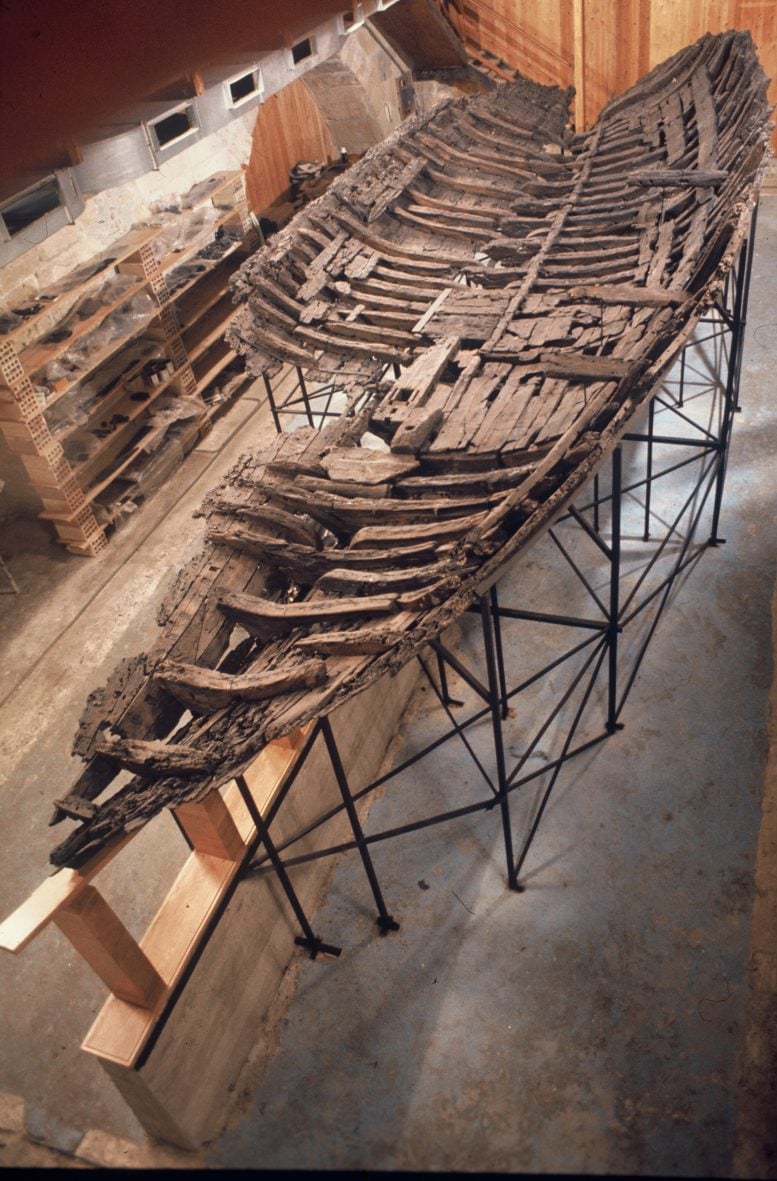
Kyrenia Ship hull remains shortly after the reassembly of the timbers recovered from the seabed excavation. Credit: Image provided to authors by Kyrenia Ship Excavation team for use with this paper, CC-BY 4.0
For the last six decades, the Kyrenia has provided archeologists and historians with key insights into the development of ancient ship technology, construction practices, and maritime trade. To date, no fewer than three Kyrenia replicas have been produced and launched, and these reconstructions have yielded considerable information on ancient ships and their sailing performance. However, the timeline of the Kyrenia’s provenance and the exact date of its sinking has always been vague at best. The initial efforts to date the ship were based on its recovered artifacts, such as the pottery on board and a small batch of coins, which initially led researchers to estimate the ship was built and sank in the later 300s BCE.
“Classical texts and finds at port sites already told us this era was significant for widespread maritime trade and connections all around the Mediterranean – an early period of globalization,” Manning said. “But the discovery of the Kyrenia ship, just under 15 meters long, likely with a crew of four, dramatically made this all very immediate and real. It yielded key insights into the practicalities of the earlier part of a millennium of intense maritime activity in the Mediterranean, from Greek through Late Antique times.”
The first volume of the final publication of the Kyrenia ship project, released last year, argued the wrecking date was a little later, closer to 294-290 BCE, but the primary piece of evidence – a poorly preserved, nearly illegible coin – was not watertight.
Manning’s team, which included co-authors Madeleine Wenger ’24 and Brita Lorentzen, ’06, Ph.D. ’15, sought to secure a date.
The perils of polyethylene glycol
The biggest hurdle for accurately dating the Kyrenia has been another artifact, one from the 20th century: polyethylene glycol (PEG). Excavators and preservationists often applied the petroleum-based compound to waterlogged wood to prevent it from decomposing after it was lifted out of the ocean’s oxygen-free environment.
“PEG was a standard treatment for decades. The trouble is it’s a petroleum product,” Manning said, “which means that if you’ve got PEG in the wood, you have this contamination from ancient fossil carbon that makes radiocarbon dating impossible.”
Manning’s team worked with researchers at the University of Groningen in the Netherlands to develop a new method to clean PEG out of wood, and they demonstrated it on PEG-treated Roman-era samples from Colchester, England, that already had established dendrochronological (tree-ring sequence) dates.
“We removed the PEG from the wood, we radiocarbon dated it and we showed that in each case, we got a radiocarbon age consistent with the real (known) age,” Manning said. “We basically got 99.9% of the PEG removed.”
They used that technique to remove PEG from a Kyrenia sample that Manning and collaborators had tried, and failed, to accurately date 10 years ago. The team also now dated a tiny, twisted piece of wood that was salvaged from the Kyrenia in the late 1960s but was too small to be included in the reconstruction, thus avoiding PEG-treatment. It subsequently sat in a jar of water in a museum for 50-odd years.
The dates showed that the most recent preserved tree rings from these timbers grew in the mid-later 4th century BCE. Because the samples did not include bark, the researchers couldn’t determine the exact date the original trees were felled, but could say the date was likely after approximately 355-291 BCE.
Organic evidence
Working with the Kyrenia’s original excavation team, the researchers examined its various artifacts, including the pottery and coins, with a focus on organic materials, including an astragalus (a sheep or goat ankle bone once used for games and divining rituals in several ancient cultures) and thousands of fresh green almonds found in some of the large amphorae, i.e., ceramic jars. These “short-lived” sample materials helped define the date of the ship’s last voyage.
The team applied combined statistical modeling with the dendrochronology of the wood samples to get a level of dating that was much more precise than previous efforts. The modeling identified the most likely range of dates for the final voyage to be between 305-271 BCE (95.4% probability) and 286-272 BCE (68.3% probability) – several years more recent than current estimations.
But there was one big hiccup along the way. The new dates didn’t align with the international radiocarbon calibration curve, which is based on known-age tree rings and is used to convert radiocarbon measurements into calendar dates for the northern hemisphere.
Manning took a closer look at the data behind the calibration curve, which has been assembled over many decades by dozens of labs and hundreds of scientists. He discovered that the period between 350 and 250 BCE had no modern accelerator mass spectrometry (AMS) radiocarbon data behind it. Instead, the calibration curve in this period relied on only a few measurements conducted in the 1980s and 1990s using an older type of radiocarbon-dating technology. With collaborators in the U.S. and the Netherlands, the team measured known-age single-year sequoia and oak samples to re-calibrate the curve for the period 433-250 BCE. That not only helped clarify a big spike in radiocarbon production caused by a minimum of solar activity centered around 360 BCE, but also led to important revisions to the curve in the period around 300 BCE – improvements that were critical to dating the Kyrenia.
Manning anticipates the new findings will not only clarify the timeline of the Kyrenia and its cargo but will also help researchers using the calibration curve for very different projects.
“This revised curve 400-250 BCE now has relevance to other problems that researchers are working on whether in Europe or China or somewhere else in the northern hemisphere,” he said. “Half of the people who cite the paper in the future will be citing the fact that we’ve revised the radiocarbon calibration curve in this period, and only half will be saying the Kyrenia shipwreck is really important and has a much better date.”
Reference: “A revised radiocarbon calibration curve 350–250 BCE impacts high-precision dating of the Kyrenia Ship” by Sturt W. Manning, Brita Lorentzen, Martin Bridge, Michael W. Dee, John Southon and Madeleine Wenger, 26 June 2024, PLOS ONE.
DOI: 10.1371/journal.pone.0302645
>>> Read full article>>>
Copyright for syndicated content belongs to the linked Source : SciTechDaily – https://scitechdaily.com/the-real-treasure-was-not-gold-surprise-discovery-reveals-secrets-of-ancient-greek-shipwreck/



