







Credit: Pixabay/CC0 Public Domain
Many more people around the world than normal were recently able to see the northern and southern lights overhead with the naked eye. This unusual event was triggered by a very strong solar storm, which affected the movement of the Earth’s magnetic field.
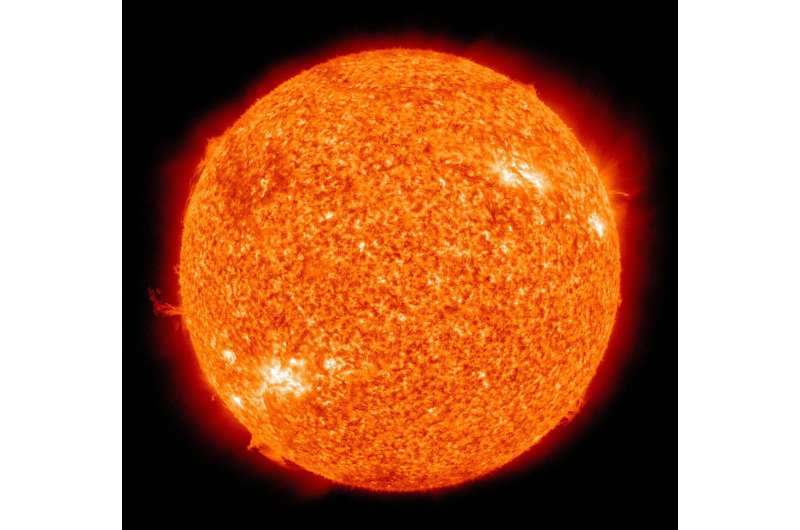
The sun is reaching the maximum point of activity in an 11-year cycle. This means that we can expect more explosive outpourings of particles. In the right circumstances, these are what ultimately generate the pretty auroras in the sky, as well as the geomagnetic storms that can damage infrastructure such as power grids and orbiting satellites.
So what is actually going on to cause these phenomena? The northern and southern Lights are usually confined to very high and very low latitudes. High-energy particles from the sun flow toward the Earth, guided by the solar magnetic field. They are transferred onto the Earth’s magnetic field in a process known as reconnection.
These really fast and hot particles then go sprinting down the Earth’s magnetic field lines—the direction of force from a magnet—until they hit a neutral, cold atmospheric particle like oxygen, hydrogen or nitrogen. At this point, some of that energy is lost—and this heats up the local environment.
However, the atmospheric particles don’t like being energetic, so they release some of this energy in the visible light range. Now, depending on which element is too hot, you will see a different set of wavelengths—and therefore colors—emitted in the visible light range of the electromagnetic spectrum. This is the source of the auroras that we can see at high latitudes and, during strong solar events, at lower latitudes too.
The blues and purples in the aurora come from nitrogen, while the greens and reds are from oxygen. This particular process happens all the time, but because the Earth’s magnetic field is similar in shape to a bar magnet, the area that is energized by the incoming particles is at very high and low latitudes (Arctic circle or Antarctica in general).
So what happened to allow us to see the aurora much further south in the northern hemisphere?
You may remember at school sprinkling iron filings on a paper on top of a magnet to see how they line up with the magnetic field. You can repeat the experiment multiple times and see the same shape each time.
The Earth’s magnetic field is also constant but can be compressed and released depending on how strong the sun is. An easy way to think about this is imagining two half-inflated balloons pressed together.
If you inflate one balloon, adding more gas to it, the pressure will increase and will push the smaller balloon back. As you release that extra gas, the smaller balloon relaxes and pushes back out.
For us, the stronger this pressure is, the closer to the equator the relevant magnetic field lines are pushed, meaning auroras can be seen.
Exceptional storms
This is also where the potential problems come in: a moving magnetic field can generate a current in anything that conducts electricity.
For modern infrastructure, the biggest currents are generated in power lines, train tracks and underground pipelines. The speed of this movement is also important and is tracked by measuring how disturbed the magnetic field is from “normal”. One such measure used by researchers is called the disturbed storm time index.
By this measure, the geomagnetic storms of May 10 and 11 were exceptionally strong. With such a strong storm, there is a potential danger for electrical currents to be induced. Power lines are most at risk, but have benefited from protections built into power stations. These have been in focus since the geomagnetic storm of 1989 which melted a power transformer in Quebec, Canada—causing hours of power outage.
More at risk are metallic pipelines which corrode when an electrical current is passed through them. This is not an instantaneous effect, but there is a slow build up of eroding material. This can have a very strong effect on infrastructure but is very hard to detect.
While currents on the ground are a problem, they are even more of a challenge in space. Satellites have a limited amount of grounding in them and an electrical surge can destroy instruments and communications. When a satellite does lose communications in this manner, it is referred to as a zombie satellite and is often lost completely—causing a very high loss of investment.
The changes in the Earth’s magnetic field can also affect the light passing through. We can’t see this change, but GPS style location system accuracy can be strongly affected, as a location reading depends on the time taken between your device and a satellite. The increase in electron density (the number of particles in the way of the signal), causes the wave to bend, meaning it takes a longer time to reach your device.
The same changes can also affect the bandwidth speed of satellite internet and the planet’s radiation belts. These are a torus of highly energetic charged particles, mostly electrons, around 13,000km away from the surface. A geomagnetic storm can push these particles into the lower atmosphere. Here, the particles can interfere with high frequency (HF) radio used by aircraft and affect ozone concentrations.
Auroras aren’t confined to Earth—plenty of planets have them and they can tell us a lot about the magnetic fields that exist on those celestial objects. A particular piece of apparatus used to simulate auroras is a “planeterella”, first developed in the early 1900s by Norwegian scientist Kristian Birkeland.
A magnetic sphere (representing Earth) is placed in a vacuum chamber and the solar wind is simulated by firing electrons at the sphere. We have two of these instruments in the UK within universities and here at Nottingham Trent University I have recently helped a student build a budget version as a Masters project.
By altering the magnetic field strength, and the distance between objects, you can observe how auroras change. The emission is mostly purple, as you would expect in a 72% nitrogen atmosphere. A strong emission ring appears around the top, where the aurora would be seen on Earth, and this ring moves up and down in latitude depending on the magnetic field strength.
As a natural event, auroras are a marvel. But even better is that with every strong geomagnetic storm, we make improvements that help protect against the potential damage from future events.
This article is republished from The Conversation under a Creative Commons license. Read the original article.
Citation:
The sun is reaching the peak of its activity—here’s how that could cause more auroras and solar storms (2024, June 8)
retrieved 8 June 2024
from https://phys.org/news/2024-06-sun-peak-auroras-solar-storms.html
This document is subject to copyright. Apart from any fair dealing for the purpose of private study or research, no
part may be reproduced without the written permission. The content is provided for information purposes only.
>>> Read full article>>>
Copyright for syndicated content belongs to the linked Source : Phys.org – https://phys.org/news/2024-06-sun-peak-auroras-solar-storms.html



