






The Threat of a Solar Superstorm Is Growing—And We’re Not Ready
Someday an unlucky outburst from our sun could strike Earth and fry most of our electronics—and we’ve already had some too-close-for-comfort near misses
By Phil Plait
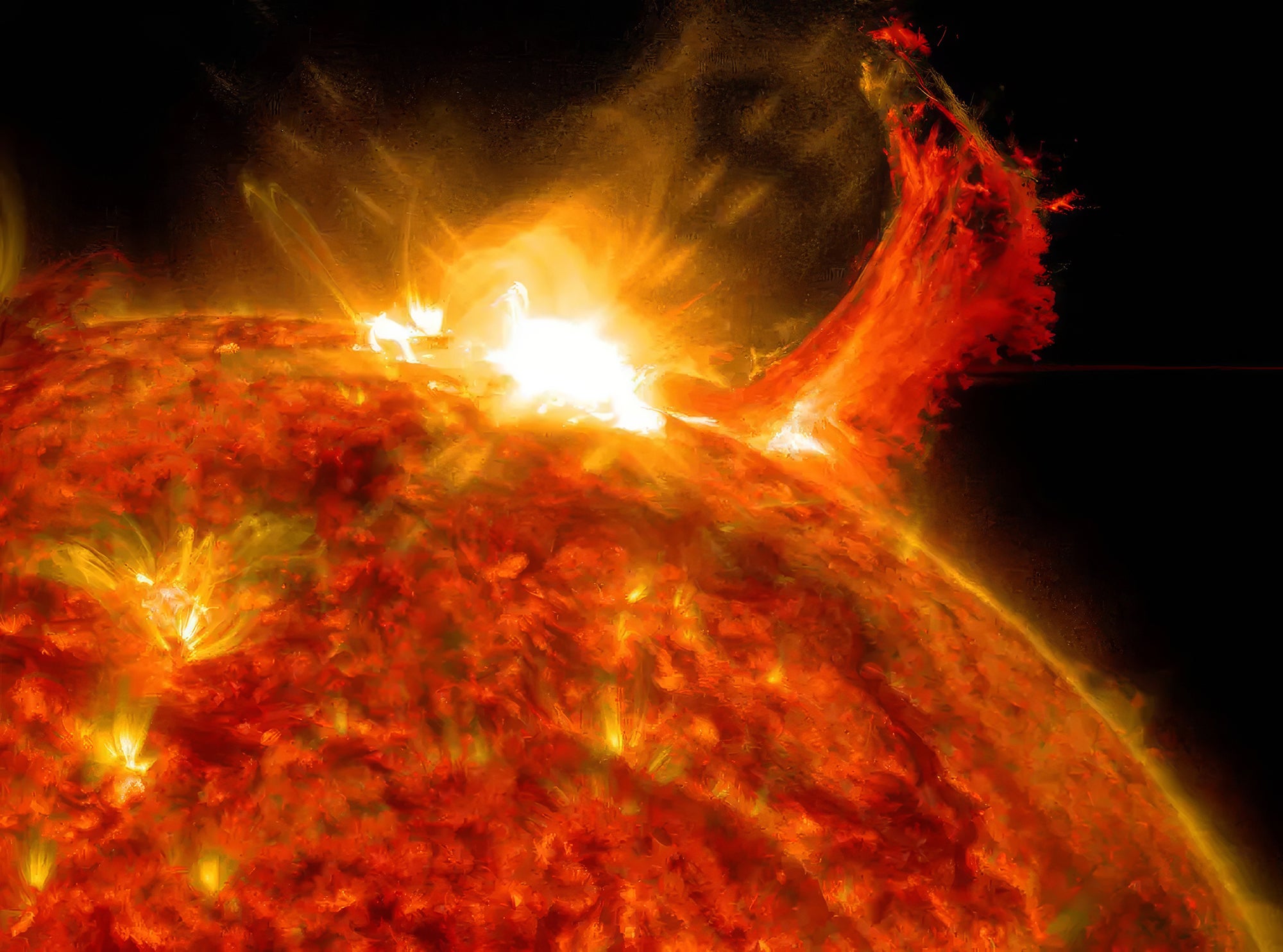
Powerful outbursts from the sun—like this bright, flashing solar flare and the adjacent eruption of hot glowing gas—can wreak havoc with Earth’s power grids, computers and telecommunications.
NASA/SDO
The sun is ramping up for a big year.
In one sense it already had a big year, thanks to the April 8 solar eclipse. But that was a terrestrial phenomenon. What we’re gearing up for is a decidedly solar one—our star is nearing the peak of its magnetic activity cycle, which means more sunspots, more storms and, potentially, more danger to Earth.
The sun’s magnetic field is generated in its interior, where conditions are so hot that electrons are stripped from their host atoms, forming an ionized gas. A basic law of physics states that moving electric charges generate a magnetic field, and it’s this ionized-gas-induced magnetism that so profoundly affects the sun’s behavior.
On supporting science journalism
If you’re enjoying this article, consider supporting our award-winning journalism by subscribing. By purchasing a subscription you are helping to ensure the future of impactful stories about the discoveries and ideas shaping our world today.
Unlike Earth, which has a fairly strong and well-organized magnetic field similar to that of a single gigantic bar magnet, the sun is dominated by countless locally generated fields. Each one shapes its own parcel of the solar interior. The actual dynamics of this magnetism are fiercely complex, but to simplify, you can think of our star’s overall magnetic field strength as waxing and waning over a period of about 11 years—what we call the solar magnetic cycle.
Hot material inside the sun rises to the surface and, once cooled, sinks again in a process called thermal convection, in a very similar way to water in a boiling teakettle. It’s like a conveyor belt for stellar energy and is part of the process by which much of the hellish heat from the solar interior makes its way out of the sun and into space to bring life-sustaining warmth to our planet. The sun’s face is festooned with millions of these ever-changing convection cells; each is accompanied by its own internal magnetic field.
Near the sun’s surface, the magnetic field lines emanating from a given towering convection cell can get tangled up with those from others. These tangles can act as a barrier that prevents cooler material from sinking back down. Instead it just sits there on the surface, radiating away its energy. Cooler material is darker, so we see these areas as spots on the sun, which we cleverly call sunspots. Their numbers increase dramatically during a solar maximum.
We say these regions are cooler, but they’re still fiendishly hot by earthly standards. In isolation they’d be about as bright as the full moon; they just look dark by comparison against the sun’s surface. Most spots are a few thousand kilometers across, but some grow huge, larger than Earth. The biggest can be immense, several times wider than our planet and visible to the properly protected unaided eye. (The eclipse glasses you may still have sitting around would suffice.)
When these localized magnetic fields breach the sun’s surface, they can raise huge loops of magnetic force, drawing material up with them to create incredibly tall glowing spires called prominences. Some can be tens of thousands of kilometers high, and all are tinted red by the glow of hot hydrogen. Several were visible during April’s eclipse, stretching out in the sky past the moon’s star-occulting shadow.
Despite their, well, prominence, these fountains are relatively benign phenomena. The magnetic fields that shape them, however, can spark very real dangers.
The tangled field lines emanating from sunspots store vast amounts of energy and can interact, snap and reconnect to release that energy. Sometimes it’s a relatively minor event, but other times the energy release triggers more lines to snap and reconnect, releasing more energy, leading to a runaway cascade of triggering events. Think of it like a bag of mousetraps: one snaps shut and jostles the bag, making others snap over and again, rapidly discharging their stored energy in a single explosive event.
Now imagine each one of these mousetraps is the equivalent of, oh, say a few hundred million thermonuclear bombs, and you will start to get the idea of how the sweatiest sci-fi apocalypse doesn’t even come close to the power of a solar flare.
Big flares fire out high-energy x-ray and gamma radiation that can damage satellites orbiting Earth; when those photons strike the metal casing of a spacecraft, they blast away clouds of electrons like shrapnel, and these fast-moving particles generate strong pulses of hardware-frying electromagnetic energy. Such flares are one of the major reasons why spacecraft engineers harden onboard computers against radiation to prevent them from shorting out.
Coronal mass ejections, or CMEs, are also ridiculously powerful solar phenomena. If solar flares are like tornadoes—local but intense—CMEs are like far larger hurricanes. They don’t emit much visible light, but they blast upwards of a billion tons of hydrogen into space, sometimes at speeds of several thousand kilometers per second.
If one is aimed at Earth, it can interact with our planet’s geomagnetic field, causing all sorts of havoc. A CME strike can funnel huge numbers of electrons down toward our north and south poles, creating spectacular auroras. But the other effects are not so appealing: the sudden fluctuations in the magnetic field can induce incredibly strong currents of electricity inside Earth. These can overpower our electric grids and create widespread blackouts. A fierce CME in 1989 caused a blackout in Quebec that lasted for days.
Together we call flares and CMEs solar storms, and scientists take them very seriously. The first solar storm ever detected, called the Carrington Event, occurred in 1859 and was incredibly powerful; if something that big were to hit our much more wired-up Earth today, it would cause widespread blackouts and chaos as transformers blew up and satellites got zapped. In 2012 a monster storm at least as powerful as the one in 1859 erupted from the sun. Happily it was not aimed at Earth; it missed us by tens of millions of kilometers. Had it hit us, though, well, it would’ve been very, very bad.
A growing body of evidence also hints that much more rarely the sun blows out a truly apocalyptic storm. Data from ancient tree rings and ice cores suggest that in C.E. 774 a solar storm hit our planet that was so powerful that it significantly altered our atmospheric chemistry. Similar data from even deeper back in time are best explained by another epochal solar storm occurring in 7176 B.C.E.; this may have been the most powerful eruption from the sun to strike Earth in the past 10,000 years.
It’s very unlikely that such a blockbuster will slam into us this cycle, but we are seeing increased activity from the sun. At least two sunspots in recent weeks got big enough to see by eye, and there have been some decently powerful flares as well. This isn’t to say you need to fret over every flare that occurs, but over the long run, these storms are a threat we need to deal with.
While we are not as prepared for such a global event as I think we should be—reinforcing the electricity grid and making it more decentralized would be a good start—the good news is that astronomers are studying the sun with fierce devotion to better understand and predict its outbursts. Several space-based observatories, such as the Solar and Heliospheric Observatory, Solar Dynamics Observatory and Parker Solar Probe, observe our star 24 hours a day, and the newly opened Daniel K. Inouye Solar Observatory sees the sun in unprecedented detail, giving us insight into its structure and magnetic activity.
The sun provides light, warmth and life for us on Earth, but it’s also a star—a massive ball of thermonuclear and electromagnetic fury—and it would do us all well to never forget that.
>>> Read full article>>>
Copyright for syndicated content belongs to the linked Source : Scientific American – https://www.scientificamerican.com/article/the-threat-of-a-solar-superstorm-is-growing-and-were-not-ready/



