






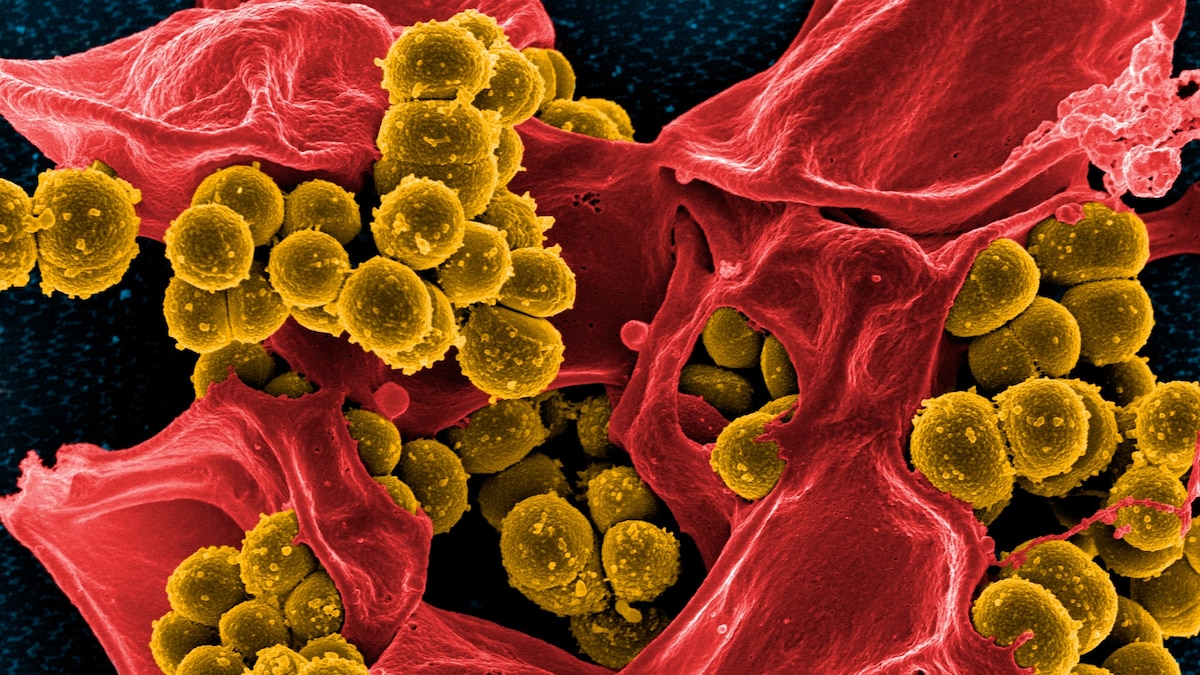
At any moment, your body contains about as many microbes as it does human cells. A whole lot of those tiny hangers-on are just waiting for you to drop dead—so they can get to work on breaking you down.
What these microbes do after death could offer clues to some of the toughest questions in forensic science, such as how to pinpoint a time of death or locate a hidden grave.
Here’s how your body decomposes in a nutshell: Within about four minutes of your demise, enzymes in the body start breaking down your cells, which begin popping open like champagne bottles for the hordes of hungry bacteria waiting inside your intestines. Meanwhile, the bacteria on your skin begin working on you from the outside in.
This is the first stage of decomposition, with all the familiar signs of death we’ve all learned from detective shows: rigor mortis, which stiffens muscles as energy-starved proteins lock together, and lividity, which creates bruised colors on skin as blood settles by gravity. During this stage, bacteria in the gut start to proliferate unchecked.
(Your gut health can affect the rest of your body. Here’s why.)
Then as decomposition proceeds, gut bacteria escape their confines and start consuming the rest of the body, depleting tissues of oxygen as they go. Eventually, microbes that can tolerate low-oxygen conditions begin to proliferate—most notably the bacteria known as Clostridium—producing the gases that cause a body to bloat. After about two days, these bacteria are so abundant that this has come to be known as the “Postmortem Clostridium Effect.”
The motley community of Clostridium and other microbes that takes over when you die is called the necrobiome, a deathly version of the microbiome that inhabits you while you’re alive. By mapping out the pattern of their succession on a dead body, much like the succession of new trees in a ravaged forest, scientists are already beginning to unlock some of the secrets of death.
The big picture
It’s all a bit unsettling, once you start thinking about our bodies’ ultimate fate. And it begs a question: What was keeping all those bacteria from decomposing us alive?
For that, you can primarily thank your immune system. As long as you’re alive, it fends off a constant assault from bacteria, fungi, and viruses that would love to get inside you, consume your delicious organic matter, and reproduce like mad. We call microbes that do those things germs, and when they harm us—whether by eating us alive, hijacking our cells to replicate themselves, or making toxic waste products—we call that an infection.
Our immune system is on call 24/7 to fight off such invaders, while giving a pass to more benign bacteria like the ones in our guts that help us digest food. When harmful microbes evade the immune system’s defenses, we move to plan B and try to flush the invaders out of a wound or poison them with antibiotics.
(Are we in a post-antibiotic era?)
But ultimately, we lose our battle with bacteria when we die, as the benign microbial groups give way to those that the immune system would have fought off.
Though most of us prefer not to think about our eventual decomposition in any kind of detail, forensic scientists have no such qualms. Instead, they’ve found it quite useful to document exactly which bacteria make a meal of our dead bodies—and when.
Timing a death
Until recently, scientists knew little about the microbes that consume humans and the tiny dramas that play out as they compete for dominance of a corpse. The Postmortem Clostridium Effect, for example, wasn’t named and outlined until 2017. The assumption was that the necrobiome would be too random, too variable to mean much of anything.
This began to change in 2013, when biologist Jessica Metcalf of Colorado State University and colleagues were the first to report that the microbes growing on dead mice changed in a consistent pattern over time. This meant that these microbes might actually be a useful tool for death investigations.
As the thinking goes, if there’s a pattern to the types of microbes that grow on a dead body—and the timing of their growth—then scientists might be able to figure out when a person died by observing how the microbes on a specific dead body compare with that overall pattern. This is the same idea used by forensic entomologists, who roughly determine time of death using the growth of maggots on a corpse.
The first to try out the necrobiome idea with human corpses were researchers at the Southeast Texas Applied Forensic Science facility, one of a handful of U.S. research sites, often called body farms, where scientists study the decomposition of human remains.
In 2013, the researchers sampled two cadavers before and at the end of the bloat stage, when anaerobic bacteria produce prodigious amounts of gas that swell a body. Sure enough, they found that as in mice, there were patterns to the makeup of bacterial groups on dead bodies over time.
(How bodies tell stories centuries after death.)
Next, scientists would need to identify such patterns on many more bodies, and under different conditions. That’s what Jennifer Pechal, a forensic scientist at Michigan State University, set out to do. By working with the Detroit medical examiner’s office, she has collected swabs of more than 2,000 cadavers. So far, she’s reported patterns in the microbial community that can nail down whether a body has been dead for more than or less than 48 hours.
Meanwhile, Metcalf is working on computer models that can crunch huge volumes of data about postmortem microbes and their byproducts to calculate an even more precise postmortem interval, or time since death. One version of her model can narrow down the time of death to within about three days in a three-week window. That might not sound precise, but it would be a big improvement for medical examiners in cases when a body has been dead too long to use indicators like body temperature or rigor mortis.
Sentinels of death
Pinning down a time of death isn’t the only potential use for the necrobiome. Researchers like Pechal hope that medical examiners will one day swab cadavers routinely to learn more about the people who died from their microbial communities.
For instance, Pechal has found differences in microbes in the mouths of cadavers with and without heart disease. This suggests that the necrobiome of a body might reveal early or undiagnosed disease that may not be obvious upon autopsy, but could contribute to the cause of death.
(There’s a mycobiome of fungi tucked inside your microbiome.)
There’s also interest in using the necrobiome to figure out where an unknown cadaver is from. It’s already known that our microbiomes vary depending where we live, so it might be possible to look for geographic signatures after death as well.
Finally, some researchers are hoping that the necrobiome might even lead us directly to where bodies are buried. At the University of Tennessee in Knoxville, the first and most famous body farm is hosting research by Jennifer DeBruyn, a microbial ecologist, and Neal Stewart, a plant ecologist. Together, they’re studying what happens in soil as a body is decomposed, and how the nutrients and substances released then affect nearby plants.
Farmers know that nutrients in soil can cause the leaves of plants to vary visibly in color, or show more subtle differences in how they reflect light at different wavelengths. It’s now fairly common to use images from drones that use various wavelengths to determine the nutrient status of crops. So what if the same idea could be applied to a hidden burial, with drones flying over potential burial sites looking for telltale signs of a buried corpse?
In the meantime, “I’m optimistic that this [using the necrobiome for time of death] will be something that medical examiners can use in the future,” Pechal says. As rapid DNA analysis and genome sequencing speed ahead, she and other forensic scientists say it’s an exciting time for the field.
Perhaps one day, it will be as routine to scan a body’s microbial and chemical fingerprints as it is to ink its actual fingerprints.
Editor’s note: This story was originally published on December 12, 2015. It has been updated.
>>> Read full article>>>
Copyright for syndicated content belongs to the linked Source : National Geographic – https://www.nationalgeographic.com/science/article/youre-surrounded-by-bacteria-that-are-waiting-for-you-to-die



