







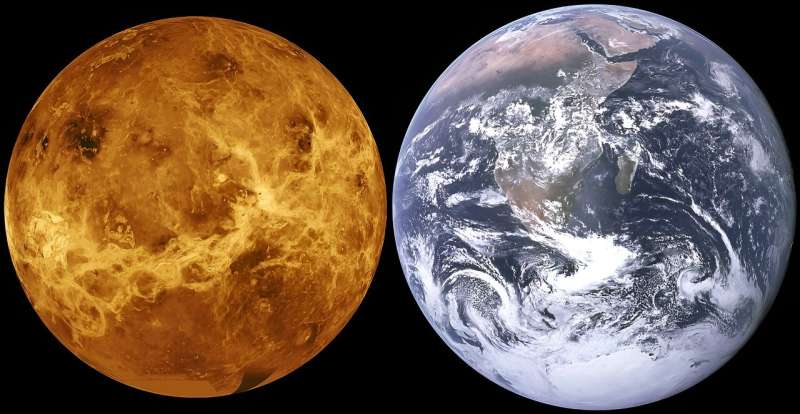
Earth and Venus. Why are they so different and what do the differences tell us about rocky exoplanet habitability? Credit: NASA
Even though Venus and Earth are so-called sister planets, they’re as different as heaven and hell. Earth is a natural paradise where life has persevered under its azure skies despite multiple mass extinctions. On the other hand, Venus is a blistering planet with clouds of sulfuric acid and atmospheric pressure strong enough to squash a human being.
But the sister thing won’t go away because both worlds are about the same mass and radius and are rocky planets next to one another in the inner solar system. Why are they so different? What do the differences tell us about our search for life?
The international astronomical community recognizes that understanding planetary habitability is a critical part of space science and astrobiology. Without a stronger understanding of terrestrial planets and their atmospheres, whether habitable or not, we won’t really know what we’re seeing when we examine a distant exoplanet. If we find an exoplanet that exhibits some signs of life, we’ll never visit it, never study it up close, and never be able to sample its atmosphere.
That shifts the scientific focus to the terrestrial planets in our own solar system. Not because they appear to be habitable but because a complete model of terrestrial planets can’t be complete without including ones that are near-literal hellholes, like sister Venus.
A recent research perspective in Nature Astronomy examines how the two planets diverged and what might have driven the divergence. It’s titled “Venus as an anchor point for planetary habitability.”
The lead author is Stephen Kane, from the Department of Earth and Planetary Sciences, University of California, Riverside. His co-author is Paul Byrne from the Department of Earth, Environmental, and Planetary Sciences, Washington University in St. Louis.
“A major focus of the planetary science and astrobiology community is understanding planetary habitability, including the myriad factors that control the evolution and sustainability of temperate surface environments such as that of Earth,” Kane and Byrne write.
“The few substantial terrestrial planetary atmospheres within the solar system serve as a critical resource for studying these habitability factors, from which models can be constructed for application to extrasolar planets.”
From their perspective, our solar system’s twins provide our best opportunity to study how similar planets can have such divergent atmospheres. The more we understand that, the better we can understand how rocky worlds evolve over time and how different conditions benefit or restrict habitability.
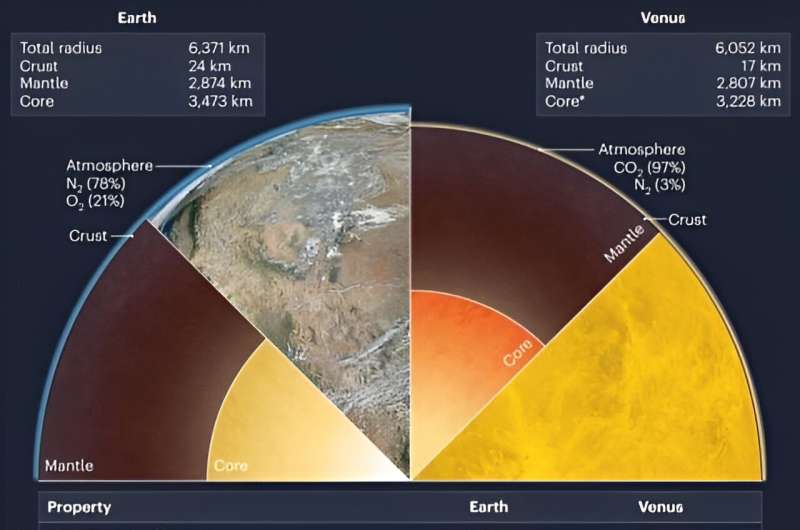
This figure from the study presents some of the main, basic differences between Earth and Venus. Credit: Kane and Byrne, 2024.
Earth is an exception. With its temperate climate and surface water, it’s been habitable for billions of years, albeit with some climate episodes that severely restricted life. But when we look at Mars, it seems to have been habitable for a period of time and then lost its atmosphere and its surface water. Mars’ situation must be more common than Earth’s.
It’s a monumental challenge to understand an exoplanet when we know nothing of its history. We only see it at one epoch of its climate and atmospheric history. But the discovery of thousands of exoplanets is helping.
“The discovery of thousands of exoplanets, and the confirmation that terrestrial planets are among the most common types, provides a statistical framework for studying planetary properties and their evolution generally,” the authors write.
A narrow range of properties allows biochemistry to emerge, and those properties may not last. We need to identify these properties and their parameters and build a better understanding of habitability. From this perspective, Venus is a treasure trove of information.
But Venus is a challenge. We can’t see through its dense clouds except with radar, and nobody’s tried landing a spacecraft there since the USSR in the 1980s. Most of those attempts failed, and the ones that survived didn’t last long. Without better data, we can’t understand Venus’ history. The simple answer is that it’s closer to the sun. But it’s too simple to be helpful.
“The evolutionary pathway of Venus to its current runaway-greenhouse state is a matter of debate, having traditionally been attributed to its closer proximity to the sun,” Kane and Byrne explain.
But when scientists look closer at Venus and Earth, they find many fundamental differences between them beyond their distances from the sun. They have different rotation rates, they have differing obliquities, and they have different magnetic fields, to name a few. That means that we can’t measure the precise effect greater solar insolation has on the planet.
This is the authors’ main point. The differences between Earth and Venus make Venus a powerful part of understanding rocky exoplanet habitability. “Venus thus offers us a critical anchor point in the planetary habitability discourse, as its evolutionary story represents an alternate pathway from the Earth-based narrative—even though the origins of both worlds are, presumably, similar,” they write.
The authors point out that the basic requirement for life is surface water. But the bigger question is what factors govern how long surface water can persist. “By this measure, investigations of planetary habitability can then focus on the conditions that allow surface liquid water to be sustained through geological time,” they write.
Earth and Venus are on opposite ends of the spectrum of rocky planet habitability. That’s an important lesson we can learn from our own solar system. For that reason, “…understanding the pathway to a Venus scenario is just as important as understanding the pathway to habitability that characterizes Earth,” the authors write.
The pair of researchers created a list of some of the factors that govern habitability on Earth and Venus.
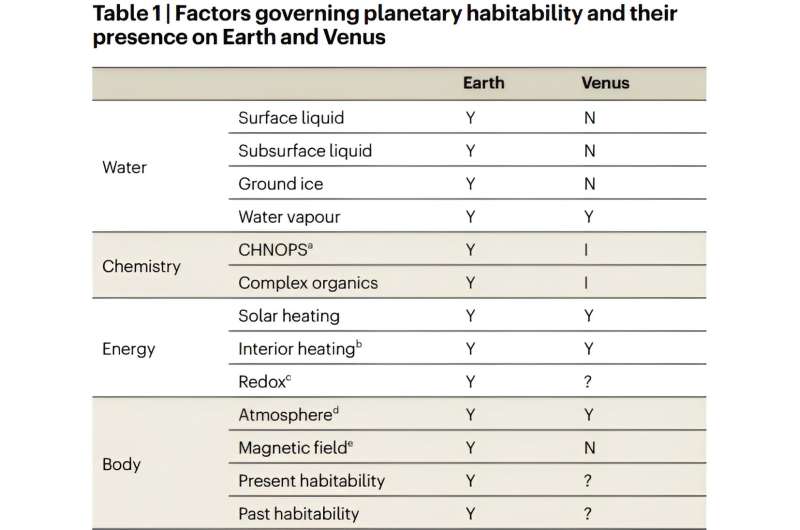
Most of these factors are self-explanatory. CHNOPS is carbon, hydrogen, nitrogen, oxygen, phosphorous, and sulfur, the life-supporting elements. Redox is the potential for an element or molecule to be reduced or oxidized and made available as chemical energy for life. The fact that there’s a question mark beside for Venus’s redox environment is a major stumbling block. Credit: Kane and Byrne, 2024.
There’s so much we don’t know about Venus. How big is its core? Did it ever have water? Some research shows that when the planet lost its water and became totally inhabitable, there was lots of oxygen in its atmosphere. If we saw that same amount of oxygen on a distant exoplanet, we might interpret it as a sign of life. Big mistake. “Venus thus acts as a cautionary tale for interpretations of apparently oxygen-rich atmospheres,” the authors write.
Kane and Byrne’s research perspective is a call to action. It mirrors what recent Decadal Surveys have said. “The recent astronomy and astrophysics, and planetary science and astrobiology decadal surveys both emphasize the need for an improved understanding of planetary habitability as an essential goal within the context of astrobiology,” they write. For the authors, Venus can anchor the effort.
But for it to serve as an anchor, scientists need answers to lots of questions. They need to study its atmosphere more thoroughly at all altitudes. They need to study its interior and determine the nature and size of its core. Critically, they need to get a spacecraft to its surface and examine its geology up close. In short, we need to do at Venus what we’ve done at Mars.
That’s challenging, considering Venus’ hostile environment. But missions are being prepared to explore Venus in more detail. VERITAS, DAVINCI, and EnVision are all Venus missions scheduled for the 2030s. Those missions will start to give scientists the answers we need.
As we learn more about Venus, we also need to learn more about exo-Venuses. “A parallel approach to studying the intrinsic properties of Venus is the statistical analysis of the vast (and still rapidly growing) inventory of terrestrial exoplanets,” the authors write.
We’re living in an age of exoplanet discovery. We’ve discovered over 5,000 confirmed exoplanets, and the tally keeps growing. We’re launching spacecraft to study the most interesting ones more thoroughly. But at some point, things will shift. How many of them do we need to catalogue? Is 10,000 enough? 20,000? 100,000?
It’s all new right now, and the enthusiasm to find more exoplanets, especially rocky ones in habitable zones, is understandable. But eventually, we’ll reach some kind of threshold of diminishing returns. In order to understand them, our effort might be more wisely spent studying Venus and how it evolved so differently.
Just as Kane and Byrne suggest.
More information:
Stephen R. Kane et al, Venus as an anchor point for planetary habitability, Nature Astronomy (2024). DOI: 10.1038/s41550-024-02228-5
Citation:
What deadly Venus can tell us about life on other worlds (2024, May 12)
retrieved 12 May 2024
from https://phys.org/news/2024-05-deadly-venus-life-worlds.html
This document is subject to copyright. Apart from any fair dealing for the purpose of private study or research, no
part may be reproduced without the written permission. The content is provided for information purposes only.
>>> Read full article>>>
Copyright for syndicated content belongs to the linked Source : Phys.org – https://phys.org/news/2024-05-deadly-venus-life-worlds.html



