







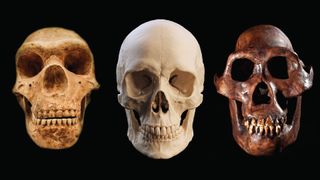
Reproductions of skulls from a Neanderthal (left), Homo sapiens (middle) and Australopithecus afarensis (right)
(Image credit: WHPics, Paul Campbell, and Attie Gerber via Getty Images; collage by Marilyn Perkins)
Modern humans (Homo sapiens) are the sole surviving representatives of the human family tree, but we’re the last sentence in an evolutionary story that began approximately 6 million years ago and spawned at least 18 species known collectively as hominins.
There were at least nine Homo species — including H. sapiens — distributed around Africa, Europe and Asia by about 300,000 years ago, according to the Smithsonian’s National Museum of Natural History in Washington, D.C. One by one, all except H. sapiens disappeared. Neanderthals and a Homo group known as the Denisovans lived alongside H. sapiens for thousands of years, and they even interbred, as evidenced by bits of their DNA that linger in many people today. But eventually, the Denisovans and the Neanderthals also vanished. By around 40,000 years ago, H. sapiens was the last hominin left.
So what was the secret to our success? Why did H. sapiens survive when all of our relatives went extinct?
To understand how we endured as a species, we must first look at what we have in common with other hominins, said William Harcourt-Smith, a paleoanthropologist at Lehman College and the American Museum of Natural History, both based in New York City. Topping that list is bipedalism. Two-legged walking originated in the Ardipithecus group — our earliest human ancestors who lived around 4.4 million years ago — and Australopithecus, which appeared about 2 million years later. Both groups were “little more than bipedal apes” with relatively small brains, Harcourt-Smith told Live Science.
Bipedalism was an important evolutionary step for hominins, but it didn’t stave off extinction for Ardipithecus, Australopithecus and a third hominin genus — Paranthropus. Australopithecus emerged as Ardipithecus was disappearing; Paranthropus and the first Homo species appeared in Africa about 3 million years ago, as Australopithecus was dying out.
Unlike emerging Homo species, which had bigger brains and smaller teeth than their predecessors, Paranthropus had small brains and were more apelike, with massive back teeth and powerful chewing muscles, Harcourt-Smith said.
“For quite a long time, you’ve got Homo and Paranthropus occupying maybe different niches but similar landscapes, and they both do really well,” Harcourt-Smith said. But after about 1 million years, Paranthropus was gone, and “Homo hangs on and proliferates, eventually across the world,” he said.
Get the world’s most fascinating discoveries delivered straight to your inbox.
What extinguished Ardipithecus, Australopithecus and Paranthropus? “Nobody knows for sure, and it probably wasn’t just one thing,” said Elizabeth Sawchuk, associate curator of human evolution at the Cleveland Museum of Natural History.
“Potential factors include environmental change, competition for food and resources between contemporaneous hominin species, and low population densities,” she told Live Science in an email.
Bigger brains in Homo certainly gave the genus an edge over Paranthropus, Harcourt-Smith added. With larger brains came improvements in cognition and toolmaking abilities, more behavioral flexibility, increased sociality and better problem-solving.
“They were likely in fairly complex family groups; perhaps they were burying their dead. They were building shelters; they were making projectile weapons; they had the controlled use of fire,” he said. “You start to see the emergence of specialization, different tools for different tasks. They were engaging with the landscape in sophisticated ways.”
This may have made Homo species more resilient and adaptable than Paranthropus was, but unraveling what made H. sapiens outlast all other Homo species is trickier. Ancient tools, art and other artifacts suggest that our cognitive powers, technical prowess and problem-solving were more advanced than those of our close relatives, Harcourt-Smith said. Flexible social strategies also could have helped H. sapiens persist where other species perished, Sawchuk suggested.
“As a species, our flexibility has served us well,” Sawchuk said. “One of the reasons we’ve been able to spread out so effectively is that we’ve learned to adapt to a variety of environments — not just biologically, but also culturally through our technology and behaviour.”
Another factor could simply be chance, Harcourt-Smith added. Small species populations can swiftly crash following natural disasters, disease outbreaks or climate shifts, leaving a formerly occupied niche open for other species to take over.
“Serendipity is part of it,” he said. “You’ve got to be in the right place at the right time.”
Flexible and competitive
Homo erectus was the first Homo species to appear, spreading across Africa and into eastern Asia. Over hundreds of thousands of years, more species followed: Homo heidelbergensis, Homo naledi, Homo floresiensis and Homo luzonensis, as well as H. sapiens, Neanderthals and Denisovans.
Related: Will humans ever be immortal?
After emerging in Africa, H. sapiens migrated into Europe, where Neanderthals were already established, and into Asia, where they encountered Denisovans. Evidence from DNA in people today shows that these groups interacted, and it’s possible that H. sapiens outcompeted and overwhelmed these groups — and possibly other Homo species that are yet to be identified.
“While we don’t know what role we played in their extinction, it seems likely that our spread out of Africa put stress on other species through competition for resources,” Sawchuk said. “Our species was very successful at moving around and mating, which is probably one of the reasons we’re still here.”
Global climate change is also thought to have contributed to the extinction of some Homo species, “but it’s hard to say how much of a role it played,” Sawchuk said. “For example, our species Homo sapiens evolved in Africa but survived the Ice Ages in Europe whereas Neanderthals, who were adapted to cold conditions, did not. It stands to reason that there was more to the equation than just climate.”
In the end, what doomed our Homo relatives “was probably a combination of factors,” Sawchuk said, “with a bit of random chance.”
As it happens, H. sapiens came perilously close to extinction at one point. A recent genetic analysis of more than 3,000 people in African and non-African groups revealed lower genetic diversity than expected. Scientists traced this to a breeding “bottleneck” between 813,000 and 930,000 years ago, with the global Homo population hovering at roughly 1,300 for more than 100,000 years.
“It’s important to remember that our survival isn’t assured,” Sawchuk said. “Falling back on our flexibility and cooperative skills will serve us well as we face new challenges.”
Mindy Weisberger is an editor at Scholastic and a former Live Science channel editor and senior writer. She has reported on general science, covering climate change, paleontology, biology and space. Mindy studied film at Columbia University; prior to Live Science she produced, wrote and directed media for the American Museum of Natural History in New York City. Her videos about dinosaurs, astrophysics, biodiversity and evolution appear in museums and science centers worldwide, earning awards such as the CINE Golden Eagle and the Communicator Award of Excellence. Her writing has also appeared in Scientific American, The Washington Post and How It Works Magazine. Her book “Rise of the Zombie Bugs: The Surprising Science of Parasitic Mind Control” will be published in spring 2025 by Johns Hopkins University Press.
>>> Read full article>>>
Copyright for syndicated content belongs to the linked Source : Live Science – https://www.livescience.com/archaeology/why-did-homo-sapiens-outlast-all-other-human-species



