







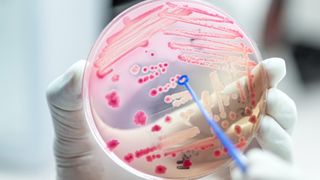
“Antibiotic resistance” is a growing problem that threatens to make life-saving antibiotics less effective.
(Image credit: Shutterstock)
Almost since antibiotics were first discovered, we’ve been aware bacteria can learn how to overcome these medicines, a phenomenon known as antimicrobial resistance.
The World Health Organization says we’re currently losing to the bugs, with resistance increasing and too few new antibiotics in the pipeline.
We wanted to know whether experts around the world think we will still have effective antibiotics in 50 years. Seven out of seven experts said yes.
Related: Dangerous ‘superbugs’ are a growing threat, and antibiotics can’t stop their rise. What can?
Lori L. Burrows
Biochemist, Canada
Yes! Antibiotics are a crucial component of modern medicine, and we can’t afford to lose them. Despite the rise of resistance in important pathogens (bugs), and the substantial decrease in new drugs in development, we have multiple tools at our disposal to protect antibiotics.
Stewardship — the principle of using antibiotics only when absolutely necessary — is key to maintaining the usefulness of current antibiotics and preventing resistance to new drugs from arising. New diagnostics, such as the rapid tests that became widely available during the pandemic, can inform stewardship efforts, reducing inappropriate antibiotic use for viral diseases. Finally, researchers continue to find creative ways, including the use of powerful artificial intelligence approaches, to identify antimicrobial compounds with new targets or new modes of action. Other promising tactics include using viruses that naturally kill bacteria, stimulating the host’s immune system to fight the bacteria, or combining existing antibiotics with molecules that can enhance antibiotic activity by, for example, increasing uptake or blocking resistance.
Related: Could bacteria-killing viruses ever prevent sexually transmitted infections?
André O. Hudson
Biochemist, United States
Yes. The real question is not whether we will have antibiotics 50 years from now, but what form of antibiotics will be used.
Most antibiotics we use today are modelled after natural products isolated from organisms such as fungi and plants. The use of AI, machine learning, and other computational tools to help design novel, unnatural compounds that can circumvent the evolution of antibiotic resistance are only in the very early stages of development. Many of the traditional medicines such as penicillins and other common antibiotics of today which are already waning in efficacy, will probably be of very little use in 50 years. Over time, with the aid of new technology, I predict we will have new medicines to fight bacterial infections. Over time, with the aid of new technologies and approaches, I predict we will have new medicines to fight bacterial infections.
Roy Robins-Browne
Microbiologist, Australia
Yes, we will have antibiotics (by which I mean antimicrobial drugs), because people will still get infections despite advances in immunization and other forms of prevention.
Having said this, drugs of the future will be quite different from those we use today, which will have become obsolete well within the next 50 years. The new drugs will have a narrow spectrum, meaning they will be targeted directly at the specific cause of the infection, which we will determine by using rapid, point-of-care diagnostic tests, similar to the RATS we currently use to diagnose COVID. Antimicrobials of the future won’t kill bacteria or limit their growth, because this encourages the development of resistance. Instead, they will limit the ability of the bacteria to cause disease or evade our immune systems.
Raúl Rivas González
Microbiologist, Spain
Yes, but not without effort.
Currently, antimicrobial resistance is a leading cause of death globally, and will continue to rise. But in my opinion, there will still be useful antibiotics to combat bacterial infections within 50 years. To achieve this, innovation and investment is required. Artificial intelligence may even be able to help. An example is the compound “RS102895”, which eliminates the multi-resistant superbug Acinetobacter baumannii. This was identified through a machine learning algorithm. The future of antibiotics requires substantial changes in the search for new active molecules and in the design of therapies that can eliminate bacteria without developing resistance. We are on the right path. An example is the discovery of clovibactin, recently isolated from uncultured soil bacteria. Clovibactin effectively kills antibiotic-resistant gram-positive bacteria without generating detectable resistance. Future antimicrobial therapy may consist of new antibiotics, viruses that kill bacteria, specific antibodies, drugs that counter antibiotic resistance, and other new technology.
Fidelma Fitzpatrick
Microbiologist, Republic of Ireland
Yes, but not many.
Without rapid scale-up of measures to curtail the “alarming global health threat” of antimicrobial resistance by 2073, there will be few effective antibiotics left to treat sepsis. The Centers for Disease Control has indicated a reversal of progress following the pandemic, when all focus in healthcare, government and society was on COVID. Without an approach targeting people, animals, agri-food systems and the environment, antimicrobial resistance will continue its upward trajectory. Doing nothing is unacceptable — lives will be lost, healthcare expenditure will increase and workforce productivity will suffer. The highest burden of antimicrobial resistance is in low-income countries. Action plans exist in most OECD, European and G20 countries. In all countries plans need to be funded and implemented across all relevant sectors as above. Better integrated data to track antibiotic use and resistance across human and animal health and the environment, in addition to research and development for new antibiotics, vaccines and diagnostics, will be necessary.
Juliana Côrrea
Public health expert, Brazil
Yes. However, available data suggest that without a shift in the political agenda towards the control and prevention of antimicrobial resistance, several antibiotics will have lost their utility.
The problem of bacterial resistance is not new and the risk of antibiotics becoming ineffective in the face of the evolutionary capacity of bacteria is one of the main problems facing global health. The creation of policies to promote the appropriate use of this resource has not progressed at the same speed as inappropriate use in human and animal health and in agricultural production. The factors that impact antibiotic use are complex and vary according to local contexts. The response to the problem goes far beyond controlling use at the individual level. We must recognize the social, political, and economic dimensions in proposing more effective governance.
Yori Yuliandra
Pharmacist, Indonesia
Yes. Despite their reduced efficacy over time, antibiotics continue to be produced every year.
Researchers are tirelessly working to develop new and more effective antibiotics. And researchers are actively exploring combinations of antibiotics to enhance their efficacy. While antimicrobial resistance is rising, researchers have been making remarkable progress in addressing this issue. They have developed innovative antibiotic classes such as FtsZ inhibitors which can inhibit cell division, a process necessary for bacteria to multiply. Clinical trials are currently taking place.
A deeper understanding of the molecular aspects of bacterial resistance has led to the discovery of new treatment strategies, such as the inhibition of key enzymes that play a pivotal role in bugs becoming resistant. And advances in computer technology have greatly accelerated drug discovery and development efforts, offering hope for the rapid discovery of new antibiotics and treatment strategies.
This edited article is republished from The Conversation under a Creative Commons license. Read the original article.
Stay up to date on the latest science news by signing up for our Essentials newsletter.
Professor Lori Burrows is a microbiologist and an expert on antibiotic resistance, bacterial attachment, motility and surface sensing, bacteriophages, and biofilm formation. The Burrows lab’s research is funded by the Canadian Institutes of Health Research (CIHR), the Natural Sciences and Engineering Research Council of Canada, the Canadian Glycomics Network, the Ontario Research Fund, and industrial support. She and her team have published over 120 peer reviewed papers, reviews, and book chapters. She is the Associate Director of McMaster University’s Michael G. DeGroote Institute for Infectious Disease Research and serves on the Editorial Boards of the Journal of Bacteriology (ASM), the Journal of Biochemistry (ASBMB), and ACS Infectious Diseases. She is a member of the Institute Advisory Board of the CIHR Institute of Infection and Immunity. She is an elected Fellow of the American Academy of Microbiology (2017) and the Canadian Academy of Health Sciences (2021). She has received the 2020 CSM Murray Award for Career Achievement from the Canadian Society of Microbiologists; the 2023 John G. Fitzgerald Award from the Canadian Association for Medical Microbiology and Infectious Diseases, and the 2023 Canadian Science Publishing Senior Investigator Award from the Canadian Society for Molecular Biosciences. She is a advocate for women in STEM, and created the CSM Burrows Award for Womxn in Microbiology, given annually to outstanding female microbiology trainees who advance the cause of equity, diversity, inclusion, and access.
>>> Read full article>>>
Copyright for syndicated content belongs to the linked Source : Live Science – https://www.livescience.com/health/medicine-drugs/will-we-still-have-antibiotics-in-50-years-7-experts-weigh-in



