






* . *
  • About
  • Advertise
  • Privacy & Policy
  • Contact
Wednesday, January 28, 2026
Earth-News
  • Home
  • Business
  • Entertainment

    O’Dowd, Dolphin Entertainment CEO, buys $4.9k in DLPN stock – Investing.com

    Sacramento Boosts Small Businesses with Exciting Live Entertainment Opportunities

    The Westerlies Share Exciting News on Grammy 2026 Nominations and Upcoming Albums

    GlowFest Lights Up Las Vegas with a Magical and Unforgettable Experience

    USF’s Spring Play and New Bouldering Wall Take Center Stage in Entertainment Issue Spring 2026

    Top Things to Do in Pensacola: Pawdi Gras, Great Pages Circus, and Dinosaur World

  • General
  • Health
  • News

    Cracking the Code: Why China’s Economic Challenges Aren’t Shaking Markets, Unlike America’s” – Bloomberg

    Trump’s Narrow Window to Spread the Truth About Harris

    Trump’s Narrow Window to Spread the Truth About Harris

    Israel-Gaza war live updates: Hamas leader Ismail Haniyeh assassinated in Iran, group says

    Israel-Gaza war live updates: Hamas leader Ismail Haniyeh assassinated in Iran, group says

    PAP Boss to Niger Delta Youths, Stay Away from the Protest

    PAP Boss to Niger Delta Youths, Stay Away from the Protest

    Court Restricts Protests In Lagos To Freedom, Peace Park

    Court Restricts Protests In Lagos To Freedom, Peace Park

    Fans React to Jazz Jennings’ Inspiring Weight Loss Journey

    Fans React to Jazz Jennings’ Inspiring Weight Loss Journey

    Trending Tags

    • Trump Inauguration
    • United Stated
    • White House
    • Market Stories
    • Election Results
  • Science
  • Sports
  • Technology

    The Next Phase of AI: Exploring Technology, Infrastructure, and Policy in 2025-2026

    Expanding advanced heart rhythm care with updated technology – news.llu.edu

    Columbus School Launches Innovative Music Technology Program

    DXC Technology and Ripple Join Forces to Transform Digital Asset Custody and Banking Payments

    Israel Bets Big on Quantum Technology in the Heat of the Global Computing Race

    The Most Underrated Chip Stock You Need to Watch and Own in 2026

    Trending Tags

    • Nintendo Switch
    • CES 2017
    • Playstation 4 Pro
    • Mark Zuckerberg
No Result
View All Result
  • Home
  • Business
  • Entertainment

    O’Dowd, Dolphin Entertainment CEO, buys $4.9k in DLPN stock – Investing.com

    Sacramento Boosts Small Businesses with Exciting Live Entertainment Opportunities

    The Westerlies Share Exciting News on Grammy 2026 Nominations and Upcoming Albums

    GlowFest Lights Up Las Vegas with a Magical and Unforgettable Experience

    USF’s Spring Play and New Bouldering Wall Take Center Stage in Entertainment Issue Spring 2026

    Top Things to Do in Pensacola: Pawdi Gras, Great Pages Circus, and Dinosaur World

  • General
  • Health
  • News

    Cracking the Code: Why China’s Economic Challenges Aren’t Shaking Markets, Unlike America’s” – Bloomberg

    Trump’s Narrow Window to Spread the Truth About Harris

    Trump’s Narrow Window to Spread the Truth About Harris

    Israel-Gaza war live updates: Hamas leader Ismail Haniyeh assassinated in Iran, group says

    Israel-Gaza war live updates: Hamas leader Ismail Haniyeh assassinated in Iran, group says

    PAP Boss to Niger Delta Youths, Stay Away from the Protest

    PAP Boss to Niger Delta Youths, Stay Away from the Protest

    Court Restricts Protests In Lagos To Freedom, Peace Park

    Court Restricts Protests In Lagos To Freedom, Peace Park

    Fans React to Jazz Jennings’ Inspiring Weight Loss Journey

    Fans React to Jazz Jennings’ Inspiring Weight Loss Journey

    Trending Tags

    • Trump Inauguration
    • United Stated
    • White House
    • Market Stories
    • Election Results
  • Science
  • Sports
  • Technology

    The Next Phase of AI: Exploring Technology, Infrastructure, and Policy in 2025-2026

    Expanding advanced heart rhythm care with updated technology – news.llu.edu

    Columbus School Launches Innovative Music Technology Program

    DXC Technology and Ripple Join Forces to Transform Digital Asset Custody and Banking Payments

    Israel Bets Big on Quantum Technology in the Heat of the Global Computing Race

    The Most Underrated Chip Stock You Need to Watch and Own in 2026

    Trending Tags

    • Nintendo Switch
    • CES 2017
    • Playstation 4 Pro
    • Mark Zuckerberg
No Result
View All Result
Earth-News
No Result
View All Result
Home Technology

To pee or not to pee? That is a question for the bladder—and the brain

June 2, 2024
in Technology
To pee or not to pee? That is a question for the bladder—and the brain
Share on FacebookShare on Twitter

💦 —

The basic urge to pee is surprisingly complex and can go awry as we age.

Emily Underwood, Knowable Magazine
– Jun 2, 2024 11:27 am UTC

Cut view of man covering urine with hands. He has some pain and problem. Isolated on striped and blue background

You’re driving somewhere, eyes on the road, when you start to feel a tingling sensation in your lower abdomen. That extra-large Coke you drank an hour ago has made its way through your kidneys into your bladder. “Time to pull over,” you think, scanning for an exit ramp.

To most people, pulling into a highway rest stop is a profoundly mundane experience. But not to neuroscientist Rita Valentino, who has studied how the brain senses, interprets, and acts on the bladder’s signals. She’s fascinated by the brain’s ability to take in sensations from the bladder, combine them with signals from outside of the body, like the sights and sounds of the road, then use that information to act—in this scenario, to find a safe, socially appropriate place to pee. “To me, it’s really an example of one of the beautiful things that the brain does,” she says.

Scientists used to think that our bladders were ruled by a relatively straightforward reflex—an “on-off” switch between storing urine and letting it go. “Now we realize it’s much more complex than that,” says Valentino, now director of the division of neuroscience and behavior at the National Institute of Drug Abuse. An intricate network of brain regions that contribute to functions like decision-making, social interactions, and awareness of our body’s internal state, also called interoception, participates in making the call.

In addition to being mind-bogglingly complex, the system is also delicate. Scientists estimate, for example, that more than 1 in 10 adults have overactive bladder syndrome—a common constellation of symptoms that includes urinary urgency (the sensation of needing to pee even when the bladder isn’t full), nocturia (the need for frequent nightly bathroom visits) and incontinence. Although existing treatments can improve symptoms for some, they don’t work for many people, says Martin Michel, a pharmacologist at Johannes Gutenberg University in Mainz, Germany, who researches therapies for bladder disorders. Developing better drugs has proven so challenging that all major pharmaceutical companies have abandoned the effort, he adds.

Recently, however, a surge of new research is opening the field to fresh hypotheses and treatment approaches. Although therapies for bladder disorders have historically focused on the bladder itself, the new studies point to the brain as another potential target, says Valentino. Combined with studies aimed at explaining why certain groups, such as post-menopausal women, are more prone to bladder problems, the research suggests that we shouldn’t simply accept symptoms like incontinence as inevitable, says Indira Mysorekar, a microbiologist at Baylor College of Medicine in Houston. We’re often told such problems are just part of getting old, particularly for women—“and that’s true to some extent,” she says. But many common issues are avoidable and can be treated successfully, she says: “We don’t have to live with pain or discomfort.”

A delicate balance

The human bladder is, at the most basic level, a stretchy bag. To fill to capacity—a volume of 400 to 500 milliliters (about 2 cups) of urine in most healthy adults—it must undergo one of the most extreme expansions of any organ in the human body, expanding roughly sixfold from its wrinkled, empty state.

To stretch that far, the smooth muscle wall that wraps around the bladder, called the detrusor, must relax. Simultaneously, sphincter muscles that surround the bladder’s lower opening, or urethra, must contract, in what scientists call the guarding reflex.
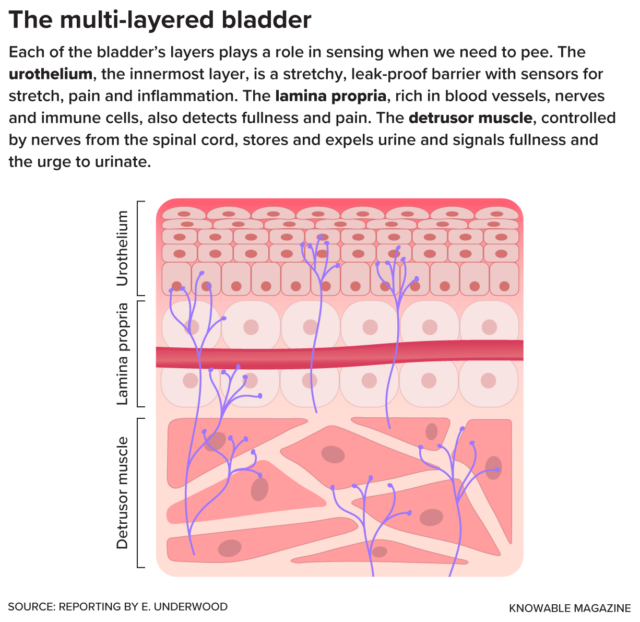
It’s not just sensory neurons (purple) that can detect stretch, pressure, pain and other sensations in the bladder. Other types of cells, like the umbrella-shaped cells that form the urothelium’s barrier against urine, can also sense and respond to mechanical forces — for example, by releasing chemical signaling molecules such as adenosine triphosphate (ATP) as the organ expands to fill with urine.

Enlarge / It’s not just sensory neurons (purple) that can detect stretch, pressure, pain and other sensations in the bladder. Other types of cells, like the umbrella-shaped cells that form the urothelium’s barrier against urine, can also sense and respond to mechanical forces — for example, by releasing chemical signaling molecules such as adenosine triphosphate (ATP) as the organ expands to fill with urine.

Filling or full, the bladder spends more than 95 percent of its time in storage mode, allowing us to carry out our daily activities without leaks. At some point—ideally, when we decide it’s time to pee—the organ switches from storage to release mode. For this, the detrusor muscle must contract forcefully to expel urine, while the sphincter muscles surrounding the urethra simultaneously relax to let urine flow out.

For a century, physiologists have puzzled over how the body coordinates the switch between storage and release. In the 1920s, a surgeon named Frederick Barrington, of University College London, went looking for the on-off switch in the brainstem, the lowermost part of the brain that connects with the spinal cord.

Working with sedated cats, Barrington used an electrified needle to damage slightly different areas in the pons, part of the brainstem that handles vital functions like sleeping and breathing. When the cats recovered, Barrington noticed that some demonstrated a desire to urinate—by scratching, circling, or squatting—but were unable to voluntarily go. Meanwhile, cats with lesions in a different part of the pons seemed to have lost any awareness of the need to urinate, peeing at random times and appearing startled whenever it happened. Clearly, the pons served as an important command center for urinary function, telling the bladder when to release urine.

Page: 1 2 3 4 Next →

>>> Read full article>>>
Copyright for syndicated content belongs to the linked Source : Ars Technica – https://arstechnica.com/?p=2028330


Tags: bladder—andquestiontechnology
Previous Post

Is a colonial-era drop in CO₂ tied to regrowing forests?

Next Post

Hong Kong’s ‘Deemed to Be Licensed’ Crypto Exchange List Sparks Debate on Regulation

The Next Phase of AI: Exploring Technology, Infrastructure, and Policy in 2025-2026

January 28, 2026

Wildcats Locked In for CBS Sports Classic Showdown Through 2029

January 28, 2026

The Data Break-Up That Shattered Soccer’s Analytics World

January 28, 2026

Top Insights and Emerging Trends Unveiled at the 2026 Economic Breakfast

January 28, 2026

O’Dowd, Dolphin Entertainment CEO, buys $4.9k in DLPN stock – Investing.com

January 28, 2026

HIV and Heart Health: What You Need to Know – HIV.gov

January 28, 2026

Ajit Pawar: Veteran Indian politician dies in plane crash – BBC

January 28, 2026

Ecological Breakdown Demands an Urgent, War-Like Response: A Call to Action Urgent Battle for Our Planet: Why Ecological Collapse Requires Immediate, All-Out Action

January 28, 2026

Kaia Gerber’s Library Science Book Club: See All of the 2026 Selections, So Far – People.com

January 28, 2026

Scientists Set Doomsday Clock to 85 Seconds Before Midnight, Warning of Escalating Global Threats

January 28, 2026

Categories

Archives

January 2026
M T W T F S S
 1234
567891011
12131415161718
19202122232425
262728293031  
« Dec    
Earth-News.info

The Earth News is an independent English-language daily published Website from all around the World News

Browse by Category

  • Business (20,132)
  • Ecology (1,044)
  • Economy (1,061)
  • Entertainment (21,940)
  • General (19,585)
  • Health (10,103)
  • Lifestyle (1,076)
  • News (22,149)
  • People (1,070)
  • Politics (1,078)
  • Science (16,278)
  • Sports (21,564)
  • Technology (16,046)
  • World (1,053)

Recent News

The Next Phase of AI: Exploring Technology, Infrastructure, and Policy in 2025-2026

January 28, 2026

Wildcats Locked In for CBS Sports Classic Showdown Through 2029

January 28, 2026
  • About
  • Advertise
  • Privacy & Policy
  • Contact

© 2023 earth-news.info

No Result
View All Result

© 2023 earth-news.info

No Result
View All Result

© 2023 earth-news.info

Go to mobile version
