







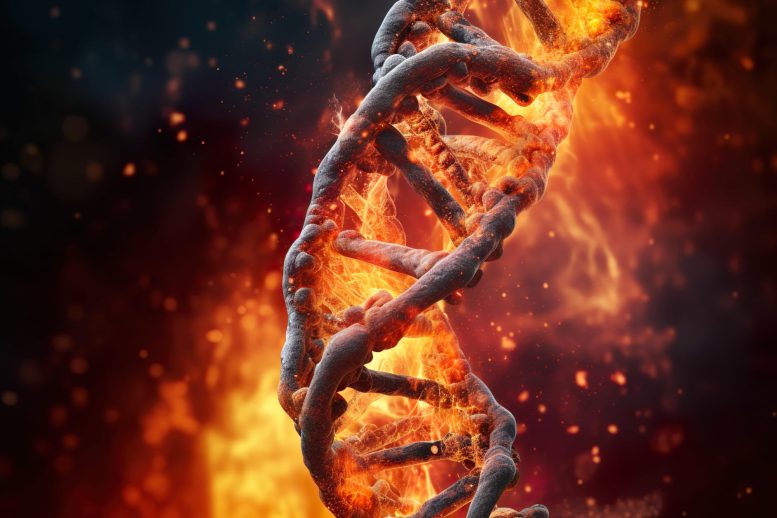
A groundbreaking study led by Stanford scientists suggests that consuming foods cooked at high temperatures, like red meat and fried food, may lead to DNA damage and increased cancer risk due to absorption of heat-damaged DNA from these foods. While this discovery is preliminary and primarily observed in lab-grown cells and mice, it highlights a potentially significant pathway for genetic damage and calls for further investigation into the health implications of different cooking methods and food choices.
Scientists have recently uncovered a surprising and potentially important reason why eating foods frequently cooked at high temperatures, such as red meat and deep-fried fare, elevates cancer risk. The suspected culprit: DNA within the food that’s been damaged by the cooking process.
As shown for the first time known to the authors, the study led by Stanford scientists, in collaboration with their counterparts at the National Institute of Standards and Technology (NIST), the University of Maryland, and Colorado State University, demonstrates that components of DNA damaged by heat can be absorbed through digestion and subsequently incorporated into the DNA of the person consuming the food.
That uptake directly places damage in the consumer’s DNA, potentially triggering genetic mutations that may eventually lead to cancer and other diseases.
While it’s too soon to say this occurs in humans – the study only observed heat-damaged DNA component uptake and increased DNA injury in lab-grown cells and mice – the findings could have important implications for dietary choices and public health.
“We have shown that cooking can damage DNA in food, and have discovered that consumption of this DNA may be a source of genetic risk,” said study senior author Eric Kool, the George A. and Hilda M. Daubert Professor in Chemistry in the Stanford School of Humanities and Sciences. “Building upon these findings could really change our perceptions of food preparation and food choices.”
Yong Woong Jun, a former postdoctoral research affiliate in chemistry at Stanford and now at the Korea Advanced Institute of Science and Technology, is the lead author of the study, which was published on June 1 in ACS Central Science.
Novel genetic hazard
Many studies link the consumption of charred and fried foods to DNA damage and attribute the harm to certain small molecules that form so-called reactive species in the body. Of note, however, those small molecules produced in typical cooking number many thousands of times less than the amount of DNA occurring naturally in foods, Kool says.
For those reactive species to cause DNA damage, they must physically encounter DNA in a cell to trigger a deleterious chemical reaction – a rare event, in all likelihood. In contrast, key components of DNA known as nucleotides that are made available through the normal breakdown of biomolecules – for instance, during digestion – are readily incorporated into the DNA of cells, suggesting a plausible and potentially significant pathway for damaged food DNA to inflict damage on other DNA downstream in consumers.
“We don’t doubt that the small molecules identified in prior studies are indeed dangerous,” says Kool. “But what has never been documented before our study is the potentially large quantities of heat-damaged DNA available for uptake into a consumer’s own DNA.”
We are what we eat
Many people aren’t aware that foods we eat – meat, fish, grains, veggies, fruit, mushrooms, you name it – include the originating organisms’ DNA. The oversight is understandable, since DNA does not appear on nutrition labels in the same manner as protein, carbohydrates, fat, vitamins, and minerals.
Yet the amounts of devoured DNA are not negligible. For example, a roughly 500-gram (16-ounce) beef steak contains over a gram (0.04 ounce) of cow DNA, suggesting that human exposure to potentially heat-damaged DNA is likewise not negligible.
Investigating the nitty-gritty of how complex DNA molecules are repaired – both after unavoidable natural errors, as well as damage induced by environmental exposures – is a chief aim of Kool’s lab at Stanford. To this end, Kool’s lab and their collaborators have devised means of inducing and measuring specific forms of damage to DNA.
While pursuing this line of research, Kool began wondering about a hypothetical connection to foodborne DNA and the well-known process of the body “salvaging” and reusing DNA scraps.
The researchers proceeded to cook foods – namely, ground beef, ground pork, and potatoes – through either 15-minute boils at 100 degrees Celsius (212 degrees Fahrenheit) or 20-minute mild roastings at 220 C (about 430 F). The Stanford researchers then extracted DNA from these foods and sent the samples to collaborators at NIST.
The NIST team, led by Miral Dizdaroglu, showed that all three foods exhibited DNA damage when boiled and roasted, and higher temperatures increased DNA damage in nearly all instances. Interestingly, even just boiling, a relatively low cooking temperature, still resulted in some DNA damage. Other intriguing results emerged as well – potatoes, for instance, incurred less DNA damage at higher temperatures than meat for unknown reasons.
The two most common kinds of damage involved a nucleotide component containing a compound called cytosine changing chemically to a related compound called uracil and the addition of oxygen to another compound called guanine. Both kinds of DNA damage are genotoxic, in that they can ultimately impair gene functioning and foster mutations that cause cells to replicate uncontrollably as cancer.
Next, Kool’s team exposed lab-grown cells and fed mice a solution containing the heat-damaged DNA components in high concentrations. The researchers used an innovative tool, created in-house in Kool’s lab in previous work, that tags sites of damaged DNA with fluorescent molecules, making the extent of the damage easy to measure.
Overall, the lab-grown cells showed significant DNA damage resulting from taking up heat-damaged DNA components. As for the mice, DNA damage appeared prominently in the cells lining the small intestine, which makes sense because that’s where much of food digestion takes place.
Meriting further investigation
The team now plans to delve deeper into these eyebrow-raising, preliminary findings. One future avenue of research is testing a broader variety of foods, following up on the idea that foods with high levels of DNA content, such as animal products, could pose more of a potential genetic menace than low-DNA-level sustenance such as potatoes and other plants. The researchers also plan on examining cooking methods that simulate different food preparations – for instance, cooking food for longer than just 20 minutes.
Importantly, the scope of research will need to expand to the long-term, lower doses to heat-damaged DNA expected over decades of consumption in typical human diets, versus the high doses administered in the proof-of-concept study.
“Our study raises a lot of questions about an entirely unexplored, yet possibly substantial chronic health risk from eating foods that are grilled, fried, or otherwise prepared with high heat,” said Kool. “We don’t yet know where these initial findings will lead, and we invite the wider research community to build upon them.”
Reference: “Possible Genetic Risks from Heat-Damaged DNA in Food” by Yong Woong Jun, Melis Kant, Erdem Coskun, Takamitsu A. Kato, Pawel Jaruga, Elizabeth Palafox, Miral Dizdaroglu and Eric T. Kool, 1 June 2023, ACS Central Science.
DOI: 10.1021/acscentsci.2c01247
The research was funded in part by the U.S. National Cancer Institute and the American Cancer Society.
>>> Read full article>>>
Copyright for syndicated content belongs to the linked Source : SciTechDaily – https://scitechdaily.com/why-does-eating-foods-cooked-at-high-temperatures-increase-cancer-risk-stanford-scientists-discover-surprising-new-reason-why/



