







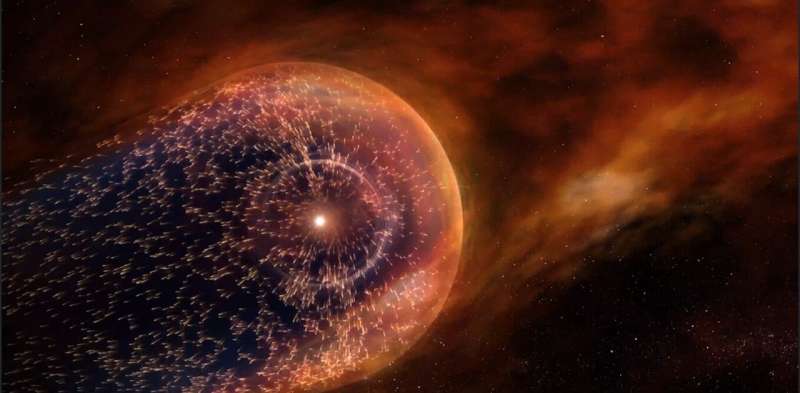
An artist’s depiction of the heliosphere, the Sun’s region of influence in space. Little is known of the actual shape of the heliosphere. Credit: NASA
The sun warms the Earth, making it habitable for people and animals. But that’s not all it does, and it affects a much larger area of space. The heliosphere, the area of space influenced by the sun, is over a hundred times larger than the distance from the sun to the Earth.
The sun is a star that constantly emits a steady stream of plasma—highly energized ionized gas—called the solar wind. In addition to the constant solar wind, the sun also occasionally releases eruptions of plasma called coronal mass ejections, which can contribute to the aurora, and bursts of light and energy, called flares.
The plasma coming off the sun expands through space, along with the sun’s magnetic field. Together they form the heliosphere within the surrounding local interstellar medium—the plasma, neutral particles and dust that fill the space between stars and their respective astrospheres. Heliophysicists like me want to understand the heliosphere and how it interacts with the interstellar medium.
The eight known planets in the solar system, the asteroid belt between Mars and Jupiter, and the Kuiper Belt—the band of celestial objects beyond Neptune that includes the planetoid Pluto—all reside within the heliosphere. The heliosphere is so large that objects in the Kuiper Belt orbit closer to the sun than to the closest boundary of the heliosphere.
Heliosphere protection
As distant stars explode, they expel large amounts of radiation into interstellar space in the form of highly energized particles known as cosmic rays. These cosmic rays can be dangerous for living organisms and can damage electronic devices and spacecraft.
Earth’s atmosphere protects life on the planet from the effects of cosmic radiation, but, even before that, the heliosphere itself acts as a cosmic shield from most interstellar radiation.
In addition to cosmic radiation, neutral particles and dust stream steadily into the heliosphere from the local interstellar medium. These particles can affect the space around Earth and may even alter how the solar wind reaches the Earth.
Supernovae and the interstellar medium may have also influenced the origins of life and the evolution of humans on Earth. Some researchers predict that millions of years ago, the heliosphere came into contact with a cold, dense particle cloud in the interstellar medium that caused the heliosphere to shrink, exposing the Earth to the local interstellar medium.
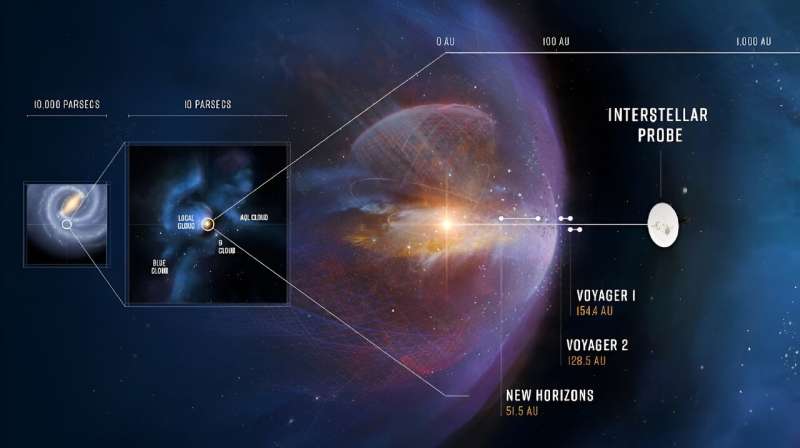
An artist’s depiction of the heliosphere and its place in the local interstellar medium and in the Milky Way galaxy. An interstellar probe could travel farther than any previous spacecraft and help scientists get a good look at our heliosphere—the Sun’s influence in space—from the outside. Credit: JHU/APL
An unknown shape
But scientists don’t really know what the heliosphere’s shape is. Models range in shape from spherical to cometlike to croissant-shaped. These predictions vary in size by hundreds to thousands of times the distance from the sun to the Earth.
Scientists have, however, defined the direction that the sun is moving as the “nose” direction and the opposing direction as the “tail” direction. The nose direction should have the shortest distance to the heliopause—the boundary between the heliosphere and the local interstellar medium.
No probe has ever gotten a good look at the heliosphere from the outside or properly sampled the local interstellar medium. Doing so could tell scientists more about the heliosphere’s shape and its interaction with the local interstellar medium, the space environment beyond the heliosphere.
Crossing the heliopause with Voyager
In 1977, NASA launched the Voyager mission: Its two spacecraft flew past Jupiter, Saturn, Uranus and Neptune in the outer solar system. Scientists have determined that after observing these gas giants, the probes separately crossed the heliopause and into interstellar space in 2012 and 2018, respectively.
While Voyager 1 and 2 are the only probes to have ever potentially crossed the heliopause, they are well beyond their intended mission lifetimes. They can no longer return the necessary data as their instruments slowly fail or power down.
These spacecraft were designed to study planets, not the interstellar medium. This means they don’t have the right instruments to take all the measurements of the interstellar medium or the heliosphere that scientists need.
That’s where a potential interstellar probe mission could come in. A probe designed to fly beyond the heliopause would help scientists understand the heliosphere by observing it from the outside.
An interstellar probe
Since the heliosphere is so large, it would take a probe decades to reach the boundary, even using a gravity assist from a massive planet like Jupiter.
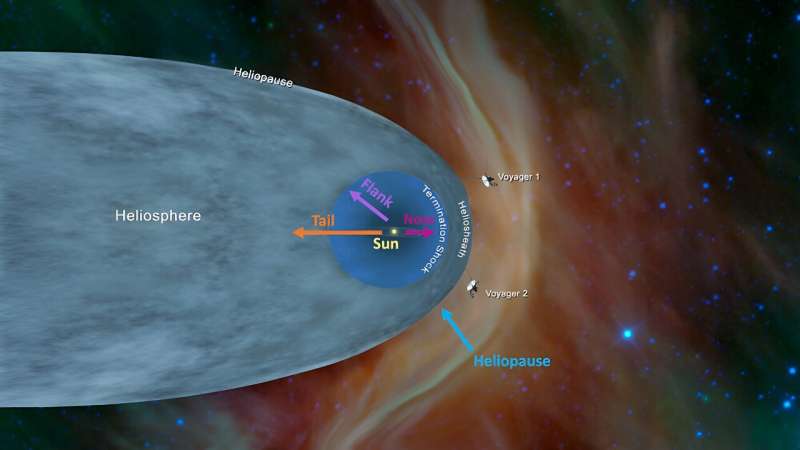
An artist’s depiction of the heliopshere – the true shape remains unknown. Labels have been added for the Sun, the heliopause and the nose and tail directions, as well as an example of the flank direction. The Voyager probes are believed to have crossed beyond the heliosphere during their decades-long journey. Credit: NASA/JPL-Caltech
The Voyager spacecraft will no longer be able to provide data from interstellar space long before an interstellar probe exits the heliosphere. And once the probe is launched, depending on the trajectory, it will take about 50 or more years to reach the interstellar medium. This means that the longer NASA waits to launch a probe, the longer scientists will be left with no missions operating in the outer heliosphere or the local interstellar medium.
NASA is considering developing an interstellar probe. This probe would take measurements of the plasma and magnetic fields in the interstellar medium and image the heliosphere from the outside. To prepare, NASA asked for input from more than 1,000 scientists on a mission concept.
The initial report recommended the probe travel on a trajectory that is about 45 degrees away from the heliosphere’s nose direction. This trajectory would retrace part of Voyager’s path, while reaching some new regions of space. This way, scientists could study new regions and revisit some partly known regions of space.
This path would give the probe only a partly angled view of the heliosphere, and it wouldn’t be able to see the heliotail, the region scientists know the least about.
In the heliotail, scientists predict that the plasma that makes up the heliosphere mixes with the plasma that makes up the interstellar medium. This happens through a process called magnetic reconnection, which allows charged particles to stream from the local interstellar medium into the heliosphere. Just like the neutral particles entering through the nose, these particles affect the space environment within the heliosphere.
In this case, however, the particles have a charge and can interact with solar and planetary magnetic fields. While these interactions occur at the boundaries of the heliosphere, very far from Earth, they affect the makeup of the heliosphere’s interior.
In a new study published in Frontiers in Astronomy and Space Sciences, my colleagues and I evaluated six potential launch directions ranging from the nose to the tail. We found that rather than exiting close to the nose direction, a trajectory intersecting the heliosphere’s flank toward the tail direction would give the best perspective on the heliosphere’s shape.
A trajectory along this direction would present scientists with a unique opportunity to study a completely new region of space within the heliosphere. When the probe exits the heliosphere into interstellar space, it would get a view of the heliosphere from the outside at an angle that would give scientists a more detailed idea of its shape—especially in the disputed tail region.
In the end, whichever direction an interstellar probe launches, the science it returns will be invaluable and quite literally astronomical.
This article is republished from The Conversation under a Creative Commons license. Read the original article.
Citation:
NASA considering an interstellar probe to study the heliosphere, the region of space influenced by the sun (2024, June 8)
retrieved 8 June 2024
from https://phys.org/news/2024-06-nasa-interstellar-probe-heliosphere-region.html
This document is subject to copyright. Apart from any fair dealing for the purpose of private study or research, no
part may be reproduced without the written permission. The content is provided for information purposes only.
>>> Read full article>>>
Copyright for syndicated content belongs to the linked Source : Phys.org – https://phys.org/news/2024-06-nasa-interstellar-probe-heliosphere-region.html



