







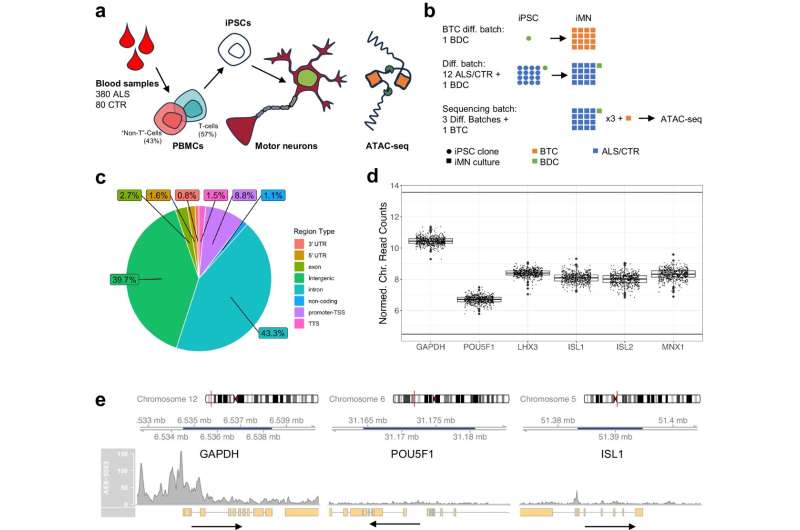
Answer ALS ATAC-seq data. Credit: Nature Communications (2024). DOI: 10.1038/s41467-024-47758-8
For most patients, it’s unknown exactly what causes amyotrophic lateral sclerosis (ALS), a disease characterized by degeneration of motor neurons that impairs muscle control and eventually leads to death.
Studies have identified certain genes that confer a higher risk of the disease, but scientists believe there are many more genetic risk factors that have yet to be discovered. One reason why these drivers have been hard to find is that some are found in very few patients, making it hard to pick them out without a very large sample of patients. Additionally, some of the risk may be driven by epigenomic factors, rather than mutations in protein-coding genes.
Working with the Answer ALS consortium, a team of MIT researchers has analyzed epigenetic modifications—tags that determine which genes are turned on in a cell—in motor neurons derived from induced pluripotent stem (IPS) cells from 380 ALS patients.
This analysis revealed a strong differential signal associated with a known subtype of ALS, and about 30 locations with modifications that appear to be linked to rates of disease progression in ALS patients. The findings may help scientists develop new treatments that are targeted to patients with certain genetic risk factors.
“If the root causes are different for all these different versions of the disease, the drugs will be very different and the signals in IPS cells will be very different,” says Ernest Fraenkel, the Grover M. Hermann Professor in Health Sciences and Technology in MIT’s Department of Biological Engineering and the senior author of the study.
“We may get to a point in a decade or so where we don’t even think of ALS as one disease, where there are drugs that are treating specific types of ALS that only work for one group of patients and not for another.”
MIT postdoc Stanislav Tsitkov is the lead author of the paper, which appears in Nature Communications.
Finding risk factors
ALS is a rare disease that is estimated to affect about 30,000 people in the United States. One of the challenges in studying the disease is that while genetic variants are believed to account for about 50% of ALS risk (with environmental factors making up the rest), most of the variants that contribute to that risk have not been identified.
Similar to Alzheimer’s disease, there may be a large number of genetic variants that can confer risk, but each individual patient may carry only a small number of those. This makes it difficult to identify the risk factors unless scientists have a very large population of patients to analyze.
“Because we expect the disease to be heterogeneous, you need to have large numbers of patients before you can pick up on signals like this. To really be able to classify the subtypes of disease, we’re going to need to look at a lot of people,” Fraenkel says.
About 10 years ago, the Answer ALS consortium began to collect large numbers of patient samples, which could allow for larger-scale studies that might reveal some of the genetic drivers of the disease. From blood samples, researchers can create induced pluripotent stem cells and then induce them to differentiate into motor neurons, the cells most affected by ALS.
“We don’t think all ALS patients are going to be the same, just like all cancers are not the same. And the goal is being able to find drivers of the disease that could be therapeutic targets,” Fraenkel says.
In this study, Fraenkel and his colleagues wanted to see if patient-derived cells could offer any information about molecular differences that are relevant to ALS. They focused on epigenomic modifications, using a method called ATAC-seq to measure chromatin density across the genome of each cell. Chromatin is a complex of DNA and proteins that determines which genes are accessible to be transcribed by the cell, depending on how densely packed the chromatin is.
In data that were collected and analyzed over several years, the researchers did not find any global signal that clearly differentiated the 380 ALS patients in their study from 80 healthy control subjects. However, they did find a strong differential signal associated with a subtype of ALS, characterized by a genetic mutation in the C9orf72 gene.
Additionally, they identified about 30 regions that were associated with slower rates of disease progression in ALS patients. Many of these regions are located near genes related to the cellular inflammatory response; interestingly, several of the identified genes have also been implicated in other neurodegenerative diseases, such as Parkinson’s disease.
“You can use a small number of these epigenomic regions and look at the intensity of the signal there, and predict how quickly someone’s disease will progress. That really validates the hypothesis that the epigenomics can be used as a filter to better understand the contribution of the person’s genome,” Fraenkel says.
“By harnessing the very large number of participant samples and extensive data collected by the Answer ALS Consortium, these studies were able to rigorously test whether the observed changes might be artifacts related to the techniques of sample collection, storage, processing, and analysis, or truly reflective of important biology,” says Lyle Ostrow, an associate professor of neurology at the Lewis Katz School of Medicine at Temple University, who was not involved in the study.
“They developed standard ways to control for these variables, to make sure the results can be accurately compared. Such studies are incredibly important for accelerating ALS therapy development, as they will enable data and samples collected from different studies to be analyzed together.”
Targeted drugs
The researchers now hope to further investigate these genomic regions and see how they might drive different aspects of ALS progression in different subsets of patients. This could help scientists develop drugs that might work in different groups of patients, and help them identify which patients should be chosen for clinical trials of those drugs, based on genetic or epigenetic markers.
Last year, the U.S. Food and Drug Administration approved a drug called tofersen, which can be used in ALS patients with a mutation in a gene called SOD1. This drug is very effective for those patients, who make up about 1 percent of the total population of people with ALS. Fraenkel’s hope is that more drugs can be developed for, and tested in, people with other genetic drivers of ALS.
“If you had a drug like tofersen that works for 1% of patients and you just gave it to a typical phase two clinical trial, you probably wouldn’t have anybody with that mutation in the trial, and it would’ve failed. And so that drug, which is a lifesaver for people, would never have gotten through,” Fraenkel says.
The MIT team is now using an approach called quantitative trait locus (QTL) analysis to try to identify subgroups of ALS patients whose disease is driven by specific genomic variants.
“We can integrate the genomics, the transcriptomics, and the epigenomics, as a way to find subgroups of ALS patients who have distinct phenotypic signatures from other ALS patients and healthy controls,” Tsitkov says. “We have already found a few potential hits in that direction.”
More information:
Stanislav Tsitkov et al, Disease related changes in ATAC-seq of iPSC-derived motor neuron lines from ALS patients and controls, Nature Communications (2024). DOI: 10.1038/s41467-024-47758-8
This story is republished courtesy of MIT News (web.mit.edu/newsoffice/), a popular site that covers news about MIT research, innovation and teaching.
Citation:
Epigenomic analysis sheds light on risk factors for amyotrophic lateral sclerosis (2024, May 2)
retrieved 2 May 2024
from https://medicalxpress.com/news/2024-05-epigenomic-analysis-factors-amyotrophic-lateral.html
This document is subject to copyright. Apart from any fair dealing for the purpose of private study or research, no
part may be reproduced without the written permission. The content is provided for information purposes only.
>>> Read full article>>>
Copyright for syndicated content belongs to the linked Source : Medical Xpress – https://medicalxpress.com/news/2024-05-epigenomic-analysis-factors-amyotrophic-lateral.html



