














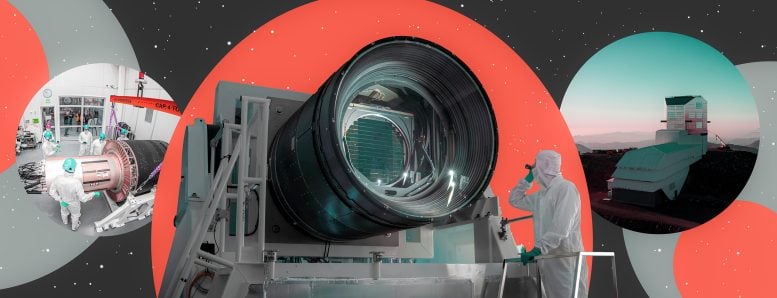
Researchers examine the LSST Camera. The camera will soon be shipped to Chile, where it will be the heart of the Vera C. Rubin Observatory (right). Credit: Greg Stewart/SLAC National Accelerator Laboratory
Once installed on a telescope in Chile, the 3,200-megapixel LSST Camera will help scientists better understand dark matter, dark energy, and other mysteries of our universe.
After two decades of work, scientists and engineers at the Department of Energy’s SLAC National Accelerator Laboratory and their collaborators are celebrating the completion of the Legacy Survey of Space and Time (LSST) Camera.
As the heart of the DOE- and National Science Foundation-funded Vera C. Rubin Observatory, the 3,200-megapixel camera will help researchers observe our universe in unprecedented detail. Over ten years, it will generate an enormous trove of data on the southern night sky that researchers will mine for new insights into the universe. That data will aid in the quest to understand dark energy, which is driving the accelerating expansion of the universe, and the hunt for dark matter, the mysterious substance that makes up around 85% of the matter in the universe. Researchers also have plans to use Rubin data to better understand the changing night sky, the Milky Way galaxy, and our own solar system.
“With the completion of the unique LSST Camera at SLAC and its imminent integration with the rest of Rubin Observatory systems in Chile, we will soon start producing the greatest movie of all time and the most informative map of the night sky ever assembled,” said Director of Rubin Observatory Construction and University of Washington professor Željko Ivezić.
To achieve that goal, the SLAC team and its partners built the largest digital camera ever constructed for astronomy. The camera is roughly the size of a small car and weighs around 3,000 kilograms (3 metric tons), and its front lens is over five feet across – the largest lens ever made for this purpose. Another three-foot-wide lens had to be specially designed to maintain shape and optical clarity while also sealing the vacuum chamber that houses the camera’s enormous focal plane. That focal plane is made up of 201 individual custom-designed CCD sensors, and it is so flat that it varies by no more than a tenth the width of a human hair. The pixels themselves are only 10 microns wide.
Built at SLAC National Accelerator Laboratory, the LSST Camera is the largest digital camera ever built for astronomy. The camera is at the heart of the Vera C. Rubin Observatory’s 10-year-long Legacy Survey of Space and Time (LSST), which will capture the entire southern sky every 3 nights. Data from the camera will help address some of the most pressing questions in cosmology, such as the nature of dark energy and dark matter, as well as advancing the study of our solar system and the changing night sky. Credit: Olivier Bonin/SLAC National Accelerator Laboratory
Still, the camera’s most important feature is its resolution, which is so high it would take hundreds of ultra-high-definition TVs to display just one of its images at full size, said SLAC professor and Rubin Observatory Deputy Director and Camera Program Lead Aaron Roodman. “Its images are so detailed that it could resolve a golf ball from around 15 miles away, while covering a swath of the sky seven times wider than the full moon. These images with billions of stars and galaxies will help unlock the secrets of the universe.”
And those secrets are increasingly important to reveal, said Kathy Turner, program manager for the DOE’s Cosmic Frontier Program. “More than ever before, expanding our understanding of fundamental physics requires looking farther out into the universe,” Turner said. “With the LSST Camera at its core, Rubin Observatory will delve deeper than ever before into the cosmos and help answer some of the hardest, most important questions in physics today.”
Searching for dark matter and dark energy
Now that the LSST Camera is complete and has been thoroughly tested at SLAC, it will be packed up and shipped to Chile and driven up the 8,900-foot-high Cerro Pachón in the Andes, where it will be hoisted atop the Simonyi Survey Telescope later this year.
Once it’s up and running, the camera’s essential purpose is to map the positions and measure the brightness of a vast number of night-sky objects. From that catalog, researchers can infer a wealth of information. Perhaps most notably, the LSST Camera will look for signs of weak gravitational lensing, in which massive galaxies subtly bend the paths light from background galaxies take to reach us. Weak lensing reveals something about the distribution of mass in the universe and how that’s changed over time, which will help cosmologists understand how dark energy is driving the expansion of the universe.
The observatory is the first built for studying weak lensing on this scale, and the project led scientists and engineers to develop a number of new technologies, including new kinds of CCD sensors and some of the largest lenses ever made – and make sure all of those components worked well together, said Martin Nordby, a senior staff engineer at SLAC and the LSST camera project manager.
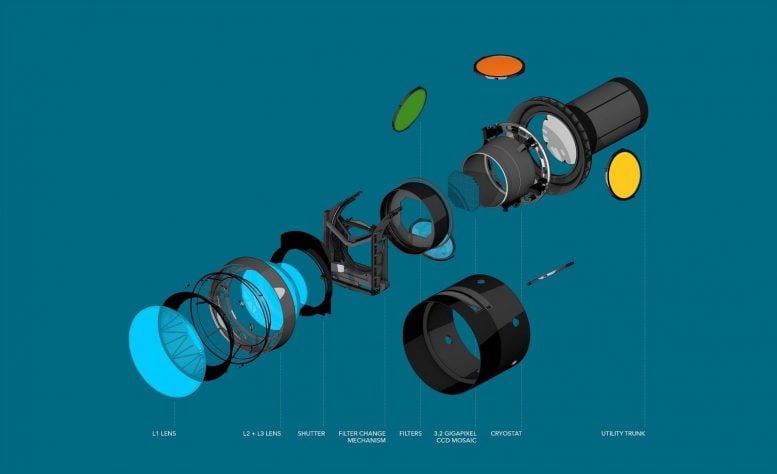
An artist’s rendering of the LSST Camera showing its major components including lenses, sensor array, and utility trunk. Credit: Chris Smith/SLAC National Accelerator Laboratory
Scientists also want to study patterns in the distribution of galaxies and how those have changed over time, identifying clusters of dark matter and spotting supernovae, all of which can help further understanding of dark matter and dark energy alike.
Risa Wechsler, a cosmologist who directs the Kavli Institute for Particle Astrophysics and Cosmology at SLAC and Stanford University, said it was an extraordinary moment. “There are so many scientists here at SLAC and around the world who will find something valuable in the data this camera will produce,” Wechsler said. “This is an exciting time to be studying cosmology.”
What else do you do with a camera that big?
The same images that reveal details of distant galaxies will help researchers study something closer to home: our own Milky Way galaxy. Many of its stars are small and faint, but with the LSST Camera’s sensitivity, researchers expect to produce a far more detailed map of our galaxy, yielding insights into its structure and evolution as well as the nature of stars and other objects within it.
Even closer to home, researchers are hoping to create a far more thorough census of the many small objects in our solar system. According to Rubin Observatory estimates, the project may increase the number of known objects by a factor of 10, which could lead to a new understanding of how our solar system formed and perhaps help identify threats from asteroids that get a little too close to the planet.
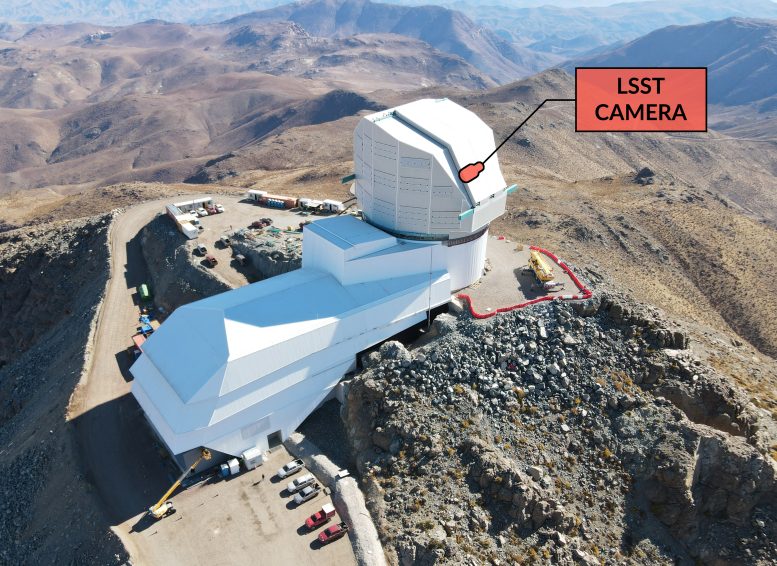
The camera will sit atop Rubin Observatory’s Simonyi Survey Telescope high in the Andes of Chile. Credit: Rubin Observatory/National Science Foundation/AURA
Finally, Rubin scientists will look at how the night sky is changing – for example, how stars die or how matter falls into supermassive black holes at the centers of galaxies.
A team effort
SLAC Director John Sarrao said the camera is a “tremendous accomplishment” for the lab and its partners. “The LSST Camera and Rubin Observatory will open new windows into our universe, yielding deep insights into some of its greatest mysteries while also revealing wonders closer to home,” Sarrao said. “It’s exciting to see SLAC’s scientific and technical expertise, project leadership and strong global partnerships come together in such an impactful way. We can’t wait to see what’s next.”
Among the partner labs that contributed expertise and technology are Brookhaven National Laboratory, which built the camera’s digital sensor array; Lawrence Livermore National Laboratory, which with its industrial partners designed and built lenses for the camera; and the National Institute of Nuclear and Particle Physics at the National Center for Scientific Research (IN2P3/CNRS) in France, which contributed to sensor and electronics design and built the camera’s filter exchange system, which will allow the camera to home in on six separate bands of light from the ultraviolet to infrared.
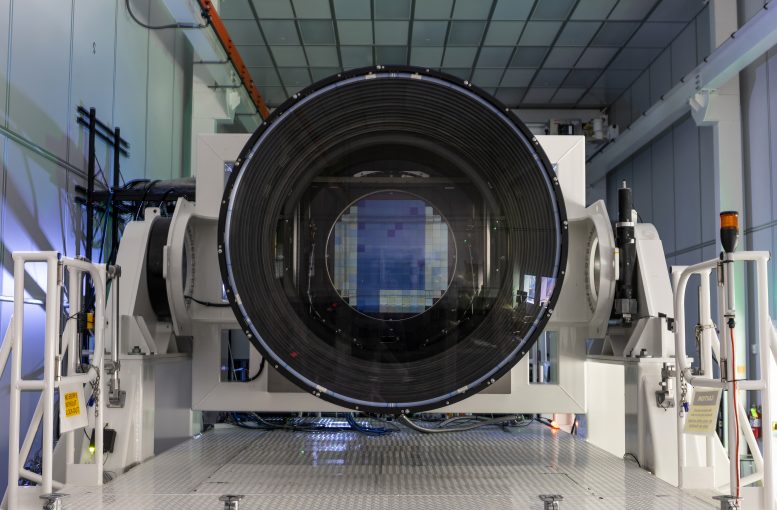
A front view of the completed LSST Camera, showing the 3,200-megapixel focal plane within. Credit: Jacqueline Ramseyer Orrell/SLAC National Accelerator Laboratory
Paul O’Connor, a senior physicist in Brookhaven’s Instrumentation Division, said, “The team at Brookhaven Lab, some of whom have been working on the project for more than 20 years, is excited to see the completion of the LSST Camera. Our fast, ultra-sensitive CCD modules, which we developed with multiple collaborators, will contribute to the breakthrough science delivered by the Rubin Observatory over the next decade, and we look forward to collaborating on this flagship astronomical survey.”
A key feature of the camera’s optical assemblies are its three lenses, one of which at 1.57 meters (5.1 feet) in diameter is believed to be the world’s largest high-performance optical lens ever fabricated. “The Lawrence Livermore National Laboratory is extremely proud to have had the opportunity to design and oversee the fabrication of the large lenses and optical filters for the LSST Camera, including the largest lens in the world,” said Vincent Riot, a LLNL engineer and the former LSST Camera project manager. “LLNL was able to leverage its expertise in large optics, built over decades of developing the world’s largest laser systems, and is excited to see this unprecedented instrument completed and ready to make its journey to the Rubin Observatory.”
IN2P3/CNRS camera scientist Pierre Antilogus said, “To make a 3D movie of the universe, the camera had to take an image in about 2 seconds and change filters in less than 90 seconds. This is quite a feat for a camera of this size. And if the size of the LSST Camera’s focal plane is unique, the density of the technology inside is even more impressive. By being in charge of the filter exchange system and contributing to the focal plane, our team is delighted to have taken part in this collective adventure to develop such a powerful camera.”
Building the camera has also been a rewarding challenge for the SLAC team that built it and led the project, said Travis Lange, the camera’s deputy project manager and camera integration manager. “I’m very proud of what we’ve built,” he said. “This has been such a unique project that has exposed me to incredible experiences – who could have imagined that the Secretary of State and Speaker of the House would hold a press conference in front of the camera clean room? That will be a tough act to follow.”
>>> Read full article>>>
Copyright for syndicated content belongs to the linked Source : SciTechDaily – https://scitechdaily.com/after-20-years-the-construction-of-astronomys-largest-digital-camera-has-finally-been-completed/