







Gamma ray bursts happen when neutron stars collide or when giant stars explode into black holes, releasing jets of super-energetic photons that look like a narrow beam of a flashlight.
(Image credit: European Southern Observatory)
This article was originally published at The Conversation. The publication contributed the article to Space.com’s Expert Voices: Op-Ed & Insights.
Amy Lien is an Assistant Professor of Physics at the University of Tampa whose research interests lie in understanding how the universe begins and evolves through the most energetic astrophysical explosions: gamma-ray bursts (GRBs), supernovas, merging neutron stars and black holes.
When faraway stars explode, they send out flashes of energy called gamma-ray bursts that are bright enough that telescopes back on Earth can detect them. Studying these pulses, which can also come from mergers of some exotic astronomical objects such as black holes and neutron stars, can help astronomers like me understand the history of the universe.
Space telescopes detect on average one gamma-ray burst per day, adding to thousands of bursts detected throughout the years, and a community of volunteers are making research into these bursts possible.
On Nov. 20, 2004, NASA launched the Neil Gehrels Swift Observatory, also known as Swift. Swift is a multiwavelength space telescope that scientists are using to find out more about these mysterious gamma-ray flashes from the universe.
Related: Brightest gamma-ray burst ever seen a 1-in-10,000-years event that’s ‘absolutely monstrous,’ scientists say
Gamma-ray bursts usually last for only a very short time, from a few seconds to a few minutes, and the majority of their emission is in the form of gamma rays, which are part of the light spectrum that our eyes cannot see. Gamma rays contain a lot of energy and can damage human tissues and DNA.
Breaking space news, the latest updates on rocket launches, skywatching events and more!
Fortunately, Earth’s atmosphere blocks most gamma rays from space, but that also means the only way to observe gamma-ray bursts is through a space telescope like Swift. Throughout its 19 years of observations, Swift has observed over 1,600 gamma-ray bursts. The information it collects from these bursts helps astronomers back on the ground measure the distances to these objects.
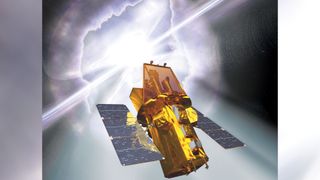
An artist’s rendering of the Swift spacecraft with a gamma-ray burst going off in the background. (Image credit: Spectrum and NASA E/PO, Sonoma State University, Aurore Simonnet)
Looking back in time
The data from Swift and other observatories has taught astronomers that gamma-ray bursts are one of the most powerful explosions in the universe. They’re so bright that space telescopes like Swift can detect them from across the entire universe.
In fact, gamma-ray bursts are among one of the farthest astrophysical objects observed by telescopes.
Because light travels at a finite speed, astronomers are effectively looking back in time as they look farther into the universe.
The farthest gamma-ray burst ever observed occurred so far away that its light took 13 billion years to reach Earth. So when telescopes took pictures of that gamma-ray burst, they observed the event as it looked 13 billion years ago.
Gamma-ray bursts allow astronomers to learn about the history of the universe, including how the birth rate and the mass of the stars change over time.
Types of gamma-ray bursts
Astronomers now know that there are basically two kinds of gamma-ray bursts – long and short. They are classified by how long their pulses last. The long gamma-ray bursts have pulses longer than two seconds, and at least some of these events are related to supernovae – exploding stars.
When a massive star, or a star that is at least eight times more massive than our Sun, runs out of fuel, it will explode as a supernova and collapse into either a neutron star or a black hole.
Both neutron stars and black holes are extremely compact. If you shrank the entire Sun into a diameter of about 12 miles, or the size of Manhattan, it would be as dense as a neutron star.
Some particularly massive stars can also launch jets of light when they explode. These jets are concentrated beams of light powered by structured magnetic fields and charged particles. When these jets are pointed toward Earth, telescopes like Swift will detect a gamma-ray burst.
On the other hand, short gamma-ray bursts have pulses shorter than two seconds. Astronomers suspect that most of these short bursts happen when either two neutron stars or a neutron star and a black hole merge.
When a neutron star gets too close to another neutron star or a black hole, the two objects will orbit around each other, creeping closer and closer as they lose some of their energy through gravitational waves.
These objects eventually merge and emit short jets. When the short jets are pointed toward Earth, space telescopes can detect them as short gamma-ray bursts.
Classifying gamma-ray bursts
Classifying bursts as short or long isn’t always that simple. In the past few years, astronomers have discovered some peculiar short gamma-ray bursts associated with supernovae instead of the expected mergers. And they’ve found some long gamma-ray bursts related to mergers instead of supernovae.
These confusing cases show that astronomers do not fully understand how gamma-ray bursts are created. They suggest that astronomers need a better understanding of gamma-ray pulse shapes to better connect the pulses to their origins.
But it’s hard to classify pulse shape, which is different than pulse duration, systematically. Pulse shapes can be extremely diverse and complex. So far, even machine learning algorithms haven’t been able to correctly recognize all the detailed pulse structures that astronomers are interested in.
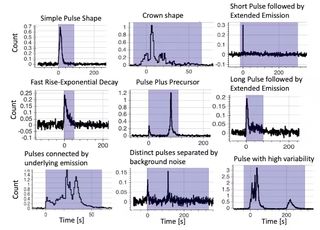
Gamma-ray bursts have a variety of different shapes, which describe how they emit energy over time. Here’s a small subset of the gamma-ray bursts detected by Swift, which captures a glimpse of the diversity of these pulse shapes. (Image credit: NASA)
My colleagues and I have enlisted the help of volunteers through NASA to identify pulse structures. Volunteers learn to identify the pulse structures, then they look at images on their own computers and classify them.
Our preliminary results suggest that these volunteers – also referred to as citizen scientists – can quickly learn and recognize gamma-ray pulses’ complex structures. Analyzing this data will help astronomers better understand how these mysterious bursts are created.
Our team hopes to learn about whether more gamma-ray bursts in the sample challenge the previous short and long classification. We’ll use the data to more accurately probe the history of the universe through gamma-ray burst observations.
This citizen science project, called Burst Chaser, has grown since our preliminary results, and we’re actively recruiting new volunteers to join our quest to study the mysterious origins behind these bursts.
Read the original article at The Conversation.
Join our Space Forums to keep talking space on the latest missions, night sky and more! And if you have a news tip, correction or comment, let us know at: [email protected].
My research interests lie in understanding how the universe begins and evolves through the most energetic astrophysical explosions: gamma-ray bursts (GRBs), supernovae, merging neutron stars and black holes. My main research utilizes GRBs detected by the Neil Gehrels Swift Observatory, a multi-wavelength space telescope dedicated to studying GRBs and the transient sky. GRBs are seen from within our neighborhood of galaxies to the early universe when the rst stars were expected to form (Fig. 1). I use GRBs to explore the history of the universe, and study how nature can form these energetic bursts from either the collapse of massive stars or merging of compact objects like neutron stars and black holes.
>>> Read full article>>>
Copyright for syndicated content belongs to the linked Source : Space.com – https://www.space.com/classifying-super-nova-energy-bursts



