







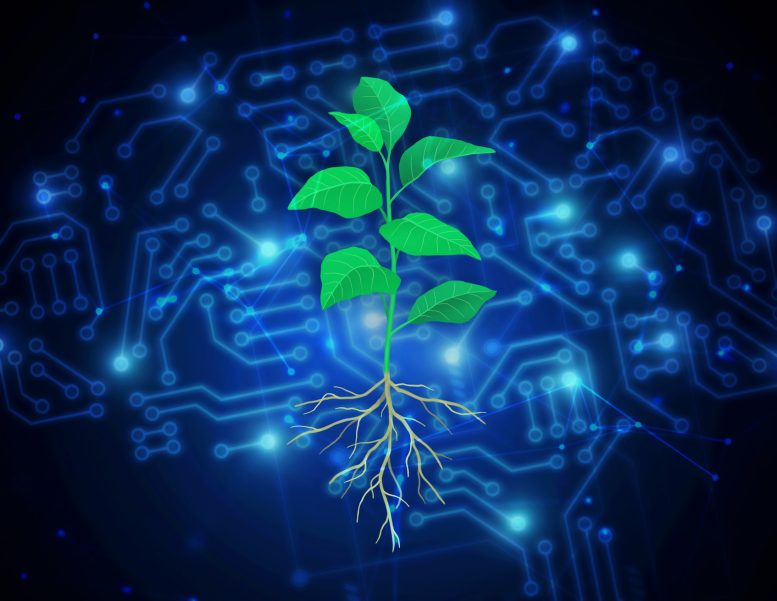
Salk Institute scientists are using an AI software, SLEAP, to develop plants with enhanced root systems that can capture and store more carbon, aligning with global efforts to combat climate change. This tool has significantly improved the efficiency and accuracy of plant phenotype and genotype analysis, speeding up the creation of effective carbon-sequestering plants. Credit: Salk Institute
A unique partnership at Salk leverages the deep learning software known as SLEAP to study plant characteristics, speeding up the development of plants that can combat climate change.
The Intergovernmental Panel on Climate Change (IPCC) has stated that carbon removal is crucial for combating climate change and keeping global temperature increases in check. In alignment with this, scientists at Salk are leveraging the natural capacity of plants to absorb carbon dioxide by enhancing their root systems. This optimization aims to increase the amount of carbon stored and extend the duration of its storage.
To design these climate-saving plants, scientists in Salk’s Harnessing Plants Initiative are using a sophisticated new research tool called SLEAP—an easy-to-use artificial intelligence (AI) software that tracks multiple features of root growth. Created by Salk Fellow Talmo Pereira, SLEAP was initially designed to track animal movement in the lab. Now, Pereira has teamed up with plant scientist and Salk colleague Professor Wolfgang Busch to apply SLEAP to plants.
SLEAP and sleap-roots predict how the different parts of plant roots connect to each other by analyzing the geometry of the roots. Credit: Salk Institute
Advanced Research with SLEAP
In a study published in Plant Phenomics, Busch and Pereira debut a new protocol for using SLEAP to analyze plant root phenotypes—how deep and wide they grow, how massive their root systems become, and other physical qualities that, prior to SLEAP, were tedious to measure. The application of SLEAP to plants has already enabled researchers to establish the most extensive catalog of plant root system phenotypes to date.
What’s more, tracking these physical root system characteristics helps scientists find genes affiliated with those characteristics, as well as whether multiple root characteristics are determined by the same genes or independently. This allows the Salk team to determine what genes are most beneficial to their plant designs.
“This collaboration is truly a testament to what makes Salk science so special and impactful,” says Pereira. “We’re not just ‘borrowing’ from different disciplines—we’re really putting them on equal footing in order to create something greater than the sum of its parts.”
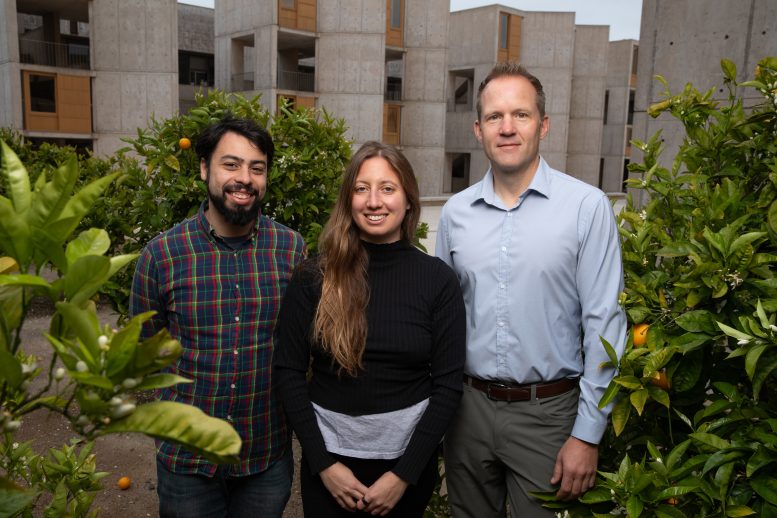
From left: Talmo Pereira, Elizabeth Berrigan, and Wolfgang Busch. Credit: Salk Institute
Prior to using SLEAP, tracking the physical characteristics of both plants and animals required a lot of labor that slowed the scientific process. If researchers wanted to analyze an image of a plant, they would need to manually flag the parts of the image that were and weren’t plant—frame-by-frame, part-by-part, pixel-by-pixel. Only then could older AI models be applied to process the image and gather data about the plant’s structure.
What sets SLEAP apart is its unique use of both computer vision (the ability for computers to understand images) and deep learning (an AI approach for training a computer to learn and work like the human brain). This combination allows researchers to process images without moving pixel-by-pixel, instead skipping this intermediate labor-intensive step to jump straight from image input to defined plant features.
“We created a robust protocol validated in multiple plant types that cuts down on analysis time and human error, while emphasizing accessibility and ease-of-use—and it required no changes to the actual SLEAP software,” says first author Elizabeth Berrigan, a bioinformatics analyst in Busch’s lab.
Impact of SLEAP on Plant Breeding
Without modifying the baseline technology of SLEAP, the researchers developed a downloadable toolkit for SLEAP called sleap-roots (available as open-source software here). With sleap-roots, SLEAP can process biological traits of root systems like depth, mass, and angle of growth.
The Salk team tested the sleap-roots package in a variety of plants, including crop plants like soybeans, rice, and canola, as well as the model plant species Arabidopsis thaliana—a flowering weed in the mustard family. Across the variety of plants trialed, they found the novel SLEAP-based method outperformed existing practices by annotating 1.5 times faster, training the AI model 10 times faster, and predicting plant structure on new data 10 times faster, all with the same or better accuracy than before.
Together with massive genome sequencing efforts for elucidating the genotype data in large numbers of crop varieties, these phenotypic data, such as a plant’s root system growing especially deep in soil, can be extrapolated to understand the genes responsible for creating that especially deep root system.
SLEAP and sleap-roots automatically detect landmarks across the entire root system architecture. Credit: Salk Institute
This step—connecting phenotype and genotype—is crucial in Salk’s mission to create plants that hold on to more carbon and for longer, as those plants will need root systems designed to be deeper and more robust. Implementing this accurate and efficient software will allow the Harnessing Plants Initiative to connect desirable phenotypes to targetable genes with groundbreaking ease and speed.
“We have already been able to create the most extensive catalog of plant root system phenotypes to date, which is really accelerating our research to create carbon-capturing plants that fight climate change,” says Busch, the Hess Chair in Plant Science at Salk. “SLEAP has been so easy to apply and use, thanks to Talmo’s professional software design, and it’s going to be an indispensable tool in my lab moving forward.”
Accessibility and reproducibility were at the forefront of Pereira’s mind when creating both SLEAP and sleap-roots. Because the software and sleap-roots toolkit are free to use, the researchers are excited to see how sleap-roots will be used around the world. Already, they have begun discussions with NASA scientists hoping to utilize the tool not only to help guide carbon-sequestering plants on Earth, but also to study plants in space.
At Salk, the collaborative team is not yet ready to disband—they are already embarking on a new challenge of analyzing 3D data with SLEAP. Efforts to refine, expand, and share SLEAP and sleap-roots will continue for years to come, but its use in Salk’s Harnessing Plants Initiative is already accelerating plant designs and helping the Institute make an impact on climate change.
Reference: “Fast and Efficient Root Phenotyping via Pose Estimation” by Elizabeth M. Berrigan, Lin Wang, Hannah Carrillo, Kimberly Echegoyen, Mikayla Kappes, Jorge Torres, Angel Ai-Perreira, Erica McCoy, Emily Shane, Charles D. Copeland, Lauren Ragel, Charidimos Georgousakis, Sanghwa Lee, Dawn Reynolds, Avery Talgo, Juan Gonzalez, Ling Zhang, Ashish B. Rajurkar, Michel Ruiz, Erin Daniels, Liezl Maree, Shree Pariyar, Wolfgang Busch and Talmo D. Pereira, 12 April 2024, Plant Phenomics.
DOI: 10.34133/plantphenomics.0175
Other authors include Lin Wang, Hannah Carrillo, Kimberly Echegoyen, Mikayla Kappes, Jorge Torres, Angel Ai-Perreira, Erica McCoy, Emily Shane, Charles Copeland, Lauren Ragel, Charidimos Georgousakis, Sanghwa Lee, Dawn Reynolds, Avery Talgo, Juan Gonzalez, Ling Zhang, Ashish Rajurkar, Michel Ruiz, Erin Daniels, Liezl Maree, and Shree Pariyar of Salk.
The work was supported by the Bezos Earth Fund, the Hess Corporation, the TED Audacious Project, and the National Institutes of Health (RF1MH132653).
>>> Read full article>>>
Copyright for syndicated content belongs to the linked Source : SciTechDaily – https://scitechdaily.com/green-revolution-2-0-scientists-use-ai-to-create-carbon-capturing-plants/



