












* . *
  • About
  • Advertise
  • Privacy & Policy
  • Contact
Wednesday, June 3, 2026
Earth-News
  • Home
  • Business
  • Entertainment

    Scott Pelley fired from ’60 Minutes,’ deepening turmoil at CBS News – Idaho State Journal

    Why Max Cady from ‘Cape Fear’ Continues to Haunt Audiences as a Timeless Nightmare

    Celebrate Pride Month 2026 with Seattle Pride in the Park and Exciting Events

    How to find free, low-cost concerts this summer in Louisville: A Q&A – The Courier-Journal

    Morgan Wallen Channels Fiery Billy Joel Vibes with Explosive Piano Flip

    Massive Fire Breaks Out at Boardman Business, Sending Thick Smoke Into the Sky

  • General
  • Health
  • News

    Cracking the Code: Why China’s Economic Challenges Aren’t Shaking Markets, Unlike America’s” – Bloomberg

    Trump’s Narrow Window to Spread the Truth About Harris

    Trump’s Narrow Window to Spread the Truth About Harris

    Israel-Gaza war live updates: Hamas leader Ismail Haniyeh assassinated in Iran, group says

    Israel-Gaza war live updates: Hamas leader Ismail Haniyeh assassinated in Iran, group says

    PAP Boss to Niger Delta Youths, Stay Away from the Protest

    PAP Boss to Niger Delta Youths, Stay Away from the Protest

    Court Restricts Protests In Lagos To Freedom, Peace Park

    Court Restricts Protests In Lagos To Freedom, Peace Park

    Fans React to Jazz Jennings’ Inspiring Weight Loss Journey

    Fans React to Jazz Jennings’ Inspiring Weight Loss Journey

    Trending Tags

    • Trump Inauguration
    • United Stated
    • White House
    • Market Stories
    • Election Results
  • Science
  • Sports
  • Technology

    Is Marvell Technology (MRVL) Overhyped After Its Stunning Recent Rally?

    Voyager Technologies CEO on acquisition of Astrobotic Technology, demand for space investment – CNBC

    Anixa Biosciences Strengthens International Patent Protection for Ovarian Cancer Vaccine Technology with Canadian Notice of Allowance – PR Newswire

    Micron Technology Surges Amid AI Boom and Market Momentum

    I Tried to Sell My House With a Chatbot – The New York Times

    Anthropic’s Partnership with the Pope on AI Harms: Genuine Collaboration or Just ‘Vatican-Washing’?

    Trending Tags

    • Nintendo Switch
    • CES 2017
    • Playstation 4 Pro
    • Mark Zuckerberg
No Result
View All Result
  • Home
  • Business
  • Entertainment

    Scott Pelley fired from ’60 Minutes,’ deepening turmoil at CBS News – Idaho State Journal

    Why Max Cady from ‘Cape Fear’ Continues to Haunt Audiences as a Timeless Nightmare

    Celebrate Pride Month 2026 with Seattle Pride in the Park and Exciting Events

    How to find free, low-cost concerts this summer in Louisville: A Q&A – The Courier-Journal

    Morgan Wallen Channels Fiery Billy Joel Vibes with Explosive Piano Flip

    Massive Fire Breaks Out at Boardman Business, Sending Thick Smoke Into the Sky

  • General
  • Health
  • News

    Cracking the Code: Why China’s Economic Challenges Aren’t Shaking Markets, Unlike America’s” – Bloomberg

    Trump’s Narrow Window to Spread the Truth About Harris

    Trump’s Narrow Window to Spread the Truth About Harris

    Israel-Gaza war live updates: Hamas leader Ismail Haniyeh assassinated in Iran, group says

    Israel-Gaza war live updates: Hamas leader Ismail Haniyeh assassinated in Iran, group says

    PAP Boss to Niger Delta Youths, Stay Away from the Protest

    PAP Boss to Niger Delta Youths, Stay Away from the Protest

    Court Restricts Protests In Lagos To Freedom, Peace Park

    Court Restricts Protests In Lagos To Freedom, Peace Park

    Fans React to Jazz Jennings’ Inspiring Weight Loss Journey

    Fans React to Jazz Jennings’ Inspiring Weight Loss Journey

    Trending Tags

    • Trump Inauguration
    • United Stated
    • White House
    • Market Stories
    • Election Results
  • Science
  • Sports
  • Technology

    Is Marvell Technology (MRVL) Overhyped After Its Stunning Recent Rally?

    Voyager Technologies CEO on acquisition of Astrobotic Technology, demand for space investment – CNBC

    Anixa Biosciences Strengthens International Patent Protection for Ovarian Cancer Vaccine Technology with Canadian Notice of Allowance – PR Newswire

    Micron Technology Surges Amid AI Boom and Market Momentum

    I Tried to Sell My House With a Chatbot – The New York Times

    Anthropic’s Partnership with the Pope on AI Harms: Genuine Collaboration or Just ‘Vatican-Washing’?

    Trending Tags

    • Nintendo Switch
    • CES 2017
    • Playstation 4 Pro
    • Mark Zuckerberg
No Result
View All Result
Earth-News
No Result
View All Result
Home Science

How NASA’s Roman Space Telescope Will Illuminate Cosmic Dawn

July 25, 2024
in Science
How NASA’s Roman Space Telescope Will Illuminate Cosmic Dawn
Share on FacebookShare on Twitter

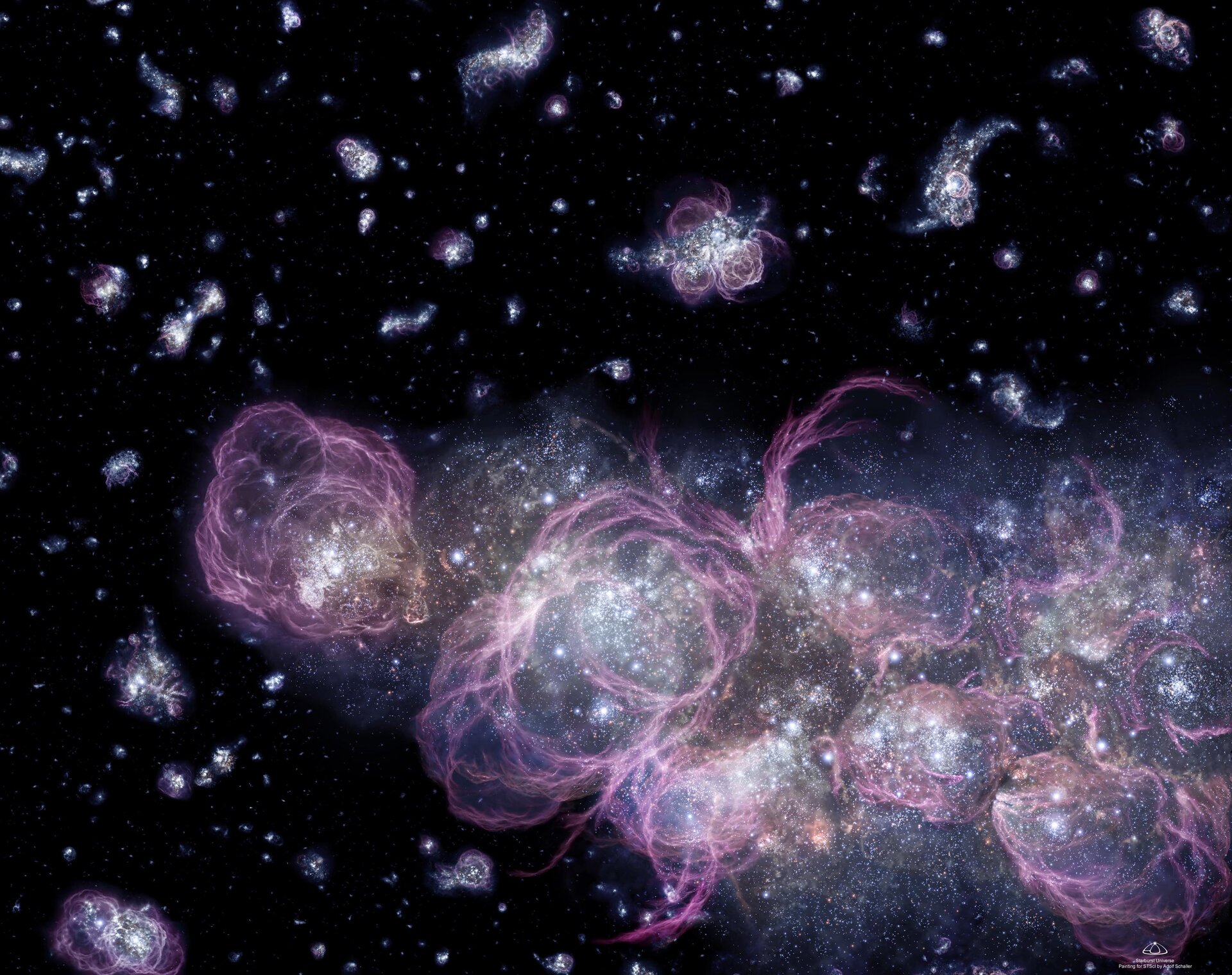
Today, enormous stretches of space are crystal clear, but that wasn’t always the case. During its infancy, the universe was filled with a “fog” that made it opaque, cloaking the first stars and galaxies. NASA’s upcoming Nancy Grace Roman Space Telescope will probe the universe’s subsequent transition to the brilliant starscape we see today –– an era known as cosmic dawn.

“Something very fundamental about the nature of the universe changed during this time,” said Michelle Thaller, an astrophysicist at NASA’s Goddard Space Flight Center in Greenbelt, Maryland. “Thanks to Roman’s large, sharp infrared view, we may finally figure out what happened during a critical cosmic turning point.”

Lights Out, Lights On

Shortly after its birth, the cosmos was a blistering sea of particles and radiation. As the universe expanded and cooled, positively charged protons were able to capture negatively charged electrons to form neutral atoms (mostly hydrogen, plus some helium). That was great news for the stars and galaxies the atoms would ultimately become, but bad news for light!

It likely took a long time for the gaseous hydrogen and helium to coalesce into stars, which then gravitated together to form the first galaxies. But even when stars began to shine, their light couldn’t travel very far before striking and being absorbed by neutral atoms. This period, known as the cosmic dark ages, lasted from around 380,000 to 200 million years after the big bang.

Then the fog slowly lifted as more and more neutral atoms broke apart over the next several hundred million years: a period called the cosmic dawn.

“We’re very curious about how the process happened,” said Aaron Yung, a Giacconi Fellow at the Space Telescope Science Institute in Baltimore, who is helping plan Roman’s early universe observations. “Roman’s large, crisp view of deep space will help us weigh different explanations.”

Prime Suspects

It could be that early galaxies may be largely to blame for the energetic light that broke up the neutral atoms. The first black holes may have played a role, too. Roman will look far and wide to examine both possible culprits.

“Roman will excel at finding the building blocks of cosmic structures like galaxy clusters that later form,” said Takahiro Morishita, an assistant scientist at Caltech/IPAC in Pasadena, California, who has studied cosmic dawn. “It will quickly identify the densest regions, where more ‘fog’ is being cleared, making Roman a key mission to probe early galaxy evolution and the cosmic dawn.”

The earliest stars were likely starkly different from modern ones. When gravity began pulling material together, the universe was very dense. Stars probably grew hundreds or thousands of times more massive than the Sun and emitted lots of high-energy radiation. Gravity huddled up the young stars to form galaxies, and their cumulative blasting may have once again stripped electrons from protons in bubbles of space around them.

“You could call it the party at the beginning of the universe,” Thaller said. “We’ve never seen the birth of the very first stars and galaxies, but it must have been spectacular!”

But these heavyweight stars were short-lived. Scientists think they quickly collapsed, leaving behind black holes –– objects with such extreme gravity that not even light can escape their clutches. Since the young universe was also smaller because it hadn’t been expanding very long, hordes of those black holes could have merged to form even bigger ones –– up to millions or even billions of times the Sun’s mass.

Supermassive black holes may have helped clear the hydrogen fog that permeated the early universe. Hot material swirling around black holes at the bright centers of active galaxies, called quasars, prior to falling in can generate extreme temperatures and send off huge, bright jets of intense radiation. The jets can extend for hundreds of thousands of light-years, ripping the electrons from any atom in their path.

NASA’s James Webb Space Telescope is also exploring cosmic dawn, using its narrower but deeper view to study the early universe. By coupling Webb’s observations with Roman’s, scientists will generate a much more complete picture of this era.

So far, Webb is finding more quasars than anticipated given their expected rarity and Webb’s small field of view. Roman’s zoomed-out view will help astronomers understand what’s going on by seeing how common quasars truly are, likely finding tens of thousands compared to the handful Webb may find.

“With a stronger statistical sample, astronomers will be able to test a wide range of theories inspired by Webb observations,” Yung said.

Peering back into the universe’s first few hundred million years with Roman’s wide-eyed view will also help scientists determine whether a certain type of galaxy (such as more massive ones) played a larger role in clearing the fog.

“It could be that young galaxies kicked off the process, and then quasars finished the job,” Yung said. Seeing the size of the bubbles carved out of the fog will give scientists a major clue. “Galaxies would create huge clusters of bubbles around them, while quasars would create large, spherical ones. We need a big field of view like Roman’s to measure their extent, since in either case they’re likely up to millions of light-years wide –– often larger than Webb’s field of view.”

Roman will work hand-in-hand with Webb to offer clues about how galaxies formed from the primordial gas that once filled the universe, and how their central supermassive black holes influenced galaxy and star formation. The observations will help uncover the cosmic daybreakers that illuminated our universe and ultimately made life on Earth possible.

The Nancy Grace Roman Space Telescope is managed at NASA’s Goddard Space Flight Center in Greenbelt, Maryland, with participation by NASA’s Jet Propulsion Laboratory and Caltech/IPAC in Southern California, the Space Telescope Science Institute in Baltimore, and a science team comprising scientists from various research institutions. The primary industrial partners are BAE Systems, Inc in Boulder, Colorado; L3Harris Technologies in Rochester, New York; and Teledyne Scientific & Imaging in Thousand Oaks, California.

Download high-resolution video and images from NASA’s Scientific Visualization Studio

By Ashley Balzer
NASA’s Goddard Space Flight Center, Greenbelt, Md.

Media contact:
Claire Andreoli
[email protected]
NASA’s Goddard Space Flight Center, Greenbelt, Md.
301-286-1940

>>> Read full article>>>
Copyright for syndicated content belongs to the linked Source : Nasa – https://www.nasa.gov/missions/roman-space-telescope/how-nasas-roman-space-telescope-will-illuminate-cosmic-dawn/


Tags: NASA’sRomanscience
Previous Post

US infant deaths rise for first time in decades

Next Post

NASA Supports Burst Test for Orbital Reef Commercial Space Station

Scott Pelley fired from ’60 Minutes,’ deepening turmoil at CBS News – Idaho State Journal

June 3, 2026

Why a yearslong fight over gambling is good news for California politicians – CalMatters

June 3, 2026

Is Marvell Technology (MRVL) Overhyped After Its Stunning Recent Rally?

June 3, 2026

Aston Villa’s Top Scorer Hanson Set for Thrilling Transfer to Spurs

June 3, 2026

Ecology acquires federal grants to protect 237 acres of coastal wetlands – Department of Ecology – State of Washington (.gov)

June 3, 2026

Surprising Discovery: Birds Masturbate More Often Than We Thought-and Scientists Say It’s Completely Normal

June 3, 2026

Savvas Triumphs with 2026 Gold Stevie Awards for Experience Science and myPerspectives English Language Arts Programs

June 3, 2026

The month of June in films – Lifestyle.INQ

June 3, 2026

‘Beauty and the Beast’ and ‘Whole New World’ Singer Peabo Bryson Dies After Suffering Stroke – TODAY.com

June 3, 2026

McGhee Tyson raising parking prices for economy lots – WBIR

June 3, 2026

Categories

Archives

June 2026
M T W T F S S
1234567
891011121314
15161718192021
22232425262728
2930  
« May    
Earth-News.info

The Earth News is an independent English-language daily published Website from all around the World News

Browse by Category

  • Business (20,132)
  • Ecology (1,246)
  • Economy (1,269)
  • Entertainment (22,146)
  • General (21,877)
  • Health (10,302)
  • Lifestyle (1,279)
  • News (22,149)
  • People (1,270)
  • Politics (1,289)
  • Science (16,482)
  • Sports (21,766)
  • Technology (16,253)
  • World (1,259)

Recent News

Scott Pelley fired from ’60 Minutes,’ deepening turmoil at CBS News – Idaho State Journal

June 3, 2026

Why a yearslong fight over gambling is good news for California politicians – CalMatters

June 3, 2026
  • About
  • Advertise
  • Privacy & Policy
  • Contact

© 2023 earth-news.info

No Result
View All Result

© 2023 earth-news.info

No Result
View All Result

© 2023 earth-news.info

Go to mobile version