





* . *
  • About
  • Advertise
  • Privacy & Policy
  • Contact
Monday, April 27, 2026
Earth-News
  • Home
  • Business
  • Entertainment

    Explore the Thriving Arts and Entertainment Scene Lighting Up the Region

    Get Ready for Fun: Join the Fiesta Pensacola 10K & 5K and Rock Out with Alice Cooper!

    Saenger Theater Lights Up Hattiesburg with Exciting and Diverse Entertainment

    How The Cars That Made Us Perfectly Blends Education and Entertainment

    What the controversial Michael Jackson movie leaves out – The Washington Post

    Mini golf, 24/7 golf simulator bring new entertainment to Temple – The Killeen Daily Herald

  • General
  • Health
  • News

    Cracking the Code: Why China’s Economic Challenges Aren’t Shaking Markets, Unlike America’s” – Bloomberg

    Trump’s Narrow Window to Spread the Truth About Harris

    Trump’s Narrow Window to Spread the Truth About Harris

    Israel-Gaza war live updates: Hamas leader Ismail Haniyeh assassinated in Iran, group says

    Israel-Gaza war live updates: Hamas leader Ismail Haniyeh assassinated in Iran, group says

    PAP Boss to Niger Delta Youths, Stay Away from the Protest

    PAP Boss to Niger Delta Youths, Stay Away from the Protest

    Court Restricts Protests In Lagos To Freedom, Peace Park

    Court Restricts Protests In Lagos To Freedom, Peace Park

    Fans React to Jazz Jennings’ Inspiring Weight Loss Journey

    Fans React to Jazz Jennings’ Inspiring Weight Loss Journey

    Trending Tags

    • Trump Inauguration
    • United Stated
    • White House
    • Market Stories
    • Election Results
  • Science
  • Sports
  • Technology

    Palantir Technologies Overcomes Political Hurdles While Driving Impressive Business Growth

    Inside Seiya Suzuki’s Swing: A High-Tech Breakdown with Bat Tracking Technology

    KLP Kapitalforvaltning AS Boosts Investment in Credo Technology Group Holding Ltd. $CRDO

    NSWC Crane Scientist Pioneers Breakthrough in Electromagnetic Spectrum Technology

    Foreign car companies bet on technology to hang onto once-lucrative China auto market – CNBC

    Kalispell Parking Advisory Board Proposes New Technology, Increased Fines, and Block Ordinance Changes

    Trending Tags

    • Nintendo Switch
    • CES 2017
    • Playstation 4 Pro
    • Mark Zuckerberg
No Result
View All Result
  • Home
  • Business
  • Entertainment

    Explore the Thriving Arts and Entertainment Scene Lighting Up the Region

    Get Ready for Fun: Join the Fiesta Pensacola 10K & 5K and Rock Out with Alice Cooper!

    Saenger Theater Lights Up Hattiesburg with Exciting and Diverse Entertainment

    How The Cars That Made Us Perfectly Blends Education and Entertainment

    What the controversial Michael Jackson movie leaves out – The Washington Post

    Mini golf, 24/7 golf simulator bring new entertainment to Temple – The Killeen Daily Herald

  • General
  • Health
  • News

    Cracking the Code: Why China’s Economic Challenges Aren’t Shaking Markets, Unlike America’s” – Bloomberg

    Trump’s Narrow Window to Spread the Truth About Harris

    Trump’s Narrow Window to Spread the Truth About Harris

    Israel-Gaza war live updates: Hamas leader Ismail Haniyeh assassinated in Iran, group says

    Israel-Gaza war live updates: Hamas leader Ismail Haniyeh assassinated in Iran, group says

    PAP Boss to Niger Delta Youths, Stay Away from the Protest

    PAP Boss to Niger Delta Youths, Stay Away from the Protest

    Court Restricts Protests In Lagos To Freedom, Peace Park

    Court Restricts Protests In Lagos To Freedom, Peace Park

    Fans React to Jazz Jennings’ Inspiring Weight Loss Journey

    Fans React to Jazz Jennings’ Inspiring Weight Loss Journey

    Trending Tags

    • Trump Inauguration
    • United Stated
    • White House
    • Market Stories
    • Election Results
  • Science
  • Sports
  • Technology

    Palantir Technologies Overcomes Political Hurdles While Driving Impressive Business Growth

    Inside Seiya Suzuki’s Swing: A High-Tech Breakdown with Bat Tracking Technology

    KLP Kapitalforvaltning AS Boosts Investment in Credo Technology Group Holding Ltd. $CRDO

    NSWC Crane Scientist Pioneers Breakthrough in Electromagnetic Spectrum Technology

    Foreign car companies bet on technology to hang onto once-lucrative China auto market – CNBC

    Kalispell Parking Advisory Board Proposes New Technology, Increased Fines, and Block Ordinance Changes

    Trending Tags

    • Nintendo Switch
    • CES 2017
    • Playstation 4 Pro
    • Mark Zuckerberg
No Result
View All Result
Earth-News
No Result
View All Result
Home Science

Hubble Space Telescope finds bucket of cosmic Easter eggs — 500 blue and red stars

March 31, 2024
in Science
Hubble Space Telescope finds bucket of cosmic Easter eggs — 500 blue and red stars
Share on FacebookShare on Twitter

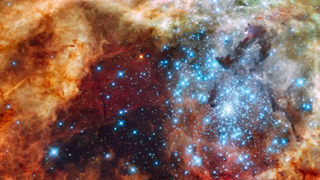
A hazy scene with orange and burgundy gaseous clouds. A burst of bright blue stars is concentrated toward the right. A single red star is seen in the center-top.

A Hubble image image of the star forming region 30 Doradus, the Tarantula Nebula, within the Large Magellanic Cloud packed with young bright blue stars
(Image credit: NASA, ESA, STScI, Francesco Paresce (INAF-IASF Bologna), Robert O’Connell (UVA), SOC-WFC3, ESO)

In December 2023, the Hubble Space Telescope completed its largest program since launching in 1990. With this program, the telescope made observations of 500 individual stars over three years — and scientists are now ready to dive into this cosmic Easter egg of data.

The comprehensive Hubble Telescope survey is called the Ultraviolet Legacy Library of Young Stars as Essential Standards, or ULLYSES; Hubble was deemed by ULLYSES operators as the sole active telescope capable of accomplishing such a pioneering endeavor.

These ultraviolet-light-observation treats will last way past the Easter holiday, however, keeping researchers busy for decades to come as they offer fresh insight into star formation, star evolution and the impact stars have on their surroundings.  

“I believe the ULLYSES project will be transformative, impacting overall astrophysics, from exoplanets to the effects of massive stars on galaxy evolution, to understanding the earliest stages of the evolving universe,” Julia Roman-Duval, ULLYSES Implementation Team leader at the Space Telescope Science Institute (STScI) in Baltimore, Maryland, said in a statement. “Aside from the specific goals of the program, the stellar data can also be used in fields of astrophysics in ways we can’t yet imagine.”

Related: Hubble Telescope witnesses a new star being born in a stunning cosmic light show (image)

The ULLYSES team used Hubble to study 220 stars first, then delved into the space telescope’s archive to retrieve observations of a further 275 stars. The researchers also incorporated data about stars from a plethora of other space telescopes and ground-based observatories.

The completed ULLYSES dataset is comprised of stellar spectra that contain information about each star’s temperature, chemical composition and the speed at which it is spinning.

Breaking space news, the latest updates on rocket launches, skywatching events and more!

Hubble and ULLYSES see red (and blue)

Of particular interest to the ULLYSES team are superhot and massive blue stars that can grow to be a million times brighter than our sun. These scorching stars glow strongly in ultraviolet light, meaning Hubble can easily distinguish them. 

Massive blue stars live fast and die young, quickly burning through the fuels needed for their intrinsic nuclear fusion processes and forging “metals,” the term astronomers use to describe elements heavier than hydrogen and helium. Hydrogen and helium are the elements that stars are mostly made of at the start of their lives.

The stellar spectra of massive blue stars can reveal details about the speeds of powerful stellar winds that flow outward from them. After massive stars explode in supernova blasts, it is these stellar winds which disperse the elements those stars have forged. The elements are then spread all throughout the cosmos — so, understanding these winds would be a major step toward understanding the galactic distribution of heavy elements that become the building blocks of the next generation of stars and planets. Those elements may eventually become the foundation for life in the universe, too.
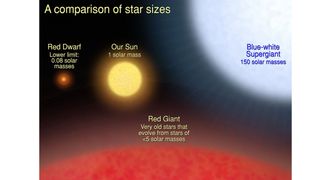
A diagram showing a huge blue-white supergiant star, with 150 solar masses, next to an even bigger red giant star. The sun looks super small comparatively, and a red dwarf pictured is even smaller!

Examples of the smallest red dwarf stars, our sun, a red giants and blue-white supergiant stars. (Image credit: NASA, ESA and A. Feild (STScI))

Due to this dispersion process, each subsequent stellar generation has a greater concentration of metals than the last. Formed when the majority of atoms in the universe were hydrogen and a little helium, the first generation of stars are considered “metal-poor,” while later generations of stars, including the sun, are “metal-rich.”

ULLYSES and Hubble targeted blue stars in galaxies close to the Milky Way that seem to be deficient in metals. These stars can, therefore, act as proxies for the earliest stars, helping scientists investigate stars that existed in the infant universe and are now beyond the range at which we can easily see deep detail.

“ULLYSES observations are a stepping stone to understanding those first stars and their winds in the universe and how they impact the evolution of their young host galaxy,” Roman-Duval said.

At the other end of the color (and size) spectrum, the ULLYSES project also focused on young stars that are cooler, smaller and redder than the sun. These stars were also located closer to home, in active star-forming regions of the Milky Way.

During their formative years, as they gathered mass from the disks of gas and dust that enshroud them, these young red stars created turbulence in their systems by blasting out high-energy ultraviolet and X-ray light. This would’ve impacted the planet-forming disks around these stars, and influenced if the planets that will eventually be born around these stars can ever be habitable.
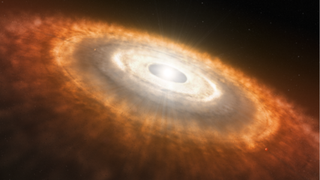
An illustration of a bright white star surrounded by a huge halo of reddish gas and dust and other stuff.

An illustration of a young star that is cooler and redder than the the sun.  (Image credit: NASA, ESA, STScI, Francesco Paresce (INAF-IASF Bologna), Robert O’Connell (UVA), SOC-WFC3, ESO)

The Hubble observations collected for ULLYSES could help scientists better understand the processes by which these young stars accrete matter from their surroundings to pile on the mass required to trigger the nuclear fusion of hydrogen to helium. Starting that process would make the young star a fully-fledged star.

This could also reveal the effect these stars have on the disks that surround them, which will eventually go on to form planets. Thus, studying the survey could potentially help scientists better understand which systems are more suited for searches for life.

“ULLYSES was originally conceived as an observing program utilizing Hubble’s sensitive spectrographs. However, the program was tremendously enhanced by community-led coordinated and ancillary observations with other ground- and space-based observatories,” Roman-Duval said. “Such broad coverage allows astronomers to investigate the lives of stars in unprecedented detail and paint a more comprehensive picture of the properties of these stars and how they impact their environment.”

Even before ULLYSES data delivers new insights into the lives of stars and their environments, this survey demonstrates that even after over three decades of cosmic observations, Hubble is still delivering ground-breaking science.

Join our Space Forums to keep talking space on the latest missions, night sky and more! And if you have a news tip, correction or comment, let us know at: [email protected].

Robert Lea is a science journalist in the U.K. whose articles have been published in Physics World, New Scientist, Astronomy Magazine, All About Space, Newsweek and ZME Science. He also writes about science communication for Elsevier and the European Journal of Physics. Rob holds a bachelor of science degree in physics and astronomy from the U.K.’s Open University. Follow him on Twitter @sciencef1rst.

>>> Read full article>>>
Copyright for syndicated content belongs to the linked Source : Space.com – https://www.space.com/hubble-telescope-cosmic-easter-eggs-star-survey


Tags: HubblescienceSpace
Previous Post

‘Everything is interrelated.’ For the Navajo Nation, the April 8 solar eclipse is a spiritual experience

Next Post

Pluto TV will rally to make Pluto a planet again on April 1 (it’s no joke)

Rediscovered After a Century: The Remarkable Comeback of the Critically Endangered Osmanthus pubipedicellatus

April 27, 2026

Science Associations Unite to Bring Communities Together This April

April 27, 2026

Fusion Energy Sciences – Department of Energy (.gov)

April 27, 2026

Unlocking Heart Health: The Powerful Science Behind Ubiquinol

April 27, 2026

I Thought Being Easygoing Was Just a Personality Trait-Until I Realized It Only Appeared Around People Whose Disappointment I Feared

April 27, 2026

Portugal’s Bruno Fernandes Vows to Win World Cup in Honor of Cristiano Ronaldo

April 27, 2026

Who Will Blink First as the Iran Conflict Sends Shockwaves Through the Global Economy?

April 27, 2026

Explore the Thriving Arts and Entertainment Scene Lighting Up the Region

April 27, 2026

‘I wasn’t in politics before and I’m not going to be after’: Macron to quit politics in 2027 – France 24

April 27, 2026

Palantir Technologies Overcomes Political Hurdles While Driving Impressive Business Growth

April 27, 2026

Categories

Archives

April 2026
M T W T F S S
 12345
6789101112
13141516171819
20212223242526
27282930  
« Mar    
Earth-News.info

The Earth News is an independent English-language daily published Website from all around the World News

Browse by Category

  • Business (20,132)
  • Ecology (1,188)
  • Economy (1,208)
  • Entertainment (22,083)
  • General (21,190)
  • Health (10,240)
  • Lifestyle (1,218)
  • News (22,149)
  • People (1,208)
  • Politics (1,227)
  • Science (16,422)
  • Sports (21,706)
  • Technology (16,192)
  • World (1,198)

Recent News

Rediscovered After a Century: The Remarkable Comeback of the Critically Endangered Osmanthus pubipedicellatus

April 27, 2026

Science Associations Unite to Bring Communities Together This April

April 27, 2026
  • About
  • Advertise
  • Privacy & Policy
  • Contact

© 2023 earth-news.info

No Result
View All Result

© 2023 earth-news.info

No Result
View All Result

© 2023 earth-news.info

Go to mobile version
