






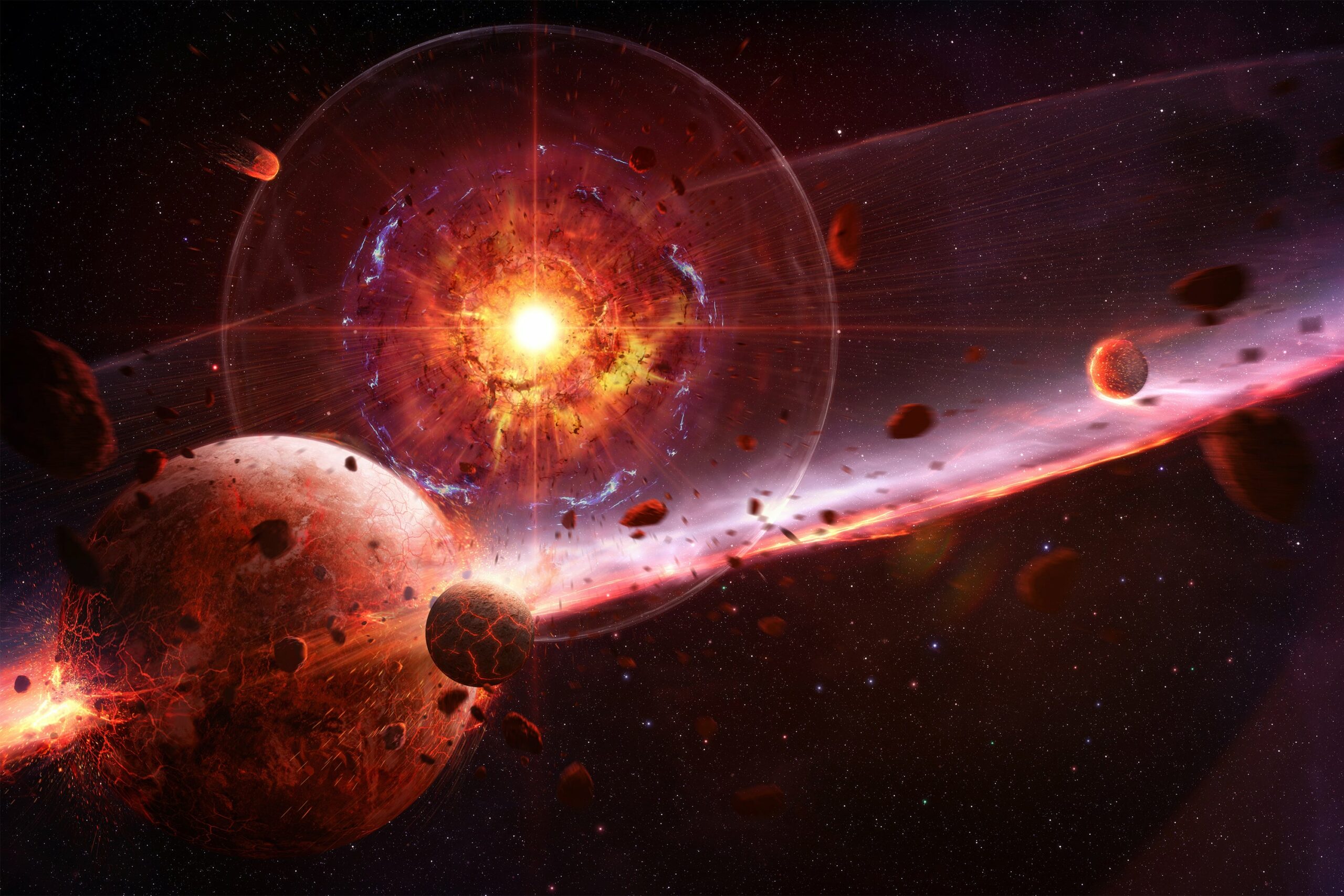
A nearby supernova could ruin your whole day.
It’s difficult to grasp just how powerful an event the explosion of an entire star is. The energy released as visible light every second by a typical supernova is millions of times the luminosity of the sun, and it can radiate at this rate for days or weeks. Some are even more powerful. And that’s just in visible light; there are other ways a supernova can blast out energy that positively crush that number.
Clearly a star’s explosive demise is best witnessed from very, very far away. Happily that’s usually the case; of the thousands of supernovae that astronomers find every year, most are hundreds of millions of light-years from us—so distant, in fact, that we need huge telescopes to see them at all.
On supporting science journalism
If you’re enjoying this article, consider supporting our award-winning journalism by subscribing. By purchasing a subscription you are helping to ensure the future of impactful stories about the discoveries and ideas shaping our world today.
But that, too, is a testament to their power: we can see them clear across the universe.
This raises two interesting (if terrifying) questions: How close can you be to a supernova before things get sticky, and perhaps more pertinent, are there ticking stellar time bombs close enough to Earth to hurt us?
There are quite a few ways a supernova can dish out cosmic catastrophe. The most dangerous is high-energy radiation such as x-rays or gamma rays. Although our planet’s atmosphere would act as a buffer to absorb some of the deadly blast, doing so would literally change the chemistry of Earth’s air—and not in a good way. The ozone layer could be devastated by such an event, for example, allowing harmful ultraviolet light from our sun to reach Earth’s surface unfiltered for years. This may lead to increased cancer rates in animals and, even worse, more fundamentally disrupt ecosystems by killing off microbes at the base of the planet’s food chains.
Smog could be another atmospheric side effect from a nearby supernova. Molecular nitrogen, the principal component of our air, can be broken down by high-energy radiation to then recombine with oxygen, forming nitrogen dioxide, a dark reddish-brown (and poisonous) gas. In sufficient quantities this process can significantly decrease sunlight from reaching Earth’s surface and cause a global cooling event. That might sound refreshing after decades of global warming, but such an event could actually radically upset the biosphere and in extreme cases trigger an ice age.
A blast of this radiation slamming into our air can also create a huge wave of rapidly moving electrons, generating an electromagnetic pulse that could damage electronics and bring down regional and even national power grids.
Over the years astronomers have done a lot of research into this possibility, and the good news—sort of—is that a supernova would have to be less than about 160 light-years from Earth to inflict this sort of damage. That’s decently close on the vast scale of our galaxy, but it’s vanishingly unlikely to happen over a human lifetime.
The Milky Way’s a big galaxy, too—120,000 light-years across—and there’s roughly one supernova within it every few decades. The chance of one being so close to Earth to put some hurt on us is small—but, irritatingly, not zero. That brings us to the second question: Are there any stars close enough to affect us should they go kablooey?
Well, kind of.
One way to create a supernova is to start with a massive star. It merrily fuses hydrogen into helium in its core for several million years but gradually starts to run out. As it churns through its nuclear fuel and begins to die, it goes through various stages. It swells up into a red supergiant and can even turn blue or yellow. It usually turns back to red before the final event, however.
Eventually the star exhausts its fuel supply. When this happens, the core collapses and explodes, blasting out truly soul-vaporizing amounts of energy—and quite a bit of matter, too. All this slams into the star’s outer layers and launches them away at speeds of several thousand kilometers per second, and that is what creates the spectacular and luminous supernova we actually see.
The lower mass limit to make a supernova this way is about eight times the sun’s mass. With less than that, the core lacks the oomph to explode.
That brings us to Spica. It’s one of the brightest stars in the sky, easily visible in the constellation Virgo, and it’s massive, probably a dozen or so times the sun’s heft, so it fits the bill. It’s just now starting to run out of fuel, beginning its long journey to becoming a red supergiant.
That’s good news: Spica won’t explode for a long, long time. And even if it were to go off right now, at a distance of about 250 light-years from Earth, it’s too far to do much to us. It’ll get bright, outshining the full moon, which could be damaging to a lot of plant and animal circadian rhythms, so that’s not great. But otherwise we should be pretty safe.
Spica is the closest massive-star supernova progenitor candidate to us, so for now, we’re looking good.
There’s another kind of supernova, however. If a superdense white dwarf (the leftover core of a star like the sun after it dies) is orbited by a nearby companion—a star like the sun, say, or another white dwarf—that companion can dump a lot of mass onto it. If this superdense white dwarf gets to about 1.4 times the mass of the sun, its intense gravity will ignite a wave of fusion in that accumulated material, creating a thermonuclear bomb with the mass of a star. This, too, creates a supernova. The properties are different than when a massive star explodes, but overall the effects are similar.
Is there such a white dwarf binary system near us? Yes. IK Pegasi is a binary star system. The primary star is normal star much like the sun, though more massive, more luminous and hotter. It’s orbited closely by a white dwarf that’s about the same mass as the sun.
At the moment this system is safe; the normal star doesn’t seem to be donating any of its mass to the white dwarf. But some time in the future, the normal star will also begin to die. It’ll swell up into and certainly dump vast amounts of matter onto the dwarf. Although it’ll take some time, this system is very likely to produce a supernova.
The bad news: it’s only 150 light-years from us, close enough to be dangerous.
The good news: Everything in space is moving, including the sun and IK Pegasi. It’s unlikely to explode for millions of years, and by then it will have moved much farther away from us. When it goes supernova, we’ll be fine. So while IK Peg is technically the closest supernova candidate, that’s only for now.
Of course, over time other stars that are too far to hurt us now may move into range. While that’s not exactly comforting, we’re talking timescales of hundreds of thousands, if not millions, of years from now.
Put it this way: In my 2008 book Death from the Skies!, I go into great detail about how a supernova can bring the hammer down on us, hard. I did a lot of research for that book, and in the end I concluded it’s not something we should worry about. There are far more proximate concerns, both in time and space, that should occupy our thoughts. The galaxy is a rough neighborhood, but for now, at least, we’re okay.
>>> Read full article>>>
Copyright for syndicated content belongs to the linked Source : Scientific American – https://www.scientificamerican.com/article/is-earth-safe-from-a-nearby-supernova/



