






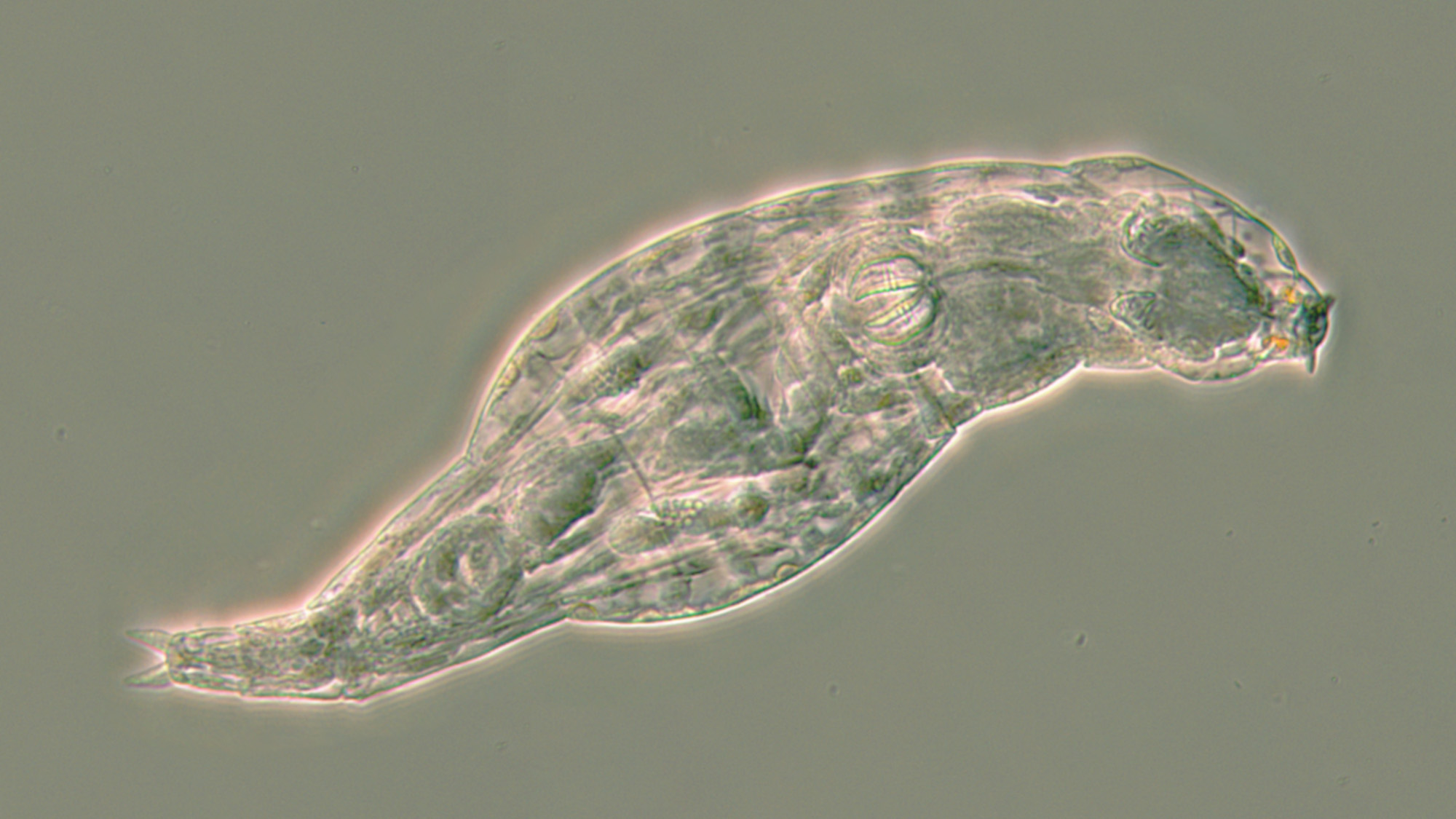
Bdelloid rotifers are ancient, asexual, oddballs. The teeny-tiny freshwater animals have seemingly persisted without sex, and the evolutionary advantages it brings, for an estimated 25 million years. New research sheds light on how this lineage of resilient aquatic organisms may have survived so long and spread worldwide–from damp moss to Antarctic ice sheets–absent sexual gene exchange. Strangely enough, the findings could help scientists home in on better antibiotic treatments for humans.
Microscopic, multicellular, aquatic bdelloid rotifers likely use genetic material stolen from plants, fungi, and bacteria to manufacture their own antimicrobial medicines, according to a study published July 18 in the journal Nature Communications. By swiping genes from non-animals, the rotifers are able to produce compounds they wouldn’t otherwise have access to. The findings suggest that borrowed genes help some bdelloids survive infection with a virulent fungal pathogen, supplementing the standard animal immune system.
“We didn’t even think animals could make these chemicals,” says Chris Wilson, senior study author and a biologist at the University of Oxford in England. “Bacteria and fungi are really good at this [type of] chemistry. Animals are not.” Yet among the many rotifer genetic sequences Wislon and his colleagues examined, they found instructions to build miniature antibiotic factories–essentially recipes swiped from bacterial and fungal cookbooks.
Skipping out on sex
Gene exchange through sexual reproduction is one of the key ways that multicellular organisms evolve resistance to disease. By mixing and sharing genetic information from generation to generation, animals have a higher chance of stumbling upon especially beneficial combinations. Yet in centuries of observation, scientists have never found a bdelloid rotifer male, implying that the micro-animals reproduce exclusively via parthenogenesis.
The phenomenon of reproduction without fertilization is well documented among animals, from insects to reptiles to birds. But usually it’s rare, almost always paired with bouts of sexual reproduction, and purely parthenogenetic species don’t tend to stand the test of evolutionary time. Bdelloid rotifers buck all three trends, making their success a long-standing mystery. The new findings help crack the case.
Previous genetic studies have demonstrated that bdelloid rotifers carry a large proportion of DNA from non-animal origins. Somewhere around 11 percent of their genome is lifted from elsewhere, through a process known as “horizontal gene transfer,” which is usually mediated through viruses. But this is the first to link those horizontally acquired genes to surviving infection.
The rate of horizontal gene transfer in bdelloids is still much lower than the rate of evolution in sexual species. Yet the research suggests even these slowly-acquired DNA bits may be critical to the rotifers’ evolutionary durability.
“It’s becoming more and more well-understood that, even through horizontal gene transfer is rare in [animals], it does happen, and it does seem to have influence,” says Maria Rosa Domingo-Sananes, a microbiologist at Nottingham Trent University in England who was uninvolved with the new study. The research, she says, gets at the functional puzzle of what these genes do. “There’s always these questions of ‘is it genetic drift’, ‘are they genetic parasites,’ ‘or are they things that might actually be beneficial’—this work is taking a first step towards an answer.”
Tracking down genetic contraband
To suss out the purpose of bdelloid’s looted genes, the scientists first had to make some rotifers sick. They exposed two different bdelloid species to a particularly nasty fungal infection. “It’s a bit like one of those zombie fungi in the Last of Us,” Wilson tells Popular Science. “When it infects the rotifers successfully, they eventually just explode in a puff of fungus. It’s not a very pleasant end.”
One of the bdelloid species was highly susceptible to the fungus, experiencing more than 70 percent mortality after three days. The other was much more resistant, with only 18 percent dying over the same timeframe.
The biologists tracked gene expression in each of the species through the course of their illness. They found that, in both lineages, pathogen exposure activated a disproportionate number of pilfered gene sequences (between 23 and 32 percent of the total expressed genes). There was lots of overlap in these switched-on sequences. But in the resistant species a set of genes associated with catalyzing the formation of antimicrobial chemicals in bacteria was hyper-active, turned on 10 times as strongly as in the susceptible species.
“It really stuck out to us. When we looked at what the genes do, this was the clearest pattern,” Wilson says. “We put two and two together and suggest that these genes are one of the main defenses rotifers have against this pathogen.”
The researchers modeled what the specific products of these cellular chemical factories would be, and predicted that the ultimate compounds would resemble known, strong, broad spectrum antibiotic and antifungal agents. The rotifers had made some adjustments to the genes–the sequences weren’t exact matches to non-animal source material–but likely the utility is similar.
Sickness solutions
Antibiotic resistance is a growing problem as more and more microbes evolve to evade the medications we’ve come to rely on. Yet finding new, reliable antimicrobial drugs is difficult, notes Wilson. Many compounds that kill off pathogens also turn out to harm human cells.
The discovery of rotifer-made medicines could help. Since rotifers are animals, the compounds they manufacture have to at least be tolerable to animals. “They can’t be really highly toxic, or they wouldn’t be able to produce them inside their own cells,” says Wilson. “We think they might be useful leads, or offer shortcuts, in our own search for human-compatible antimicrobial chemicals.”
“It’s an interesting idea and a good argument,” agrees Domingo-Sananes. When it comes to antimicrobial resistance, “we do need to try whatever we can,” she says. “If there’s diversity in these rotifers that’s underexploited, why not explore it?”
However, a rotifer tolerating a compound doesn’t mean it will end up working for humans. Mice and people are much more closely related than rotifers and people, she points out–but often medical treatments that prove safe and effective in rodents don’t pass the same threshold in human trials.
Both Wilson and Domingo-Sananes caution that lots more work needs to be done before any of this might be transferable to people. One big next step: Actually isolating the chemicals made by the disease-resistant rotifers and confirming that the compounds are antimicrobial. Domingo-Sananes would also like to see follow-up work assessing other rotifer lineages and pathogens, to determine if different types of infections elicit different genetic responses.
For now though, WIlson remains pleasantly surprised and optimistic. And if nothing else, he views his findings as reason to keep digging into bizarre biology. “We had no idea there would be any link to antimicrobials when we started this research,” he says. “It’s one of those things you just sometimes stumble across, like antibiotics themselves were stumbled across by accident in the first place.”
“When you look deeply at something that seems completely obscure–a tiny animal that lives in the soil that no one’s ever heard of…you might just find something unexpected that turns out to be useful.”
>>> Read full article>>>
Copyright for syndicated content belongs to the linked Source : Popular Science – https://www.popsci.com/environment/asexual-animal-makes-medicine/



