





* . *
  • About
  • Advertise
  • Privacy & Policy
  • Contact
Friday, June 5, 2026
Earth-News
  • Home
  • Business
  • Entertainment

    10 Must-Watch Shows for Fans of ‘Spider-Noir

    Scott Pelley fired from ’60 Minutes,’ deepening turmoil at CBS News – Idaho State Journal

    Why Max Cady from ‘Cape Fear’ Continues to Haunt Audiences as a Timeless Nightmare

    Celebrate Pride Month 2026 with Seattle Pride in the Park and Exciting Events

    How to find free, low-cost concerts this summer in Louisville: A Q&A – The Courier-Journal

    Morgan Wallen Channels Fiery Billy Joel Vibes with Explosive Piano Flip

  • General
  • Health
  • News

    Cracking the Code: Why China’s Economic Challenges Aren’t Shaking Markets, Unlike America’s” – Bloomberg

    Trump’s Narrow Window to Spread the Truth About Harris

    Trump’s Narrow Window to Spread the Truth About Harris

    Israel-Gaza war live updates: Hamas leader Ismail Haniyeh assassinated in Iran, group says

    Israel-Gaza war live updates: Hamas leader Ismail Haniyeh assassinated in Iran, group says

    PAP Boss to Niger Delta Youths, Stay Away from the Protest

    PAP Boss to Niger Delta Youths, Stay Away from the Protest

    Court Restricts Protests In Lagos To Freedom, Peace Park

    Court Restricts Protests In Lagos To Freedom, Peace Park

    Fans React to Jazz Jennings’ Inspiring Weight Loss Journey

    Fans React to Jazz Jennings’ Inspiring Weight Loss Journey

    Trending Tags

    • Trump Inauguration
    • United Stated
    • White House
    • Market Stories
    • Election Results
  • Science
  • Sports
  • Technology

    How Is Technology Transforming the Future of the Restaurant Industry?

    Innovative Chemical “Cage” Strategy Enables Precise Drug Delivery and Activation

    China has approved the world’s first invasive brain-computer chip—here’s what’s next – MIT Technology Review

    Is Marvell Technology (MRVL) Overhyped After Its Stunning Recent Rally?

    Voyager Technologies CEO on acquisition of Astrobotic Technology, demand for space investment – CNBC

    Anixa Biosciences Strengthens International Patent Protection for Ovarian Cancer Vaccine Technology with Canadian Notice of Allowance – PR Newswire

    Trending Tags

    • Nintendo Switch
    • CES 2017
    • Playstation 4 Pro
    • Mark Zuckerberg
No Result
View All Result
  • Home
  • Business
  • Entertainment

    10 Must-Watch Shows for Fans of ‘Spider-Noir

    Scott Pelley fired from ’60 Minutes,’ deepening turmoil at CBS News – Idaho State Journal

    Why Max Cady from ‘Cape Fear’ Continues to Haunt Audiences as a Timeless Nightmare

    Celebrate Pride Month 2026 with Seattle Pride in the Park and Exciting Events

    How to find free, low-cost concerts this summer in Louisville: A Q&A – The Courier-Journal

    Morgan Wallen Channels Fiery Billy Joel Vibes with Explosive Piano Flip

  • General
  • Health
  • News

    Cracking the Code: Why China’s Economic Challenges Aren’t Shaking Markets, Unlike America’s” – Bloomberg

    Trump’s Narrow Window to Spread the Truth About Harris

    Trump’s Narrow Window to Spread the Truth About Harris

    Israel-Gaza war live updates: Hamas leader Ismail Haniyeh assassinated in Iran, group says

    Israel-Gaza war live updates: Hamas leader Ismail Haniyeh assassinated in Iran, group says

    PAP Boss to Niger Delta Youths, Stay Away from the Protest

    PAP Boss to Niger Delta Youths, Stay Away from the Protest

    Court Restricts Protests In Lagos To Freedom, Peace Park

    Court Restricts Protests In Lagos To Freedom, Peace Park

    Fans React to Jazz Jennings’ Inspiring Weight Loss Journey

    Fans React to Jazz Jennings’ Inspiring Weight Loss Journey

    Trending Tags

    • Trump Inauguration
    • United Stated
    • White House
    • Market Stories
    • Election Results
  • Science
  • Sports
  • Technology

    How Is Technology Transforming the Future of the Restaurant Industry?

    Innovative Chemical “Cage” Strategy Enables Precise Drug Delivery and Activation

    China has approved the world’s first invasive brain-computer chip—here’s what’s next – MIT Technology Review

    Is Marvell Technology (MRVL) Overhyped After Its Stunning Recent Rally?

    Voyager Technologies CEO on acquisition of Astrobotic Technology, demand for space investment – CNBC

    Anixa Biosciences Strengthens International Patent Protection for Ovarian Cancer Vaccine Technology with Canadian Notice of Allowance – PR Newswire

    Trending Tags

    • Nintendo Switch
    • CES 2017
    • Playstation 4 Pro
    • Mark Zuckerberg
No Result
View All Result
Earth-News
No Result
View All Result
Home Science

Robots vs. humans: Which do children trust more when learning new information?

December 22, 2023
in Science
Robots vs. humans: Which do children trust more when learning new information?
Share on FacebookShare on Twitter

Robots versus humans: Which would children trust more when learning new information?

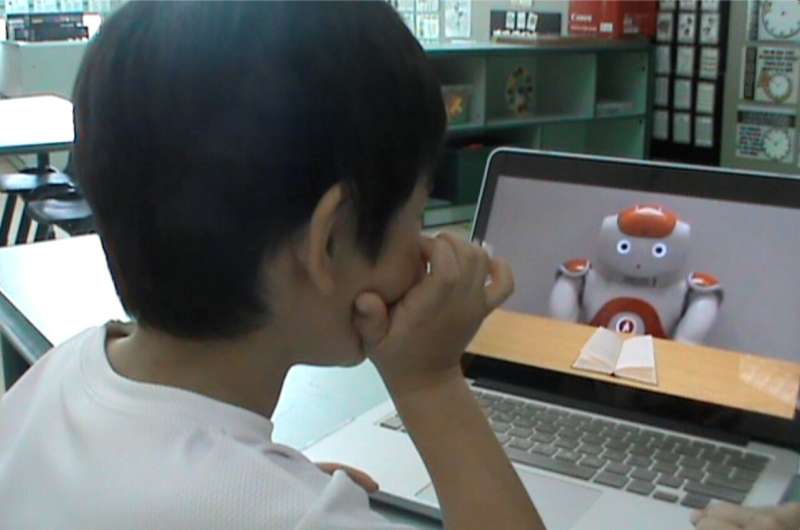
A child watching a robot provide accurate or inaccurate information. Credit: SUTD

In this digital age, children are exposed to overwhelming amounts of information online, some of it unverified and increasingly generated by non-human sources, such as AI-driven language models. As children grow older, the ability to assess a source’s reliability is an important skill in cultivating critical thinking.

Children aged 3 to 5 years display selective trust based on the informant’s past accuracy when faced with both humans and robots, according to a study published in the journal Child Development titled, “Younger, not older, children trust an inaccurate human informant more than an inaccurate robot informant.”

“Children do not just trust anyone to teach them labels, they trust those who were reliable in the past. We believe that this selectivity in social learning reflects young children’s emerging understanding of what makes a good (reliable) source of information,” explained Li Xiaoqian, a research scholar at Singapore University of Technology and Design (SUTD) who co-authored the study with her Ph.D. supervisor Professor Yow Wei Quin, a psychology professor and head of Humanities Arts and Social Sciences cluster at SUTD. “The question at stake is how young children use their intelligence to decide when to learn and whom to trust.”

In the study, participants from Singapore preschools such as ChildFirst, Red SchoolHouse and Safari House, aged between 3 and 5, were split below and above the median age of 4.58 years old into “younger” and “older” cohorts respectively.

They were paired with a robot or human informant, which either provided accurate or inaccurate labels to objects, such as “ball” or “book.” The researchers then tested to see if the informant’s identity (human or robot) and track record as a reliable informant as well as the child’s age influenced the child’s trust in the informant to label things correctly in the future.

Participants were presented with only one informant during the study, and their trust was measured by their willingness to accept new information. The humanoid social robot by SoftBank Robotics, NAO, which has a human-like but robotic voice, was used as the robot informant.

To keep conditions comparable, the human informant matched her movements to those of the robot. An experimenter was also seated next to the participant to ask the necessary questions, so that the participant would not feel pressured to agree with the informant.

The study revealed that children were willing to accept new information from both human and robot informants who had previously given accurate information, but not from a potentially unreliable informant who had made mistakes in the past—especially when the informant was a robot. As for the age effect, the authors reported that younger children were likelier to accept information from an unreliable human than an unreliable robot, but older children were found to distrust or reject information from an unreliable informant, human or robot.

“These results implicate that younger and older children may have different selective trust strategies, especially the way they use informants’ reliability and identity cues when deciding who to trust. Together with other research on children’s selective trust, we show that as children get older, they may increasingly rely on reliability cues to guide their trust behavior,” said Dr. Li.

Previous research has shown that children rely on factors such as age, familiarity, and language to figure out whether an informant is reliable or not. It may be that younger children rely on identity cues like these more than they do epistemic evidence. As they get older, children place more emphasis on “what you know” than “who you are” when deciding to trust an informant.

This is the first study to ask the questions: (1) Do children draw different inferences about robots with varying track records of accuracy? and (2) Are these inferences comparable to those about humans?

“Addressing these questions will provide a unique perspective on the development of trust and social learning among children who are growing up alongside various sources of information, including social robots,” said Prof Yow.

This research has significant implications for pedagogy, where robots and non-human educational tools are increasingly integrated into the classroom. Children today may not perceive robots as trustworthy as humans if they have not interacted much with robots. However, as children gain more exposure to smart machines, they could be inclined to see robots as intelligent and reliable sources of knowledge.

Future studies could explore the selective learning development theory beyond the scope of word learning, such as tool usage, emotional expression congruency, or episodic domains such as location learning. For now, the researchers hope that their findings are considered in the realm of design pedagogy.

“Designers should consider the impact of perceived competence when building robots and other AI-driven educational tools for young children. Recognizing the developmental changes in children’s trust of humans versus robots can guide the creation of more effective learning environments, ensuring that the use of technologies aligns with children’s developing cognitive and social needs,” said Prof Yow.

More information:
Xiaoqian Li et al, Younger, not older, children trust an inaccurate human informant more than an inaccurate robot informant, Child Development (2023). DOI: 10.1111/cdev.14048

Citation:
Robots vs. humans: Which do children trust more when learning new information? (2023, December 22)
retrieved 22 December 2023
from https://phys.org/news/2023-12-robots-humans-children.html

This document is subject to copyright. Apart from any fair dealing for the purpose of private study or research, no
part may be reproduced without the written permission. The content is provided for information purposes only.

>>> Read full article>>>
Copyright for syndicated content belongs to the linked Source : Phys.org – https://phys.org/news/2023-12-robots-humans-children.html


Tags: Humansrobotsscience
Previous Post

High-sensitivity visualization of ultrafast carrier diffusion by wide-field holographic microscopy

Next Post

Researchers use VLT exoplanet hunter to study Jupiter’s winds

How Is Technology Transforming the Future of the Restaurant Industry?

June 5, 2026

Connecting Community With Science at Savannah River Ecology Laboratory – Department of Energy (.gov)

June 5, 2026

2026 World Cup Schedule: All Games, Dates, Matchups and How To Watch – FOX Sports

June 5, 2026

Parents Rally Together to Demand Stronger Science Education in Bar Harbor Schools

June 5, 2026

White House Launches Bold New Plan to Strengthen Oversight of Science Grants

June 5, 2026

Master Your Nutrition: Unlock Lasting Lifestyle Tips with Publix’s GLP-1 Guide

June 5, 2026

The FIFA World Cup: Mastering the Art of Looking Away

June 5, 2026

Putin Envoy Reveals Active Russia-US Talks on Energy and Economic Cooperation

June 4, 2026

New York’s FY 2026-27 Budget: Healthcare Regulatory Proposals Hit Roadblocks in Legislature

June 4, 2026

10 Must-Watch Shows for Fans of ‘Spider-Noir

June 4, 2026

Categories

Archives

June 2026
M T W T F S S
1234567
891011121314
15161718192021
22232425262728
2930  
« May    
Earth-News.info

The Earth News is an independent English-language daily published Website from all around the World News

Browse by Category

  • Business (20,132)
  • Ecology (1,249)
  • Economy (1,271)
  • Entertainment (22,147)
  • General (21,905)
  • Health (10,305)
  • Lifestyle (1,282)
  • News (22,149)
  • People (1,273)
  • Politics (1,290)
  • Science (16,485)
  • Sports (21,769)
  • Technology (16,256)
  • World (1,262)

Recent News

How Is Technology Transforming the Future of the Restaurant Industry?

June 5, 2026

Connecting Community With Science at Savannah River Ecology Laboratory – Department of Energy (.gov)

June 5, 2026
  • About
  • Advertise
  • Privacy & Policy
  • Contact

© 2023 earth-news.info

No Result
View All Result

© 2023 earth-news.info

No Result
View All Result

© 2023 earth-news.info

Go to mobile version
