







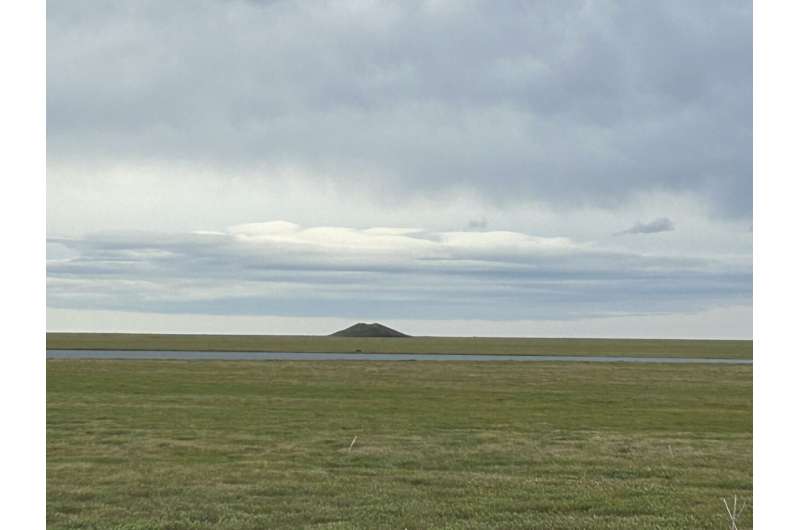
A permafrost-created a pingo or “ice pimple” in the North Slope of Alaska. Scientists from Sandia National Laboratories have been using a fiber optic cable to study permafrost in the Arctic seafloor to improve the understanding of global climate change. Credit: Sandia National Laboratories
The Arctic is remote, with often harsh conditions, and its climate is changing rapidly—warming four times faster than the rest of the Earth. This makes studying the Arctic climate both challenging and vital for understanding global climate change.
Scientists at Sandia National Laboratories are using an existing fiber optic cable off Oliktok Point on the North Slope of Alaska to study the conditions of the Arctic seafloor up to 20 miles from shore. Christian Stanciu, project lead, will present their latest findings on Friday, Dec. 15 at AGU’s Fall Meeting in San Francisco.
Their goal is to determine the seismic structure of miles of Arctic seafloor. Using an emerging technique, they can spot areas of the seafloor where sound travels faster than on the rest of the seafloor, typically because of more ice. They have identified several areas with lots of ice, said Stanciu, a Sandia geophysicist.
The scientists also used the cable to determine temperatures over the stretch of seafloor and monitored temperature changes over seasons. These data, unlike any collected before, were inserted into a computer model to infer the distribution of submarine permafrost, said Jennifer Frederick, a computational geoscientist.
“One of the innovations of this project is that we can now use a single fiber to get acoustic and temperature data,” Stanciu said. “We developed a new system to remotely collect both types of data using one fiber strand. We’re getting some interesting results.”
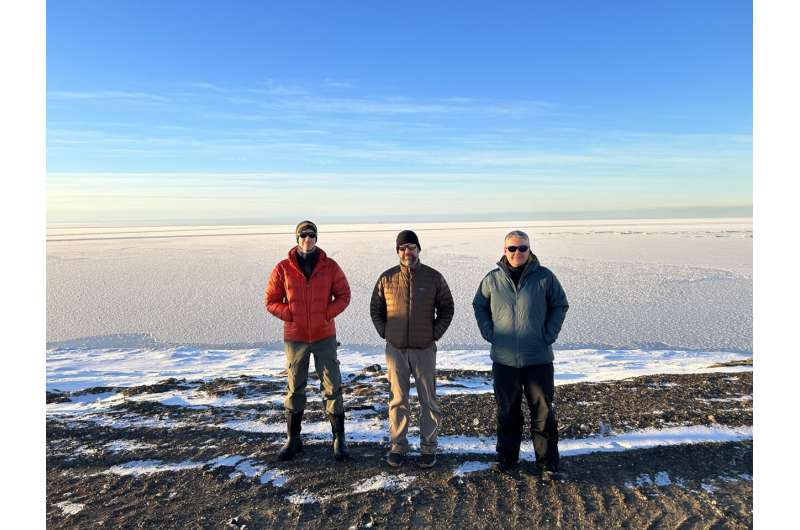
Sandia National Laboratories researchers Michael Baker, Rob Abbott and Christian Stanciu, stand in front of the iced overBeaufort Sea on the North Slope of Alaska. By sending laser pulses down a fiber optic cable under the sea floor, the researchers study permafrost in the seafloor. Credit: Sandia National Laboratories
Permafrost and bouncing light
Like leftover roast turkey sitting in the back of the freezer since Thanksgiving, Arctic permafrost is a banquet just waiting to be thawed. Specifically, as the once-living matter that was frozen during the last ice age thaws, microbes begin to digest it and produce waste gases such as methane and carbon dioxide, Frederick said. Scientists are studying just how large a microbial banquet lies frozen in the Arctic and how large of an impact those gases could have on the global climate.
To study permafrost on the Arctic seafloor, the researchers used pulses of laser light shot down a submarine telecommunications fiber optic cable buried off the coast of Alaska, running north from Oliktok Point. Tiny imperfections in the cable caused light to bounce back to a sensor system.
By capturing this light at two wavelengths, or colors, and comparing them, the researchers could determine the temperature of the cable every yard, Frederick said. This is called distributed temperature sensing.
By looking at light of a different wavelength the researchers could detect when the cable had been strained by a passing sound wave. This so-called distributed acoustic sensing provided information about the structure of the seafloor to depths of one to three miles, Stanciu said.
Using this method, the scientists believe they have identified the bottom of the seafloor permafrost at around a quarter of a mile deep. They also found another area with unusually large amounts of ice, possibly consistent with a pingo or “ice pimple,” a domed hill formed by ice pushing upwards, he added. The data analysis for the measurements was done principally by Sandia intern Brandon Herr.
“The fact that we can monitor the temperature continuously, we can now pick up changes from year-to-year and season-to-season,” Frederick said. “We’re specifically looking for unexplainable warm spots. We think we’ll be able to see areas of seafloor seeps—somewhat like springs coming out of the ground, except on the seafloor. We’re interested in them because they’re carriers of deeper, carbon-rich fluids and are an indication of warming and change.”
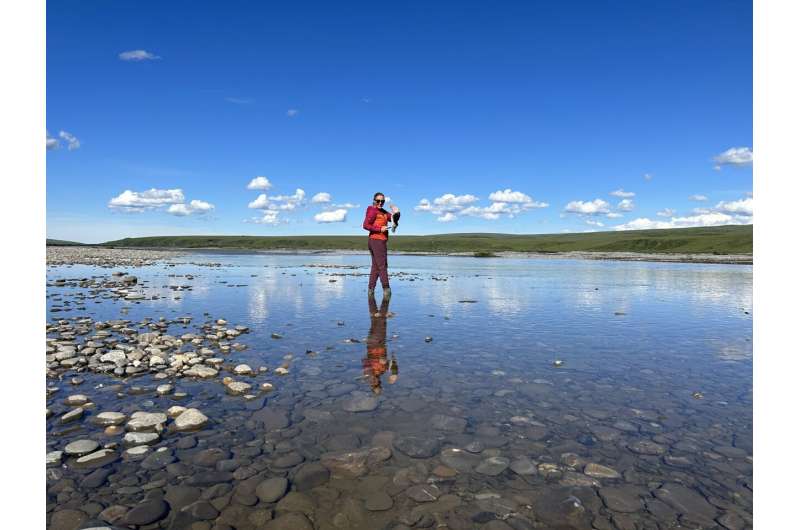
Sandia National Laboratories researcher Jennifer Frederick explores a river in the North Slope of Alaska. Studying permafrost in the Arctic seafloor can improve our understanding of global climate change. Credit: Sandia National Laboratories
History and innovations
Sandia has been collecting climate data from northern Alaska for more than 25 years. The current research project started about a year ago and builds off prior work on the same fiber optic cable by Sandia geophysicists Rob Abbott and Michael Baker.
One recent innovation from Stanciu’s team is a fully operational system that allows near-real time remote data collection. This minimizes time and cost of travel to Oliktok and the risk of losing data when the system is unattended, Stanciu said. Acoustic and temperature data cannot be collected at the same time, but one or the other now can be collected continuously.
One challenge the team solved during the first year of the project was determining how to calibrate temperature data from the fiber optic cable, Frederick said. Typically, distributed temperature sensing systems are built with self-check systems such as fiber that doubles back on itself for redundancy or with built-in thermometers. However, since the team is using a telecommunications dark fiber, they needed computational models to validate the seasonal temperature changes they detected. The data analysis for this was done principally by Sandia intern Ethan Conley.
Frederick uses the data from the distributed temperature sensing and the results from the distributed acoustic sensing modeling to provide constraints to a geophysical modeling code developed by Sandia. The code models liquids and gases flowing through soils underground. Frederick uses this code to model 100,000 years of geologic history for the studied stretch of Arctic seafloor, including the average temperature of the most recent ice age and how much the sea level has risen. The results of the model are maps of the current distribution of submarine permafrost.
Limitations of the interrogator system the team uses, including the power of the laser and sensitivity of the sensors, keep the scientists from collecting data more than 18–25 miles offshore, Frederick said. With improvements to the system, she hopes to push the distance out farther.
“This project has many different pieces,” Frederick said. “I’m looking at temperature and Christian is looking at acoustics to get a subsurface model. Really you need all of these pieces to say something about the larger picture of the current distribution of permafrost and whether we are seeing changes like seeps and how that plays into the larger greenhouse gas emissions picture. Being able to use new tools and push them to their extreme to see what we can learn is really cool.”
Citation:
Scientists use fiber optic cable to study Arctic seafloor permafrost (2023, December 15)
retrieved 16 December 2023
from https://phys.org/news/2023-12-scientists-fiber-optic-cable-arctic.html
This document is subject to copyright. Apart from any fair dealing for the purpose of private study or research, no
part may be reproduced without the written permission. The content is provided for information purposes only.
>>> Read full article>>>
Copyright for syndicated content belongs to the linked Source : Phys.org – https://phys.org/news/2023-12-scientists-fiber-optic-cable-arctic.html



